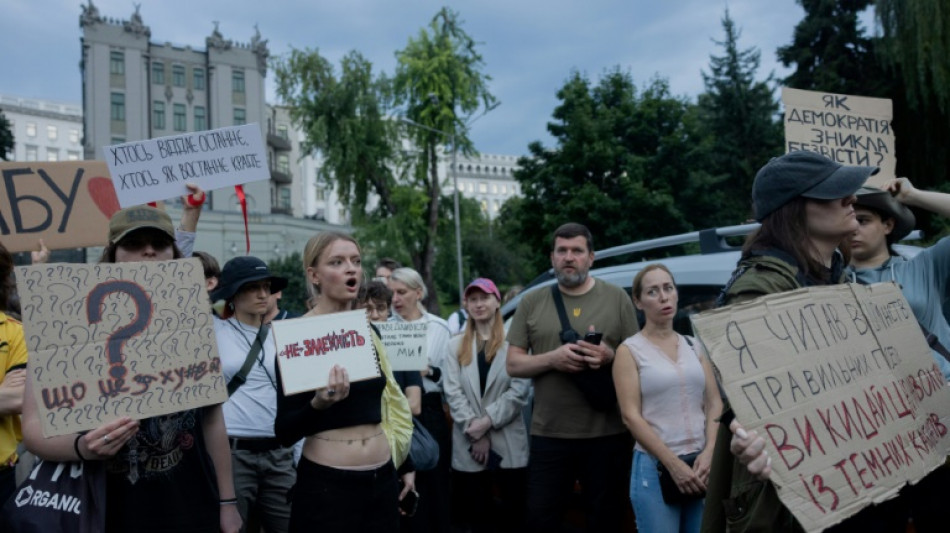
Zelensky defends contested anti-corruption law changes / Photo: © AFP
Ukrainian President Volodymyr Zelensky on Wednesday defended legislative changes removing the independence of two key anti-corruption bodies, sparking the first major protests in Ukraine since the start of Russia's invasion.
"We all share a common enemy: the Russian occupiers," Zelensky said after meeting with top law enforcement and anti-corruption officials.
"And defending the Ukrainian state requires a strong enough law enforcement system -- one that ensures a real sense of justice," he added.
"We all hear what society is saying," he said, promising to "resolve existing issues".
The bill would place the National Anti-Corruption Bureau of Ukraine (NABU) and Specialised Anti-Corruption Prosecutor's Office (SAPO) under the direct authority of the prosecutor general, who is appointed by the president.
After meeting with Zelensky, NABU and SAPO repeated their criticism of the changes and said "unambiguous legislative steps are required to reinstate the guarantees revoked by parliament".
Zelensky signed off on the widely criticised law on Tuesday, the same day it was passed by parliament.
The law sparked the first major protest in Kyiv since Russian troops invaded in 2022, with over 1,000 people taking part.
Large gatherings are banned under Ukraine's martial law.
- 'Serious step back' -
While the government says the law will make the anti-corruption agencies function better, its critics say it consolidates power in Zelensky's hands.
They also argue it will allow government meddling in high-profile graft cases.
The Anti-Corruption Action Center, an NGO, said the law would render the agencies meaningless as Zelensky's prosecutor general would "stop investigations into all of the president's friends".
The European Union called the decision a "serious step back".
NABU began work in 2015, as Kyiv sought to bring the country closer to Europe after a 2014 pro-European revolution.
Since its inception, the agency has uncovered widespread graft, including among figures in Zelensky's administration.
On Monday, law enforcement conducted large-scale raids at NABU, detaining one employee on suspicion of spying for Russia.
Transparency International's Ukraine office called the raids an "attempt by the authorities to undermine the independence of Ukraine's post-Revolution of Dignity anti-corruption institutions."
Transparency International ranked Ukraine 105th out of 180 countries in its "corruption perceptions index" in 2024, up from 144 in 2013.
Supporters of the law warn that a political crisis over the legislation could work in Russia's favour by undermining unity in the country.
Commenting on the protests at a briefing, Kremlin spokesman Dmitry Peskov on Wednesday said there was "a lot of corruption" in the country and the issue was "a sensitive topic" for Ukraine.
T.Allen--TNT