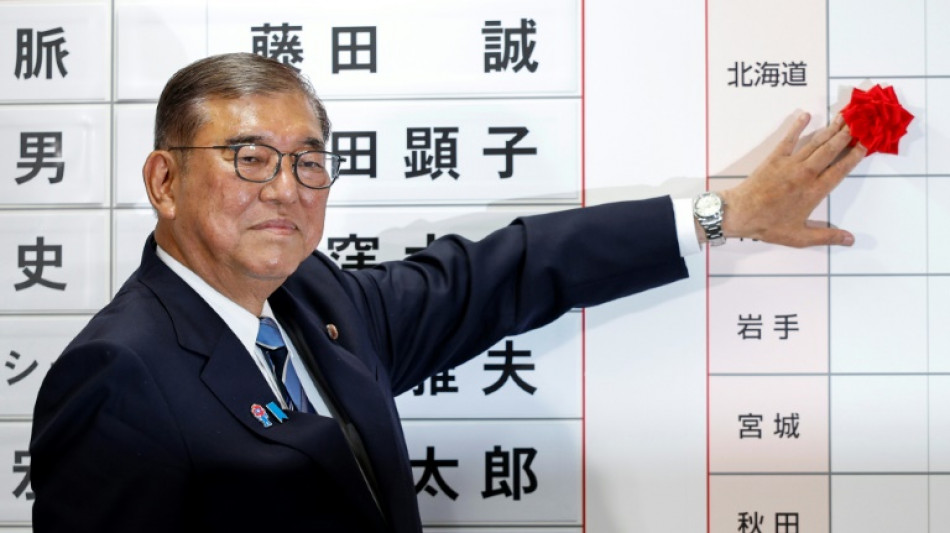
Japan PM hangs on after election debacle / Photo: © POOL/AFP
Japanese Prime Minister Shigeru Ishiba was clinging on Monday even after his coalition disastrously lost its upper house majority in elections, as painful new US tariffs loom.
The Liberal Democratic Party (LDP), which has governed almost continuously since 1955, and its partner Komeito had to win 50 seats in Sunday's vote but they fell three short, national broadcaster NHK reported.
Voters angry at inflation turned to other parties on Sunday, notably the "Japanese first" Sanseito, which made strong gains with its "anti-globalist" drive echoing the agenda of populist parties elsewhere.
The election debacle comes only months after Ishiba's coalition was forced into a minority government in the more powerful lower house, in the LDP's worst result in 15 years.
But asked late Sunday if he intended to remain in office, Ishiba told local media: "That's right."
He told another channel that "the deadline of (US) tariffs is coming on August 1. Until then we have to do our best with our body and soul."
Ishiba is expected to inform a meeting of senior LDP figures on Monday that he will stay in office, Jiji Press reported.
If Ishiba does go, it was unclear who might step up to replace him now that the government needs opposition support in both chambers to pass legislation.
"Ishiba may be replaced by someone else, but it's not clear who will be the successor," Hidehiro Yamamoto, politics and sociology professor at the University of Tsukuba, told AFP.
- 'Japanese first' -
In the election 125 seats in the 248-seat upper house were contested in the election.
The coalition needed 50 of those up for grabs but NHK and others said they only won 47, with the LDP winning 39 and Komeito eight, giving them 122 deputies.
Second-placed was the Constitutional Democratic Party of Japan (CDP) which won 22 of those being contested followed by the Democratic Party For the People (DPP) with 17.
The right-wing Sanseito party won 14 seats.
Sanseito wants "stricter rules and limits" on immigration, opposes "radical" gender policies, and wants a rethink on decarbonisation and vaccines.
Last week, it was forced to deny any links to Moscow -- which has backed populist parties elsewhere -- after a candidate was interviewed by Russian state media.
The opposition is fragmented, and chances are slim that the parties can form an alternative government.
But pressure will grow on the coalition to cut or abolish consumption tax, something which Ishiba has opposed in view of Japan's colossal national debts of over 200 percent of gross domestic product.
After years of stagnant or falling prices, consumers in the world's fourth-largest economy have been squeezed by inflation since Russia's 2022 invasion of Ukraine.
- Trump tariffs -
In particular, the price of rice has doubled, squeezing many household budgets despite government handouts.
Voter Hisayo Kojima -- one of legions of older people in Japan's falling and ageing population -- said outside a voting station on Sunday that her pension "is being cut shorter and shorter".
Not helping is lingering resentment about an LDP funding scandal, and US tariffs of 25 percent due to bite from August 1 if there is no trade deal with the United States.
Japanese imports are already subject to a 10 percent tariff, while the auto industry, which accounts for eight percent of jobs, is reeling from a 25 percent levy.
Despite Ishiba securing an early meeting with US President Donald Trump in February, and sending his trade envoy to Washington seven times, there has been no trade accord.
US Treasury Secretary Scott Bessent said Friday after meeting Ishiba in Tokyo that a "mutually beneficial trade agreement... remains within the realm of possibility."
F.Harris--TNT