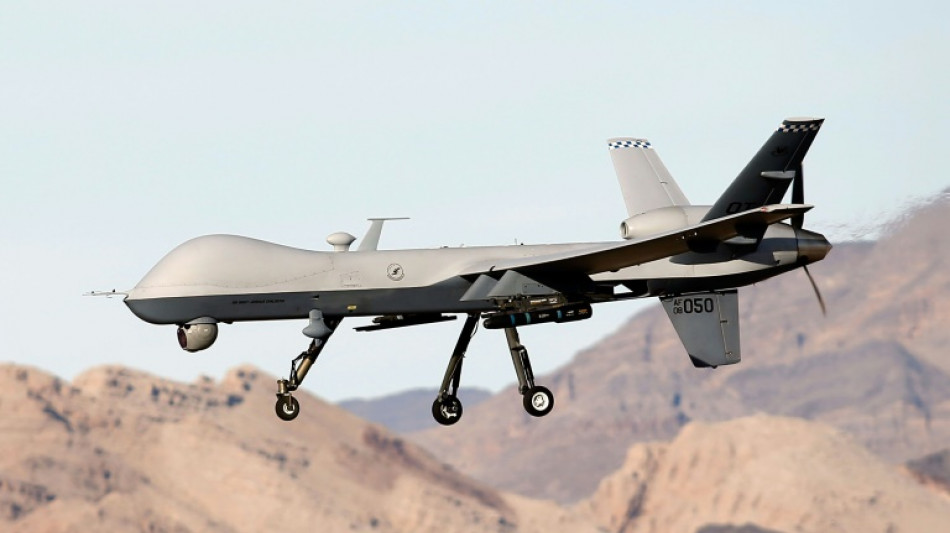
German court rejects Yemenis' claim over US strikes / Photo: © GETTY IMAGES NORTH AMERICA/AFP
Germany's highest court on Tuesday threw out a case brought by two Yemenis seeking to sue Berlin over the role of the US Ramstein airbase in a 2012 drone attack, ending a years-long legal saga.
Plaintiffs Ahmed and Khalid bin Ali Jaber first brought their case to court in 2014 after losing members of their family in the strike on the village of Khashamir.
The case has since been through several German courts. But the Constitutional Court on Tuesday ultimately ruled that Berlin is not required to take action against such attacks, which were not judged to be in breach of international law.
Washington has for years launched drone strikes targeting suspected Al-Qaeda militants in Yemen, an impoverished country that has been torn by fierce fighting between its beleaguered Saudi-backed government and Iran-backed rebels.
The two Yemeni men, supported by the Berlin-based European Center for Constitutional and Human Rights (ECCHR), had argued that Germany was partly responsible for the attack because the strike was aided by signals relayed via the Ramstein base in western Germany.
"Without the data that flows through Ramstein, the US cannot fly its combat drones in Yemen," the group said.
The ECCHR's Andreas Schueller argued that "the German government must put an end to the use of this base -- otherwise the government is making itself complicit in the deaths of innocent civilians".
- 'Complaint unfounded' -
The court found that Germany "does have a general duty to protect fundamental human rights and the core norms of international humanitarian law, even in cases involving foreign countries".
However, in order for this duty to be binding, there must be "a serious risk of systematic violation of applicable international law".
"Measured against these standards, the constitutional complaint is unfounded," the court said.
The ECCHR said the ruling had "failed to send a strong signal" and meant that "instead, individual legal protection remains a theoretical possibility without practical consequences".
However, Schueller said the verdict "leaves the door open for future cases".
"Violations of international law can be subject to judicial review, even if the court imposes high hurdles. This is an important statement by the Constitutional Court in these times," he said.
- 'Margin of discretion' -
According to the ECCHR, the two Yemeni men were having dinner ahead of the wedding of a male family member in 2012 when they heard the buzz of a drone and then the boom of missile attacks that claimed multiple lives.
Their case against Germany was initially thrown out, before the higher administrative court in Muenster ruled in their favour in 2019.
However, the government appealed and a higher court overturned the decision in 2020, arguing that German diplomatic efforts were enough to ensure Washington was adhering to international law.
In a statement shared by the ECCHR, the two men called the ruling "dangerous and disturbing".
"(It) suggests countries that provide assistance to the US assassination programme bear no responsibility when civilians are killed. Our hearts are broken, and our faith in international law is shaken," they said.
The German government welcomed the ruling, which it said showed that Berlin had "a wide margin of discretion in assessing whether the actions of third states comply with international law".
"According to the ruling, the government has no fundamental duty to protect foreigners abroad who are affected by military action by third states if, in the government's assessment, these attacks are within the bounds of what is permissible under international law," the defence and foreign ministries said in a statement.
E.Cox--TNT