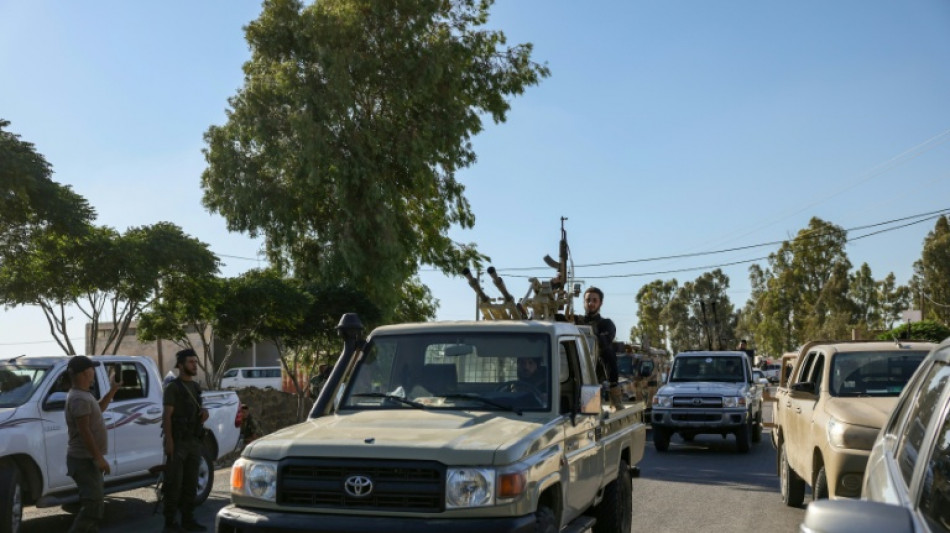
Syrian forces enter Druze city after deadly clashes / Photo: © AFP
Syrian government forces entered the majority Druze city of Sweida on Tuesday, the interior ministry said, aiming to end clashes with Bedouin tribes that have killed nearly 100 people.
The southern city had been under the control of armed factions from the Druze minority, whose religious leaders said they had approved the deployment of Damascus's troops and called on fighters to hand over their weapons.
A curfew was to be imposed on the southern city in a bid to halt the violence, which erupted at the weekend and has since spread across Sweida governorate.
Government forces said they intervened to separate the two sides but ended up taking control of several Druze areas around Sweida, an AFP correspondent reported.
Military columns were seen advancing toward Sweida on Tuesday morning, with heavy artillery deployed nearby.
The defence ministry said later that they had entered the city, and urged people to "stay home and report any movements of outlaw groups".
An AFP correspondent heard explosions and gunshots as soldiers moved into Sweida.
Troops had begun heading towards the city on Monday, taking control of at least one Druze village, with one Druze faction saying talks were underway with the Damascus government.
The Syrian Observatory for Human Rights war monitor reported 99 people killed since the fighting erupted on Sunday -- 60 Druze, including four civilians, 18 Bedouin fighters, 14 security personnel and seven unidentified people in military uniforms.
The defence ministry reported 18 deaths among the ranks of the armed forces.
While Druze religious authorities had called on Monday evening for a ceasefire and said they didn't oppose the central government, Sheikh Hikmat al-Hijri, one of the three Druze spiritual leaders in Sweida, opposed the arrival of the security forces and called for "international protection".
Israel, which has attempted to portray itself as a protector of the Druze in Syria and sees them as potential allies, bombed several Syrian tanks on Monday.
The strikes were "a clear warning to the Syrian regime -- we will not allow harm to be done to the Druze in Syria", said Defence Minister Israel Katz, whose country has its own Druze population.
- 'Extreme terror' -
The fighting underscores the challenges facing interim leader Ahmad al-Sharaa, whose Islamist forces ousted president Bashar al-Assad in December after nearly 14 years of civil war.
Syria's pre-war Druze population was estimated at around 700,000, many of them concentrated in Sweida province.
The Druze, followers of an esoteric religion that split from Shiite Islam, are mainly found in Syria, Lebanon and Israel.
Following deadly clashes with government forces in April and May, local and religious leaders reached an agreement with Damascus under which Druze fighters had been providing security in the province.
"We lived in a state of extreme terror -- the shells were falling randomly," said Abu Taym, a 51-year-old father.
Amal, a 46-year-old woman, said: "We fear a repeat of the coastal scenario", referring to massacres in March of more than 1,700 mostly Alawite civilians in northwest Syria, where groups affiliated with the government were blamed for most of the killings.
"We are not against the state, but we are against surrendering our weapons without a state that treats everyone the same," she added.
In a post on X, Syrian Defence Minister Murhaf Abu Qasra urged his troops to "protect your fellow citizens" from "outlaw gangs", and to "restore stability to Sweida".
The violence began on Sunday when Bedouin gunmen abducted a Druze vegetable vendor on the highway to Damascus, prompting retaliatory kidnappings.
The Observatory said members of Bedouin tribes, who are Sunni Muslims, had sided with security forces during earlier confrontations with the Druze.
Bedouin and Druze factions have a longstanding feud in Sweida, and violence occasionally erupts between the two sides.
T.Cunningham--TNT