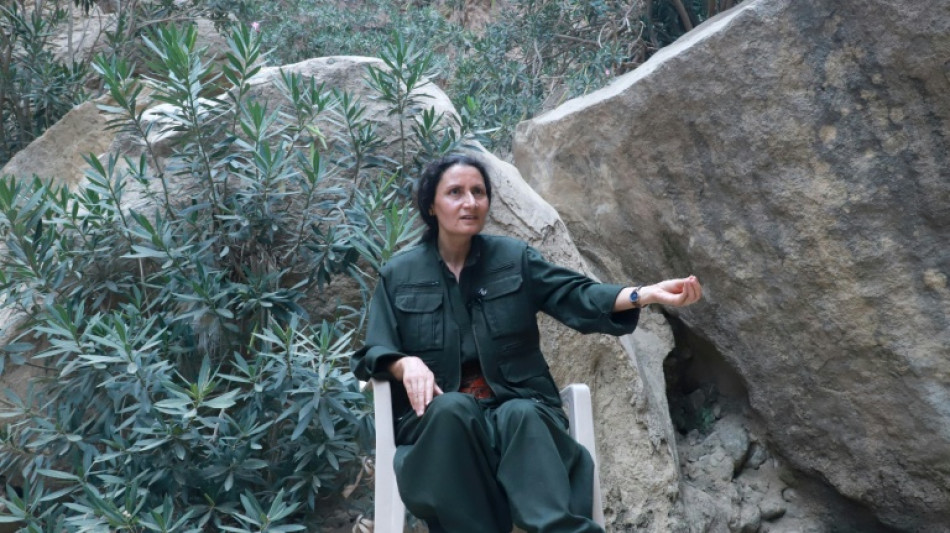
PKK militants want to enter Turkish politics: top commander / Photo: © AFP
Kurdish militants want to return to Turkey and enter mainstream politics, one of the PKK's joint leaders told AFP on Friday after the group's fighters began destroying their arms at a ceremony in Iraq.
Speaking to AFP after handing in her own weapon alongside 29 of her comrades, the Kurdistan Workers' Party's top female commander Bese Hozat said if Turkey were willing, the disarmament process could be completed very quickly.
But the 47-year-old militant also warned the fragile peace process risked being derailed if Ankara fails to free the PKK's jailed founder Abdullah Ocalan, also known as 'Apo' -- Kurdish for 'uncle'.
"If Apo were freed tomorrow and... Turkey made legal and constitutional arrangements the next day, within a week we could return to engage in democratic politics," she said of a process which Ankara expects to last for months.
Ocalan has been serving a life sentence in solitary confinement on the prison island of Imrali near Istanbul since 1999 and his release has been a constant demand of the PKK.
- 'We miss him very much' -
"Ensuring leader Apo's physical freedom legally, via legal guarantees, is essential... he should be able to freely lead and manage this process. This is our primary condition and demand," she said.
"We want to see him, we miss him very much and there are many things we want to discuss with him," said Hozat, who joined the PKK when she was 16 and has spent more than three decades of her life as a fighter.
"Without this development, it is highly unlikely that the process will continue successfully."
Earlier this week, the 76-year-old dismissed talk of his own release as unimportant, positioning himself more as a guide than as a leader of the ongoing process.
Hozat said it was essential Turkey put in place mechanisms to allow them to return without fear of prosecution or reprisal.
"We do not want to wage armed struggle against Turkey, we want to come to Turkey and do democratic politics. In order for us... to achieve democratic integration with Turkey, it is imperative we can freely travel to Turkey," she said.
"If Turkey takes concrete steps, enacts laws and implements radical legal reforms... we will go to Turkey and engage in politics. If (not)... we will end up either in prison or being killed."
- 'The PKK no longer exists' -
Asked whether she now expected Turkey and its Western allies to remove the PKK from their blacklists of terrorist organisations, Hozat said the issue was irrelevant.
"Right now, the PKK no longer exists, we've dissolved it. We are a freedom movement.. advocating for peace and a democratic society.
"The PKK has achieved its main goal: the existence of the Kurds has been recognised."
Seen as the world's largest stateless people, the Kurds were left without a country when the Ottoman Empire collapsed after World War I.
Although most live in Turkey, where they make up around a fifth of the population, the Kurds are also spread across Iraq, Iran and Syria, where Ankara has for years been striking Kurdish fighters.
Hozat hailed positive changes in Syria since the PKK announced the end of its armed struggle against Turkey.
"Turkish attacks on (Kurdish-majority) northeastern Syria have ceased and its autonomous administration is currently negotiating" with the Damascus government.
Hozat said the Kurdish question was the key to freedom for all peoples of the Middle East.
"If the Kurdish question is resolved, the Middle East can truly become a democracy," she said.
"That's why we want this solution everywhere, including Iran, which must also become democratic. The Kurdish question must also be resolved there on the basis of autonomy."
R.Hawkins--TNT