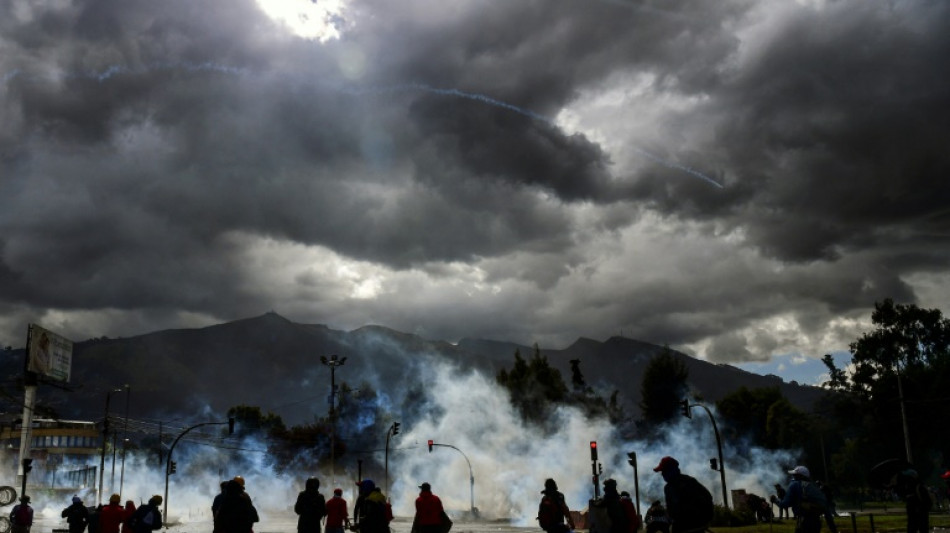
Government, protesters no closer on Day 12 of fuel price revolt / Photo: © AFP
Ecuador's government and Indigenous protesters accused each other of intransigence Friday as thousands gathered for a 12th day of a fuel price revolt that has claimed six lives and injured dozens.
After the most violent day of the campaign so far -- with police firing tear gas to disperse thousands storming Congress -- the government accused protesters of shunning a peaceful outcome.
"They have unmasked themselves. They don't want to negotiate. They don't want to come to an agreement... They don't want peace. Until now, the only thing they have demonstrated is that they want violence," minister of government Francisco Jimenez told broadcaster FM Mundo.
An estimated 14,000 protesters are taking part in the mass show of discontent countrywide against rising hardship in an economy hard hit by the coronavirus pandemic.
Most of the ire is concentrated on the capital Quito, where some 10,000 people, most from other parts of the country.
Six of the country's 24 provinces are under a state of emergency and a night-time curfew is in place in Quito.
Protesters are demanding a cut in already subsidized fuel prices, which have risen sharply in recent months, as well as jobs, food price controls, and more public spending on healthcare and education.
- Poorest 'suffer the most' -
But the action has been costly, with losses of some $50 million per day to the economy, and production of fuel -- Ecuador's biggest export -- halved, according to the energy ministry.
On Thursday, protesters won a limited concession from President Guillermo Lasso who granted them access, "for the sake of dialogue and peace," to a cultural center emblematic of the Indigenous struggle that had been commandeered by police.
Hours later, however, a group of protesters headed for Congress, where police fired tear gas in response to a barrage of rocks, fireworks and Molotov cocktails.
Three people died in confrontations Thursday, bringing the toll to six since the movement started on June 13 at the initiative of the powerful Confederation of Indigenous Nationalities of Ecuador (Conaie).
Conaie leader Leonidas Iza told AFP the revolt would continue "until we have results. We can no longer hold back the anger of the people."
People were desperate, said Iza.
"We expected the president to answer the central questions of the crisis, the poverty our people are experiencing. The economic question is one of despair, which is why we are here," he said.
"There is a lot of poverty, the increase in the price of fuel has increased all the prices, and we, the poorest, are the ones who suffer the most."
Conaie is credited with bringing down three presidents between 1997 and 2005.
Its most recent mobilization has brought Quito to a standstill, and many shop owners and workers in the capital do not look kindly on what they see as an invasion -- flying white anti-protest flags.
"The class struggle has deepened," said Iza in response.
No talks have been scheduled between the government and Conaie.
F.Morgan--TNT