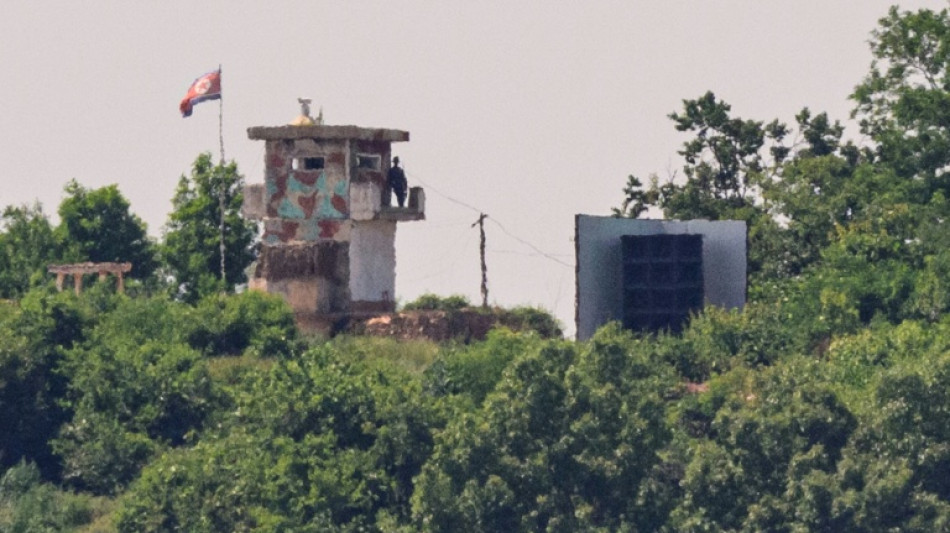
North Korean detained after crossing land border: Seoul military / Photo: © AFP
A North Korean civilian voluntarily crossed the heavily mined land border between the two countries, aided by the South's military in a delicate 20-hour operation, Seoul's Joint Chiefs of Staff said Friday.
Tens of thousands of North Koreans have fled to South Korea since the peninsula was divided by war in the 1950s, with most going overland to neighbouring China first, then entering a third country such as Thailand before finally making it to the South.
Defections across the land border that divides the peninsula are relatively rare, as the area is densely forested, heavily mined and monitored by soldiers on both sides.
The North Korean man was first detected by a South Korean military surveillance device sometime between 3:00 and 4:00 am Thursday (1800 to 1900 GMT) near a shallow stream inside the DMZ, the Joint Chiefs of Staff said.
The man stayed mostly still during the day and was sometimes hard to track due to the lush forest in the area, the JCS said, but South Korea's military approached him that night.
"The military identified the individual near the MDL, conducted tracking and surveillance," the JCS said in a statement, referring to the Military Demarcation Line, the de facto border.
The MDL runs through the middle of the Demilitarized Zone -- the border area separating the two Koreas, which is one of the most heavily mined places on earth.
Seoul's military then "successfully carried out a standard guiding operation to secure custody," the JCS said.
The mission involved a considerable number of South Korean troops, the JCS said, and took place in an area difficult to navigate due to dense vegetation and landmine risks.
When the man first noticed the approaching South Korean troops, he asked: "Who are you?" according to the JCS.
The soldiers responded: "We are the South Korean military. We'll guide you to safety."
Upon hearing this, the man crossed the MDL and joined the troops, who then escorted him south out of the DMZ.
The operation took about 20 hours, according to Seoul.
- Bold, risky move -
The JCS said "relevant authorities" will investigate the detailed circumstances of the incident.
North Koreans are typically handed over to Seoul's intelligence agency for screening when they arrive in the South.
Ahn Chan-il, a defector-turned-researcher who runs the World Institute for North Korea Studies, said the man is likely a farmer who had been working near the DMZ.
If so, the man could have sensed the conciliatory mood between the two Koreas, Ahn said, as loudspeaker broadcasts from both sides -- K-pop and international news from the South, and eerie, unsettling sounds from the North -- have recently ceased.
"The lush summer vegetation within the DMZ likely offered the best cover for a high-risk escape," he told AFP.
"Crossing the DMZ is an extremely dangerous act due to the presence of unmarked mines. It was a bold, risky move -- and in this case, somehow, with a lot of luck, he succeeded."
The incident comes after a North Korean soldier defected to the South by crossing the MDL in August last year.
Also last year, another North Korean defected to the South across the de facto border in the Yellow Sea, arriving on Gyodong island off the peninsula's west coast near the border between the Koreas.
The number of successful escapes by North Korean defectors dropped significantly from 2020 after the North sealed its borders -- purportedly with shoot-on-sight orders along the land frontier with China -- to prevent the spread of Covid-19.
No unusual activities by the North Korean military have been detected, the JCS said Friday.
South Korea's President Lee Jae Myung, who took office last month, has vowed a more dovish approach towards Pyongyang compared with his hawkish predecessor Yoon Suk Yeol.
"Politics and diplomacy must be handled without emotion and approached with reason and logic," Lee said Thursday.
"Completely cutting off dialogue is really a foolish thing to do."
T.Bennett--TNT