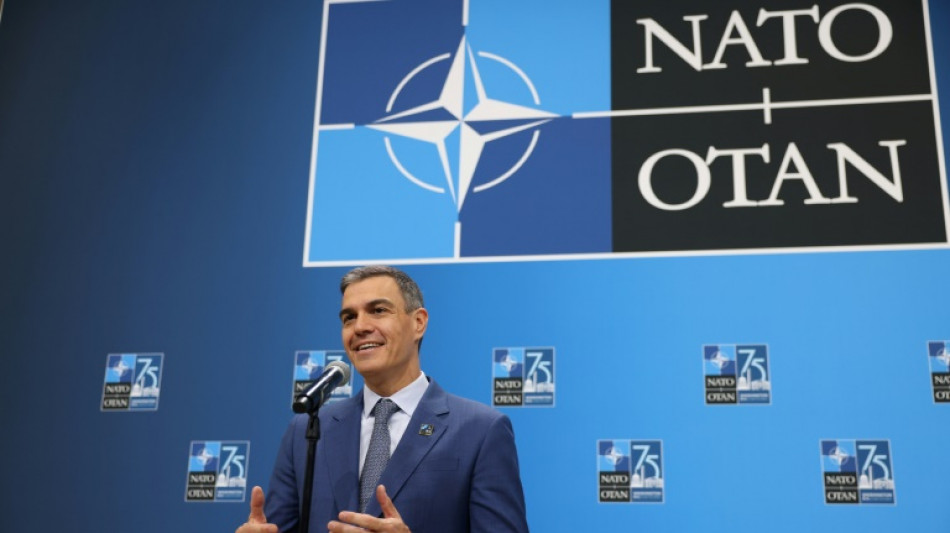
NATO strikes spending deal, but Spain exemption claim risks Trump ire / Photo: © AFP
NATO on Sunday signed off on a pledge to ramp up defence spending before its upcoming summit, but Madrid insisted it would not need to hit the five percent of GDP demanded by US President Donald Trump.
The claim by Spanish Prime Minister Pedro Sanchez sets up a potential clash with Trump, who has pressured allies to commit to that headline figure when they meet for the two-day gathering starting on Tuesday in The Hague.
Spain had been the last holdout on a compromise deal that sees allies promise to reach 3.5 percent on core military needs over the next decade, and spend 1.5 percent on a looser category of "defence-related" expenditures such as infrastructure and cybersecurity.
Multiple diplomats at NATO said the agreement -- set to be unveiled at the summit -- had gone through with the approval of all 32 nations and that there was no exemption for Madrid.
But within minutes Sanchez came out saying he had struck an accord with NATO that would see his country keep respecting its commitments "without having to raise our defence spending to five percent of gross domestic product".
"We understand the difficulty of the geopolitical context, fully respect the legitimate desire of other countries to increase their defence investment, if they so wish, but we are not going to do it," he said.
NATO diplomats now fear that Spain's position could undermine its carefully choreographed show of unity with Trump in The Hague, which already risks being overshadowed by the US decision to strike Iran.
"Not ok," one diplomat said, on condition of anonymity.
Madrid's claims came after Sanchez on Thursday threw a last-minute grenade into preparations for the gathering in the Netherlands by taking a strong stand against the agreement.
In a blistering letter to NATO chief Mark Rutte, Sanchez said that committing to a headline figure of five percent of GDP "would not only be unreasonable, but also counterproductive".
That prompted a warning from Trump that "Spain has to pay what everybody else has to pay."
"NATO is going to have to deal with Spain," he told reporters on Friday, calling the country "notorious" for spending less on defence than other alliance members.
- 'Flexibility' -
The outburst from Madrid's centre-left leader also sparked fury from other NATO members desperate to keep Trump -- who has threatened not to protect allies spending too little -- on their side.
The pledge is seen as key both to satisfying Trump and helping NATO build up the forces it needs to deter Russia.
After several days of wrangling involving Sanchez and Rutte, officials said Spain on Sunday signed off on the pledge.
Diplomats said that language around the spending pledge in the summit's final declaration had been slightly softened from "we commit", to "allies commit".
They insisted the fundamentals of the deal remained intact and that it applied to Spain.
But government sources in Madrid said the linguistic tweak meant only those countries that opted-in were covered by the promise and that Rutte was set to send a letter to Sanchez saying that Spain will have "flexibility".
Sanchez is facing a difficult balancing act of aligning with NATO allies and cajoling his junior coalition partner, the far-left alliance Sumar, which is hostile to increasing military spending.
Spain has been one of the lowest-spending NATO countries on defence in relative terms.
The country is only set to hit the alliance's current target of two percent this year after a 10-billion-euro ($11.5 billion) injection.
A.M.James--TNT