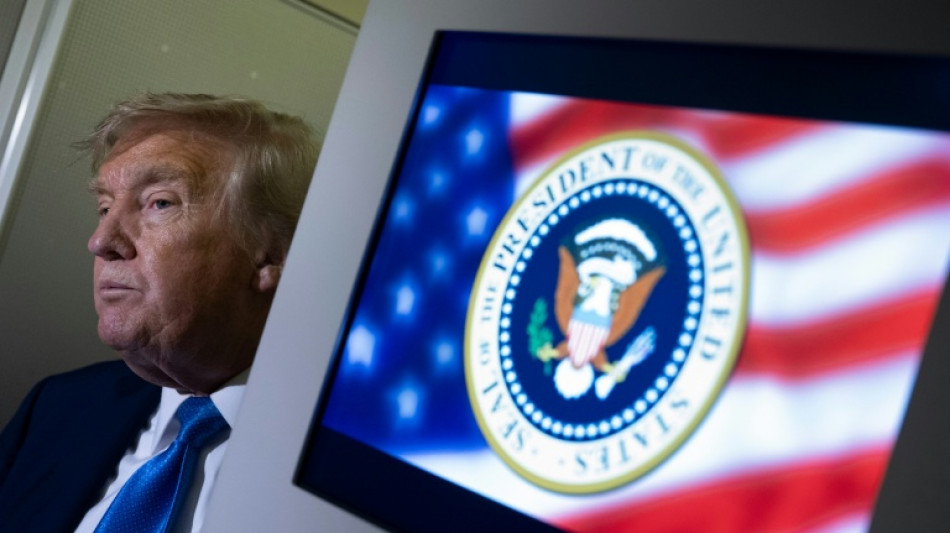
How Trumponomics has shaken global markets / Photo: © AFP/File
US President Donald Trump has taken just a few months since his election to upend global financial markets with his economic policies.
Many investors are pulling money out of the United States, the mighty dollar has lost its lustre and Wall Street is being outpaced by European stock markets.
Here is a look at the financial roller-coaster ride.
US stocks under pressure
After years of global dominance, US stocks are feeling the heat -- and Europe is the main beneficiary.
Wall Street's S&P 500 index has gained just two percent since the start of the year, compared with 16 percent for Frankfurt's main index.
Growth at the exchanges in London (eight percent) and Paris (three percent) is also outstripping Wall Street.
Kevin Thozet from the investment firm Carmignac pinned the blame firmly on Trump.
The president's flip-flopping on tariffs had created a "high level of uncertainty" about their potential impact on growth, Thozet told AFP.
Dollar slides
The dollar has lost 10 percent of its value against the euro in the past six months, "its worst performance in 30 years", according to Robert Farago, an analyst at the British investment firm Hargreaves Lansdown.
Trump's tariffs are the main culprit but the global reserve currency is also suffering from concerns about the size of the US debt -- exacerbated by a budget proposal from the president that many analysts say will be hugely expensive.
While some have suggested the Chinese yuan could become a dollar alternative, ECB chief Christine Lagarde has touted the euro, discussing in May its potentially greater "international role".
But any currency attempting to topple the dollar faces plenty of challenges.
"The yuan is not convertible, and the euro is too fragmented," said Jean Lemierre, chairman of the board of directors of BNP Paribas.
Debt worries
American debt is a cornerstone of the financial system, as the rest of the world lends to the United States in search of a safe investment.
But Jamie Dimon, head of JPMorgan Chase, said in early June that the level of US debt was a "real problem" and that bond markets were facing a "tough time".
In a sign of the loss of confidence, interest rates on 30-year US Treasury bonds surpassed the symbolic five percent mark at the end of May.
"I've always told clients they need US debt if they want an asset that remains intact even in a disaster, but I think that's no longer the case," said Alexandre Hezez, a strategist at Banque Richelieu.
Steve Sosnick, chief strategist at US-based Interactive Brokers, told AFP the fact the dollar was falling while rates were rising was "a sign there's money moving out of the US".
Winners: gold, crypto
Investors have long regarded gold as the ultimate safe harbour in a crisis, and the clamour for the metal has seen its value jump by almost 30 percent since the start of the year.
Major central banks have also had a hand in pushing up the price, as they look to gold as a more sure bet than dollars to hold in their reserves.
Meanwhile, Trump has leant heavily into cryptocurrencies with investments of his own and official measures to bring the assets into the mainstream.
Bitcoin passed $100,000 for the first time just after the US election, increasing almost 60 percent in a year.
Oil uncertainties
Trump made it a priority to bring down oil prices so that US inflation would come down.
Crude oil fell below $60 per barrel in April, its lowest price since 2021.
But that was because investors spooked by Trump's tariffs were anticipating weaker demand worldwide if economies slowed.
The military escalation between Israel and Iran has seen prices climb again to around $75 a barrel.
W.Phillips--TNT