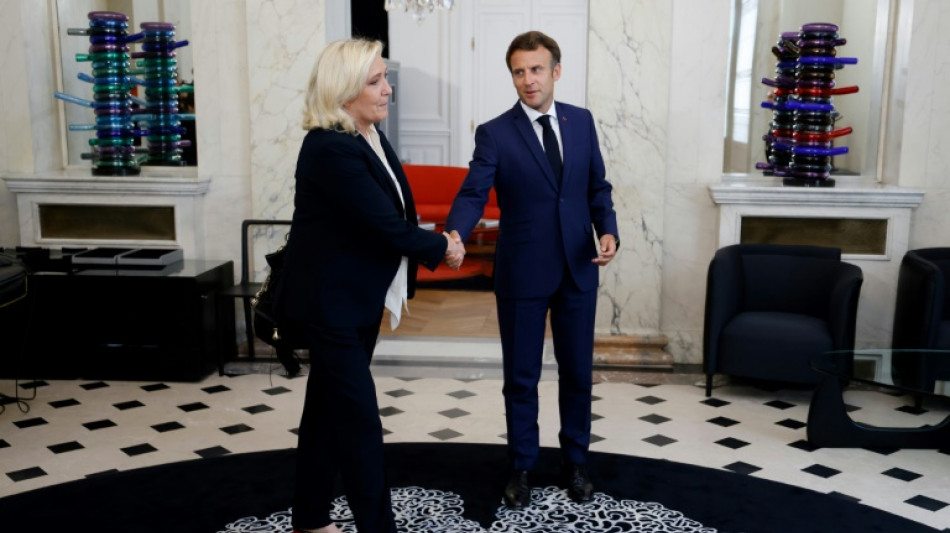
Macron struggles to find compromise in France impasse / Photo: © POOL/AFP
French President Emmanuel Macron pressed on with efforts Wednesday to end the crisis created by his failure to retain a parliamentary majority but with no solution in sight to an impasse that jeopardises his reform plans.
Macron's centrist alliance finished Sunday's parliamentary elections 44 seats short of a majority in the National Assembly, as a new left-wing coalition and the far-right made major gains.
The situation has called into question Macron's plans for reform in his second term after his April presidential re-election -- including a key measure to reduce the retirement age -- and risks denting his international stature.
On Tuesday, Macron hosted rare talks at the Elysee Palace with opposition leaders, including the head of the far-right National Rally (RN) Marine Le Pen, to find a way out of the crisis.
He will meet other leaders on Wednesday, though the head of the left-wing NUPES alliance, hard-leftist Jean-Luc Melenchon is sending MP Adrien Quatennens, 32, to represent him in a clear snub to the president.
The meetings so far appear to have made little headway, and Macron has also rejected an offer from under-fire PM Elisabeth Borne to resign.
"The unfindable compromise? Emmanuel Macron is trying to regain the initiative but no consensus has been found," said the right-wing Le Figaro daily.
- National unity government? -
Analysts have said the most viable solution would be a deal between Macron's centrist alliance and the right-wing Republicans (LR), a party on the decline but which still won 61 seats.
But after talks with Macron on Tuesday, LR leader Christian Jacob ruled out any kind of "pact" with Macron's Together alliance.
Former prime minister Edouard Philippe, whose Horizons party is part of Macron's alliance, told BFM television late Tuesday that a "grand coalition" should now be formed.
"We need to hear what the voters have said and take them seriously," he said.
Macron has remained characteristically remote, not making any public comment so far on what commentators see as one of the biggest setbacks of his political career.
Communist party chief Fabien Roussel, who is part of the NUPES alliance and held talks with Macron on Tuesday, said after the meeting that the president had evoked a "government of national unity" as a way out.
Speaking as she introduced new MPs at parliament on Wednesday, Le Pen said the president had floated the same idea with her.
Olivier Veran, the minister in charge of relations with parliament, told BFM on Wednesday that "all options" were on the table. But he ruled out working with Le Pen's RN or the hard-left France Unbowed (LFI) of Melenchon to find a majority.
This could be achieved, he said, either through an alliance or on a "bill by bill" basis, the government finding a majority with the help of the right or left, depending on the legislation.
Julien Bayou, the leader of the Green EELV party that is part of NUPES, said after his talks with Macron on Wednesday that his party would be in opposition. But it would vote "according to the national interest" and would put forward its own legislation on climate change.
Melenchon has threatened to file a motion of no-confidence against Borne next month, but other opposition leaders have shown less appetite for such action.
Borne, an experienced technocrat with little experience of frontline campaign politics and in office for just over month, has been widely criticised for her performance in the election.
Francois Bayrou, a key Macron ally who leads the MoDem party that is part of his coalition, increased the pressure on Borne on Wednesday.
France needed a "political" prime minister, he said.
T.Allen--TNT