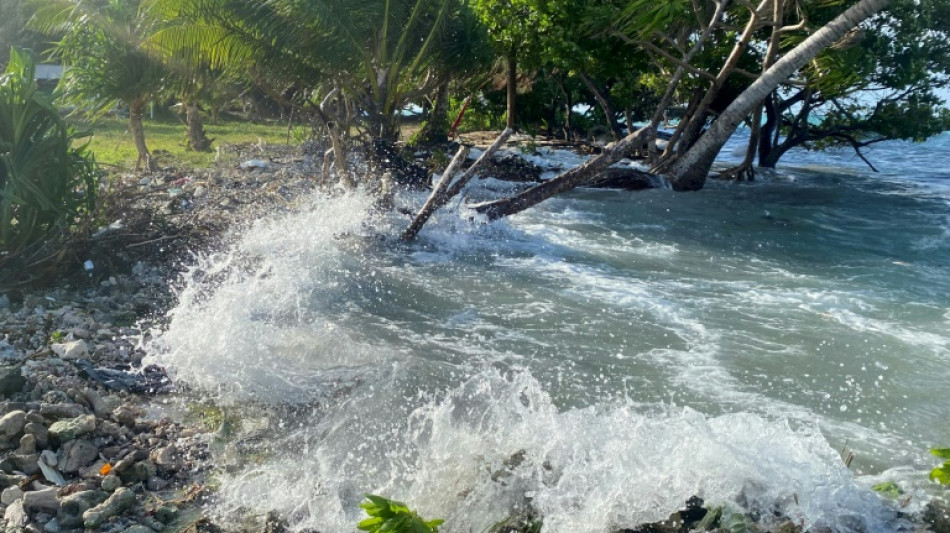
'We show up': Pacific leaders apply pressure at oceans summit / Photo: © AFP
Nowhere is humanity's exploitation of the oceans more starkly illustrated than the Pacific Ocean, where small island nations are fighting to outlast a crisis not of their making.
The islands are besieged by rising seas and worsening storms, their coastlines choked in plastic, fishing waters plundered and coral reefs bleached and barren.
But they refuse to be victims, pouring whatever resources they can into protecting the seas that sustain their people -- and calling out those not doing their share.
This week, Pacific leaders have made some of the boldest commitments at the UN Ocean Conference, challenging wealthier nations to up their game.
French Polynesia set the bar high at the outset of the five-day summit in Nice, France, announcing it would create the world's largest marine protected area in the far South Pacific.
Within this enormous expanse of five million square kilometres (1.93 million square miles) will be a fully-protected sanctuary, double the size of Sweden, that totally forbids any human activity.
Samoa announced nine new marine areas protecting 30 percent of its waters, while Vanuatu and the Solomon Islands unveiled plans for a mammoth joint marine park linking neighbouring Pacific nations.
Once completed, they said, this ocean reserve would span six million square kilometres -- an area as vast as the Amazon rainforest.
The Marshall Islands and Solomon Islands joined a global call for a pause on deep-sea mining, while four Pacific nations came forward to ratify a treaty to protect the high seas.
"We show up by doing -- by taking action -- and not just through talkfests," said Sivendra Michael, permanent secretary at Fiji's environment ministry.
- 'Time to act' -
Almost as many Pacific heads of state and government turned up in Nice as European ones, making an impression in colourful traditional dress and through the force of their message.
The elephant in the room is money, said Coral Pasisi, climate director at the Pacific Community, the region's principal scientific and technical development organisation.
Pacific nations receive less than half of one percent of global climate finance, she said, and it can take years for sinking island nations to raise the capital to build a single seawall.
Rich nations pledged last year to commit $300 billion a year to developing countries for climate action by 2035. But small island nations are wary, after similar promises have gone unmet.
"Sometimes we feel alone in the world," Taivini Teai, environment minister of French Polynesia, told AFP.
"But we must pull together and make industrialised countries understand that it is time to act."
On stage and in private meetings in Nice, including with French President Emmanuel Macron, Pacific leaders demanded again and again that rich nations help them with actions, not words.
"We need to adapt to shield our oceans from further harm. And that means -- plain and simple -- money. And money that we can use," said Palau President Surangel Whipps Jr.
"The gap between what we need and what is available is growing dangerously wide. And this is a security issue for the Pacific."
- Listen to us -
The oceans summit did not address a lack of progress on phasing out fossil fuels -- deeply frustrating Pacific countries that have rallied to get the contentious issue back on the global agenda.
"For the smallest of the countries and the most vulnerable, we have been the boldest and the loudest" on fossil fuels, said Michael of Fiji.
Vanuatu's environment minister Ralph Regenvanu said it was "unfortunate" that fossil fuels weren't given sufficient prominence in Nice.
"It's the single greatest cause of the damage to the oceans we're seeing now, and we're not talking about it enough," he said.
Fed up with climate summits and pleading for action, Vanuatu and its Pacific neighbours are testing if international law can compel countries to cut their greenhouse gas emissions.
For low-lying Tuvalu -- which is already making arrangements to shift its citizens permanently elsewhere -- the sense of urgency could not be greater as the tide laps higher.
"I hope they listened to us," said Tuvalu President Feleti Teo, of his appeal in Nice for wealthier governments to come to their aid.
K.M.Thompson--TNT