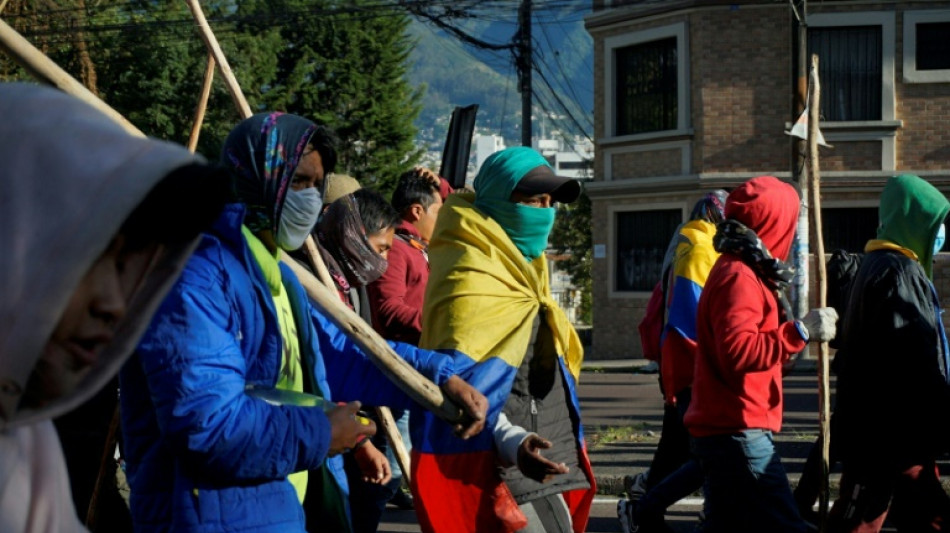
Ecuador military calls Indigenous protests a 'grave threat' / Photo: © AFP
Thousands of Ecuadorans took to the streets Tuesday for a ninth day of Indigenous-led fuel price protests, as the military vowed to defend the country's democracy against what it called a "grave threat."
Called by the powerful Confederation of Indigenous Nationalities of Ecuador (Conaie), the demonstrations have seen roads barricaded countrywide, cost the economy tens of millions of dollars and left dozens injured.
"Ecuador's democracy faces a grave threat from the concerted actions of... people who are preventing the free movement of the majority of Ecuadorans," Defense Minister Luis Lara told a press conference, flanked by the heads of the army, navy and air force.
The armed forces, he warned, "will not allow attempts to break the constitutional order or any action against democracy and the laws of the republic."
Conaie -- credited with helping topple three presidents between 1997 and 2005 -- called the demonstrations as Ecuadorans increasingly struggle to make ends meet.
Indigenous people comprise more than a million of Ecuador's 17.7 million inhabitants and wield much political clout, but are disproportionately affected by rising inflation, unemployment and poverty exacerbated by the coronavirus pandemic.
- 10 Demands -
Thousands of protesters entered Quito from the south and north on Monday, on foot and on the backs of trucks, to reinforce protesters in the capital, where they burnt tires and tree branches in the streets -- and were back out in the streets on Tuesday morning.
At least some in the crowd, many wielding sticks and others draped in the Ecuadoran flag, or carrying children in their arms, said the president's ouster was precisely what they sought.
"We are the people and we will stay here until the end," Victor Taday, a 50-year-old Indigenous resident of Quito originally from Chimborazo province, told AFP Monday night -- as similar marches took place in other parts of the country.
It was time for Lasso to "go away," he said.
Fuel prices have risen sharply since 2020, almost doubling for diesel from $1 to $1.90 per gallon and rising from $1.75 to $2.55 for gasoline.
Conaie is demanding a price cut to $1.50 a gallon for diesel and $2.10 for gasoline.
It also wants jobs, food price controls and a commitment to renegotiating the personal bank loans of about four million families.
The movement has since been joined by students, workers and other Ecuadorans also feeling the economic pinch.
Police said Monday 63 armed forces personnel have been wounded in clashes and 21 others briefly held hostage since the protests began, while human rights observers reported 79 arrests and 55 civilians wounded.
President Guillermo Lasso extended a state of emergency to cover six of the country's 24 provinces, with a night-time curfew in the capital Quito, as he sought to curtail the countrywide show of anger.
The state of emergency empowers Lasso to mobilize the armed forces to maintain order, suspend civil rights and declare curfews.
Conaie has vowed to maintain its blockade until the government meets 10 demands.
- 'They seek chaos' -
The president, a former banker in power since May 2021, said in a video on Twitter Monday that the protesters "do not want peace" and have rejected government calls for dialogue.
"They seek chaos. They want to eject the president," he charged.
Ecuador's parliament Monday evening voted 81 to 56 in favor of a resolution demanding the government conduct a "serious, clear and honest" dialogue with the protesters.
It proposed the convening of a "round table" of talks including the UN, Red Cross, universities and the powerful Catholic Church to find a solution to the stalemate.
F.Hughes--TNT