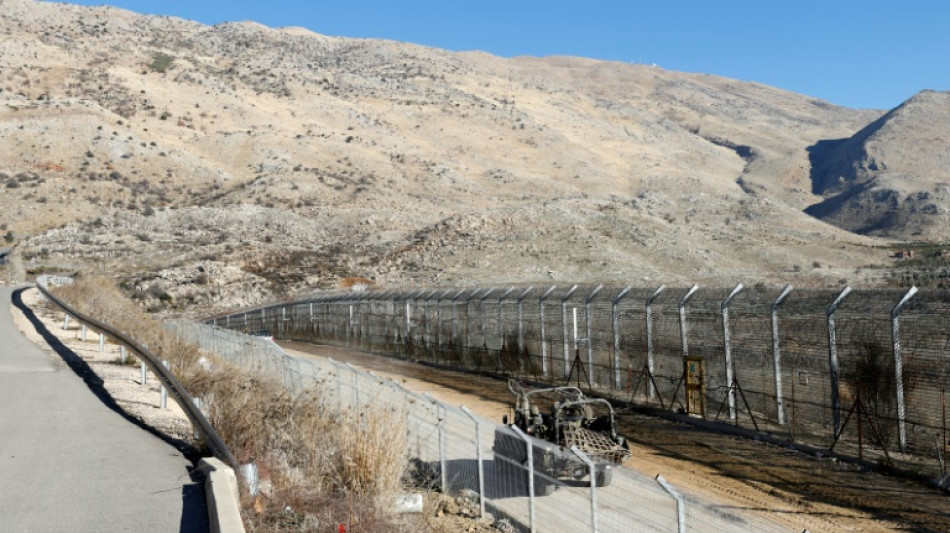
Syria says Israeli strikes 'aimed at undermining' progress, stability / Photo: © AFP
Syria's Foreign Minister Asaad al-Shaibani condemned on Wednesday Israeli strikes in retaliation for overnight rocket fire, saying they were aimed at destabilising his country.
Israel bombed southern Syria after the military reported that two projectiles were fired into Israeli territory, with media reports saying these were the first launched from Syria since the fall of longtime ruler Bashar al-Assad in December.
Two unknown groups claimed responsibility for the launches, while Syrian authorities denied responsibility and said they would "never be a threat" to anyone in the region.
Israeli Defence Minister Israel Katz held Syria's leader "directly responsible".
There were no reports of casualties or damage on the Israeli side from the projectiles, which the military said triggered air raid sirens in the southern Golan Heights, a territory Israel seized from Syria in 1967 and annexed in 1981.
The Israeli military said that the two projectiles "fell in open areas", later announcing it struck "weapons" belonging to the Syrian government in retaliation.
Shaibani said that the Israeli attacks were "coordinated provocations aimed at undermining Syria's progress and stability".
"These actions create an opening for outlawed groups to exploit the resulting chaos," the top Syrian diplomat told a news conference in Damascus alongside visiting EU Commissioner for the Mediterranean Dubravka Suica.
"Syria has made its intentions clear: we are not seeking war, but rather reconstruction," he added.
- Israel blames Sharaa -
The foreign ministry earlier said in a statement carried by the official SANA news agency that the Israeli shelling was a "blatant violation of Syrian sovereignty" that "aggravates tensions in the region".
"Syria has never been and will never be a threat to anyone in the region," it said.
The ministry said it could not confirm whether rockets were launched towards Israel, blaming "numerous parties... trying to destabilise the region".
Katz said in a statement that "we view the president of Syria as directly responsible for any threat or fire directed at the State of Israel".
Syria's interim President Ahmed al-Sharaa led the Islamist group that spearheaded the offensive that toppled Assad.
Following Assad's overthrow, Israel moved its forces into the UN-patrolled demilitarised zone in the Golan, and has carried out hundreds of strikes against military targets in Syria.
Israel says the strikes aim to stop advanced weapons from reaching Syria's new authorities, whom it considers jihadists.
A group called the "Martyr Mohammed al-Deif Brigades", named after the Hamas commander killed by Israel in the Gaza Strip, released a video it said showed the moment the rockets landed in the occupied Golan Heights.
A second group known as the "Islamic Resistance Front in Syria" claimed responsibility for launching the two rockets at Israel. The group was created a few months ago and called for action against Israel from south Syria.
AFP was unable to verify the authenticity of their claims.
- Escalation -
SANA reported Israeli shelling "targeting the Yarmuk Basin, in the west of Daraa" province.
The Syrian Observatory for Human Rights war monitor said bombardments had hit farmland in the province, without reporting casualties.
Since taking over, Sharaa has said Syria does not want conflict with its neighbours, urging international pressure on Israel to halt its attacks.
Analyst Bassam al-Suleiman said those benefiting from the escalation were "Iran and its militias", former Assad allies with a past presence in Syria.
A strong government in Damascus "apparently contradicts the Israeli vision for Syria" as a weak neighbour, he said.
Israel's recurring bombings of Syrian army infrastructure "hinders the emergence of a force capable of controlling all of Syria", Suleiman added.
Syria and Israel have technically been at war since 1948.
US President Donald Trump last month lifted sanctions on Syria and expressed hope for eventual normalisation with Israel -- though analysts say that remains unlikely.
During a visit to Damascus last week, US Special Envoy for Syria Thomas Barrack proposed a "non-aggression agreement" as a starting point between the two countries.
R.Hawkins--TNT