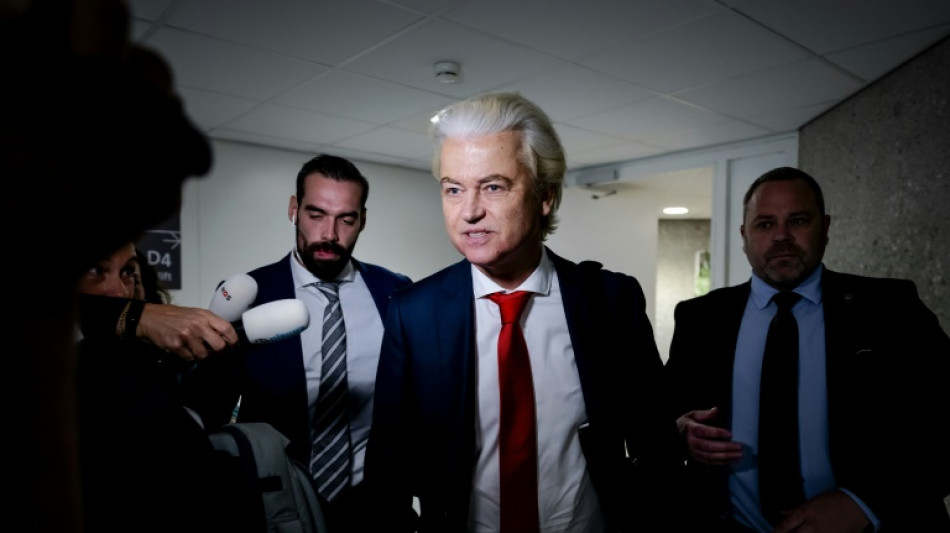
Dutch government falls as far-right leader Wilders quits coalition / Photo: © ANP/AFP
Far-right Dutch leader Geert Wilders withdrew his party from the government Tuesday in a row over immigration, bringing down a shaky coalition and likely ushering in snap elections.
Wilders has been frustrated with what he saw as the slow pace of introducing the "strictest-ever immigration policy", agreed with coalition partners after his shock election win in November 2023.
"No signature for our asylum plans... PVV leaves the coalition," said Wilders on X, formerly Twitter, referring to his far-right Freedom Party.
The withdrawal opens up a period of political uncertainty in the European Union's fifth-largest economy and major exporter, as far-right parties make gains across the continent.
The latest government crisis also comes just weeks before the Netherlands is due to host world leaders for a NATO summit.
Last-ditch crisis talks on Tuesday morning lasted barely half an hour before the leaders of the four coalition parties came out in a testy mood.
"I have just informed the prime minister that I will withdraw the PVV ministers from the cabinet and that we can no longer bear responsibility for this," said Wilders.
"I signed up for the strictest asylum policy, not for the downfall of the Netherlands and that our responsibility for this cabinet therefore ends at this moment," he added.
Eighteen months after his surprise election win sent shockwaves through Europe, polls suggest his PVV is still the strongest.
However, the gap to his nearest rivals has narrowed, with the left-wing Green/Left party of former European Commission vice-president Frans Timmermans following close behind.
The liberal VVD party, a traditional powerhouse in Dutch politics, are also running near the top two, meaning any election would likely be closely fought.
VVD leader Dilan Yesilgoz, visibly angry, described Wilders' move as "super irresponsible", adding she was afraid it would open the door to left-wing parties.
"How can you do this to the Netherlands?" she told reporters.
- 'Patience was up' -
In late May, Wilders called an impromptu press conference to announce his "patience was up" with the government of Prime Minister Dick Schoof.
He threatened to torpedo the coalition if a new 10-point plan to crimp immigration was not implemented within a few weeks.
His plan included border closures for asylum seekers, tougher border controls and deporting dual nationals convicted of a crime.
Summarising his demands, he said: "Close the borders for asylum seekers and family reunifications. No more asylum centres opened. Close them."
Political and legal experts criticised the plans as unworkable or illegal, with some suggesting Wilders was creating a crisis to collapse the government.
The far-right leader has often been called the "Dutch Trump" for his anti-immigrant views -- and instantly recognisable bouffant hairstyle.
His ambitions to lead his country were frustrated after his election win, as his coalition partners blocked his premiership bid, settling instead on Schoof as a compromise candidate.
The leaders of the four coalition partners agreed not to take up cabinet positions, instead running their parties as parliamentary chiefs.
Wilders has been an uncompromising figure in parliament, his quick-witted jousting with Timmermans being a highlight of debates.
He has frequently said that the only way to implement his anti-immigrant policies is for him to become prime minister.
However, in the fractured Dutch political system, no party can win an absolute majority in the 150-seat parliament and Wilders will need partners.
He can count on the support of the BBB farmers' party. The backing of the VVD -- currently an uneasy coalition partner -- is less certain.
The fourth party in the current coalition -- the anti-corruption New Social Contract -- has seen support collapse since charismatic leader Pieter Omtzigt stepped down.
Far-right parties have been on the rise across Europe. In May, the far-right Chega ("Enough") party took second place in Portuguese elections.
In Germany, the anti-immigration far-right AfD doubled its score in legislative elections in February, reaching 20.8 percent.
And in Britain, polls show the anti-immigration, hard-right Reform UK party of Nigel Farage is making significant gains following a breakthrough in local elections.
N.Roberts--TNT