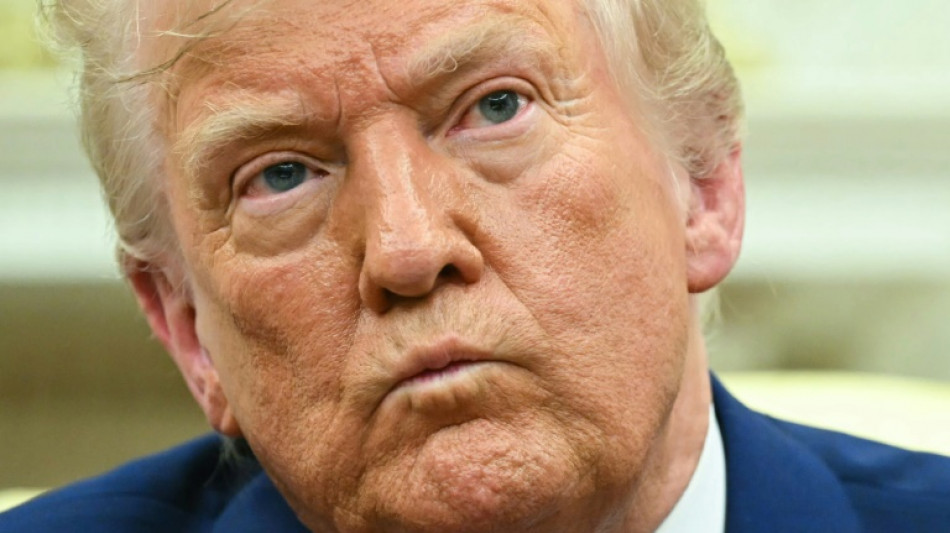
Trump says Iran deal would not allow 'any' uranium enrichment / Photo: © AFP/File
US President Donald Trump on Monday ruled out allowing Iran to enrich uranium under any nuclear deal between the foes -- as Tehran defended what it said was its "peaceful" pursuit of fuel for power generation.
Uranium enrichment has remained a key point of contention in five rounds of talks since April to ink a new accord to replace the deal with major powers that Trump abandoned during his first term in 2018.
"Under our potential Agreement — WE WILL NOT ALLOW ANY ENRICHMENT OF URANIUM!" Trump said on his Truth Social network after the Axios news outlet said Washington's offer would let Tehran enrich some of the nuclear fuel.
Republican Trump also blamed predecessor Joe Biden for the impasse, saying the Democrat "should have stopped Iran a long time ago from 'enriching.'"
Axios said the latest proposal that Washington had sent Tehran on Saturday would allow limited low-level uranium enrichment on Iranian soil, for an amount of time that has yet to be determined.
Iran has insisted that Iran has "nothing to hide" on its nuclear program.
Speaking in Cairo, where he met the UN nuclear watchdog's chief Rafael Grossi, Iran's Foreign Minister Abbas Araghchi said: "If the goal is to deprive Iran of its peaceful activities, then certainly no agreement will be reached."
The remarks came after Grossi of the International Atomic Energy Agency (IAEA) on Monday called for more transparency from Iran following a leaked report that showed Tehran had stepped up uranium enrichment.
- 'Need for more transparency' -
The IAEA report showed that Iran has ramped up production of uranium enriched up to 60 percent -- close to the roughly 90 percent level needed for atomic weapons.
"There is a need for more transparency -- this is very, very clear -- in Iran, and nothing will bring us to this confidence (besides) full explanations of a number of activities," Grossi said ahead of meeting Araghchi.
Grossi added that some of the report's findings "may be uncomfortable for some, and we are... used to being criticized".
Iran has rejected the report, warning it would retaliate if European powers that have threatened to reimpose nuclear sanctions "exploit" it.
"Some countries are trying to abuse this agency to pave the way for escalation with Iran. I hope that this agency does not fall into this trap," Araghchi said of the IAEA.
Iran meanwhile pushed for the United States to drop sanctions that have crippled its economy as a condition for a nuclear agreement with Trump's administration.
Araghchi said on Saturday that he had received "elements" of the US proposal for a nuclear deal following the five rounds of talks, mediated by Oman.
- 'With or without a deal' -
Both Araghchi and Grossi met Egyptian President Abdel Fattah al-Sisi, who praised the US-Iran talks and called for "de-escalation in order to prevent a slide into a full-fledged regional war".
On Monday, Iranian foreign ministry spokesman Esmaeil Baqaei told a news conference: "We want to guarantee that the sanctions are effectively lifted."
"So far, the American side has not wanted to clarify this issue," he said.
The US envoy in the nuclear talks said last month that Trump's administration would oppose any Iranian enrichment.
"An enrichment program can never exist in the state of Iran ever again. That's our red line. No enrichment," Steve Witkoff told Breitbart News.
Following a phone call with Witkoff the day before about the ongoing nuclear talks, Egyptian Foreign Minister Badr Abdelatty urged a peaceful solution and a nuclear-weapon-free Middle East, saying in Monday's press conference that "the region is already experiencing enough problems and crises".
He warned that military confrontation would create "a state of chaos from which no one will be spared".
Iran has vowed to keep enriching uranium "with or without a deal" on its nuclear program.
The United States has sent Iran a proposal for a nuclear deal that the White House called "acceptable" and in Tehran's "best interest" to accept, US media reported on Saturday.
The New York Times, citing officials familiar with the diplomatic exchanges, said the proposal calls on Iran to stop all enrichment and suggests creating a regional grouping to produce nuclear power.
W.Baxter--TNT