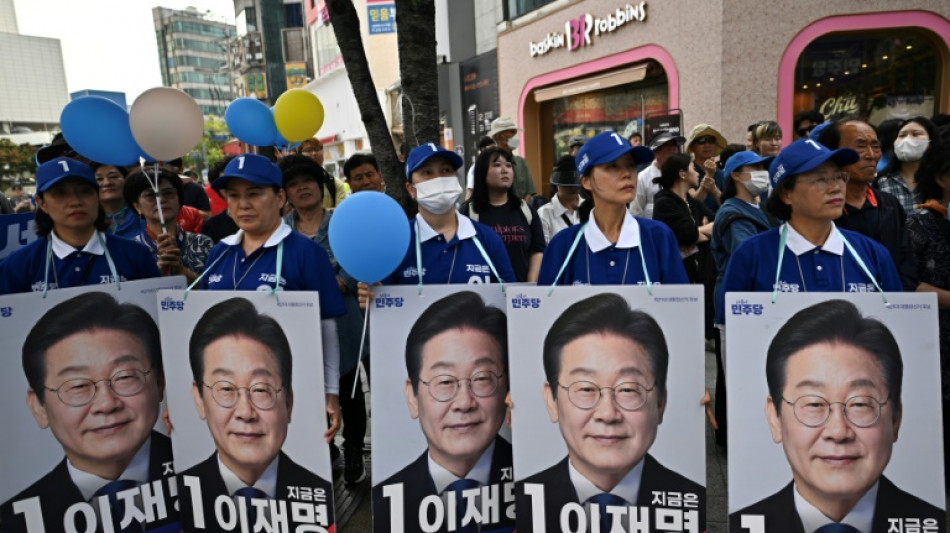
South Korea votes for new president after martial law turmoil / Photo: © AFP
South Koreans will vote Tuesday for a new president, capping six months of political upheaval following ex-leader Yoon Suk Yeol's disastrous declaration of martial law.
Millions have already cast their ballots in the snap election, with more than a third of registered voters doing so last week during two days of early voting, the National Election Commission said.
All major polls have put liberal Lee Jae-myung well ahead, with the latest Gallup survey showing 49 percent of respondents viewed him as the best candidate.
Kim Moon-soo, from the conservative People Power Party (PPP) -- Yoon's former party -- trailed Lee on 35 percent.
The fallout from martial law, which has left the country effectively leaderless for the first months of US President Donald Trump's second term, is the top concern for voters, experts said.
"Polls show the election is largely viewed as a referendum on the previous administration," Kang Joo-hyun, a political science professor at Sookmyung Women's University, told AFP.
"What's particularly striking is that the martial law and impeachment crisis not only swayed moderates but also fractured the conservative base."
And analysts say that South Korea's conservative party is in crisis.
Yoon's impeachment over a disastrous declaration of martial law, which saw armed soldiers deployed to parliament, made him the second straight conservative president to be stripped of office after Park Geun-hye in 2017.
Conservative candidate Kim also failed to convince a third party candidate, Lee Jun-seok of the Reform Party, to unify and avoid splitting the right-wing vote.
- 'Turning point' -
"Conservative politics was associated with competent governance, but it's now hard to argue that they remain capable," said Kang Won-taek, a political science professor at Seoul National University.
Lee's Democratic Party already holds a parliamentary majority and analysts say the fractured conservative base will struggle in opposition unless it can resolve its issues.
South Korean presidents serve a single five year term.
With a regular presidential election, there is a months-long transition period, and the new leader's term begins at midnight after the predecessor's final day.
But in a snap election, the winner becomes president as soon as the National Election Commission ratifies the vote tally.
After months of turmoil and a revolving-door of lame-duck acting leaders, many South Koreans are eager for the country to move forward.
In Gwangju, spiritual heartland of the South Korean left, Jung Se-yoon, 65, a retired teacher, said the election was a "turning point".
"It will take far too long for the country to get back on its feet if we miss this chance," Jung said.
Experts said voter turnout was expected to be high.
"The focus won't be on whether Lee will win, but on whether he will secure more than 50 percent of the vote," Bae Kang-hoon, co-founder of political think tank Valid.
"If he manages to do so, it would give him a significant boost in momentum to govern as president."
H.Davies--TNT