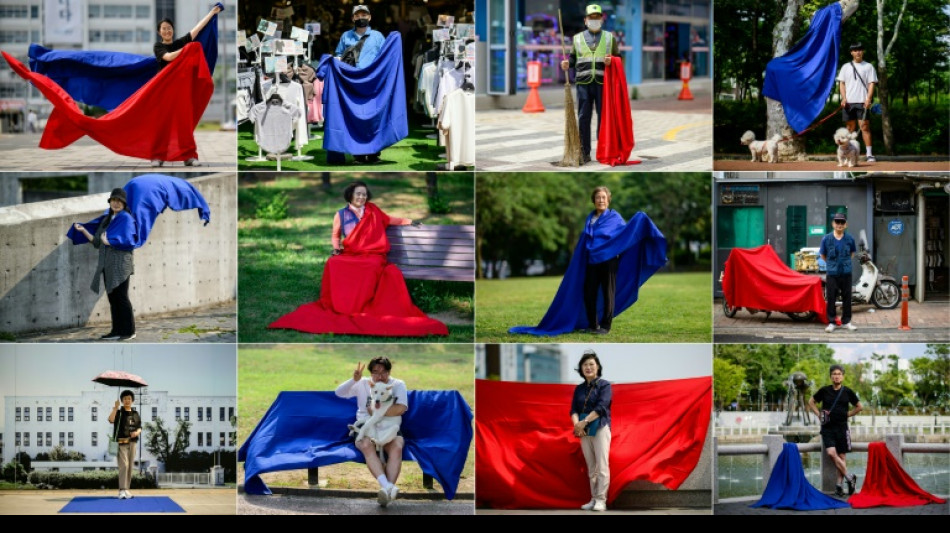
South Korean voters weigh political divide in partisan heartlands / Photo: © AFP
The top contenders in South Korea's presidential vote Tuesday have framed their campaigns as an existential fight for the country's soul, and whoever wins will have to unite a sharply-polarised society.
The election was triggered by ex-leader Yoon Suk Yeol's disastrous declaration of martial law last year.
All major polls suggest victory for Lee Jae-myung of the liberal Democratic Party, with Kim Moon-soo of the right-wing People Power Party (PPP) trailing far behind.
From the city of Daegu, for decades synonymous with conservatism, to Gwangju, the spiritual heartland of the left, AFP spoke to voters about where they stand and how the country's divide can be healed.
- Switching sides -
Lee Woo-hyun, an entertainment professional from Daegu and long-time conservative voter, told AFP the martial law fiasco "really shook" him.
"When I talk to my parents and other senior citizens, I can see they are turning away from the red," the 45-year-old said, referring to the symbolic colour of the PPP.
"Some might wonder how one incident could completely change my stance," Lee said.
"But for me, it did. A lot of people in their mid-40s feel the same way. They don't think what happened was right."
- Generational divide -
Ko Seung-ju, an electrical engineering major, sees growing cracks in Daegu's traditional conservative support base.
"Younger voters are no longer likely to blindly support the conservatives," Ko said.
The Yoon administration's decision to cut the national research and development budget has hit science and engineering students hard, he said.
"I really hope that gets reinstated."
- 'Balance is important' -
Kim Sung-gyun, 60, a former automotive industry worker, said he is undecided.
He disagreed with Yoon's attempt to impose martial law, which he described as creating "extreme chaos".
"People's lives are already difficult enough."
But he expressed reservations about one side gaining unchecked power -- pointing to the opposition's near two-thirds majority in parliament.
"Balance is important," he said.
He said he plans to vote for whoever he believes "puts the people first", regardless of traditional regional loyalties.
- The unshaken -
Shopowner Kim remains unfazed by the martial law bid.
"Declaring martial law was wrong, but nothing actually happened afterwards so they should just move on," said Kim, who declined to share his full name over privacy concerns.
For the 69-year-old, the local economy is the primary concern.
He said it was "wiped out" by the Covid-19 pandemic and has never recovered.
"It's impossible to keep a business afloat -- there's rent to pay, wages to cover and constant stress piling on."
- A vote for democracy -
Lee Gwi-nye, 79, a lifelong resident of Gwangju, voiced firm support for the Democratic Party and its candidate Lee.
"Democracy lets us live freely and comfortably," she said.
"But parties like the PPP, honestly, don't feel democratic at all."
To her, democracy means "being able to live and act freely, with peace of mind".
- 'History matters' -
Jung Se-yoon, 65, a retired teacher, said she doesn't believe in voting solely along party lines.
But she vividly recalled a bloody 1980 crackdown in Gwangju by South Korea's former military regime which left hundreds dead or missing.
"Those experiences still resonate. That's why I believe history matters," she said.
The upcoming election must serve as a "turning point".
"It will take far too long for the country to get back on its feet if we miss this chance -- and by then, we might fall too far behind," Jung said.
- Beyond party lines -
Haylee Lee, an English teacher, urged fellow Gwangju residents to "make a decision based on their own convictions" rather than fall into habitual partisan voting.
What matters most to her is how much effort presidential hopefuls make to listen to the concerns of ordinary people.
"Many politicians come from privileged backgrounds," she said.
"I wonder how well they actually listen to the voices of the middle class."
- Pressure as a centrist -
Park Yeon-ok, 64, who works at a social enterprise in Gwangju, told AFP she often faces pressure when she identifies as a centrist.
"Many people immediately ask: 'So you're not supporting the Democratic Party? Then are you backing the People Power Party?' That kind of reaction is pretty common," she said.
In this election, Park sees PPP candidate Kim as someone capable of bringing about unity.
"The divisions run deep," she said.
"I hope the next leader can help bridge those gaps."
F.Hammond--TNT