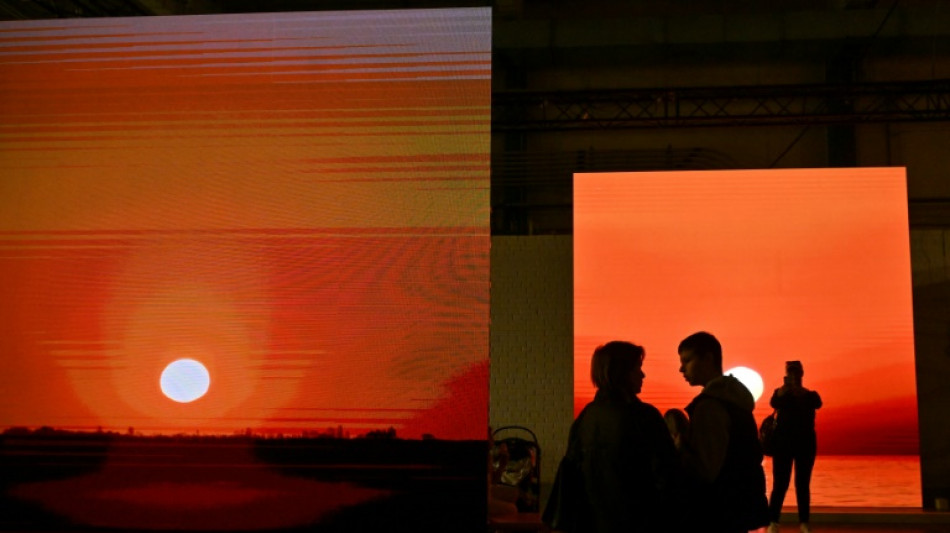
Kyiv exhibition helps relieve stress of war / Photo: © AFP
Virtual sunrises, a giant sculpture of a purring cat and a soundproof booth you can scream into -- the installations at Kyiv's "Third Wind" exhibition may seem like a bit of light-hearted fun.
But for the show's organisers, among them leading psychologists and mental health experts, the art has a very serious purpose: to help Ukrainians de-stress and explore their emotions after three years of war.
Russia's invasion has triggered a mental health crisis in Ukraine, with more than half of respondents to a recent survey feeling "anxiety and tension".
If only for a brief moment, the installations offer visitors a much-needed mental break from the war and help them "release tension, cry or smile a little", said curator Yulia Solovey.
"Above all, it's about giving people the strength to keep moving forward," she told AFP.
The exhibition has proven wildly popular, with nearly 100,000 people visiting within the space of a month.
Among them was 41-year-old resident Inna Purgan, who came seeking a "return to childhood" after a weekend of Russian strikes.
"It was very stressful, I couldn't sleep because of the drones and explosions," she told AFP.
After letting out a high-pitched scream in a soundproof booth, one of the interactive experiences, she said she felt a little better.
"It makes you feel lighter!" she said with a smile.
The exhibition's name is a play on "second wind", a burst of energy experienced during moments of exhaustion.
It is a feeling many Ukrainians relate to in their fourth year of war, with the exhibition inviting visitors to answer the question "What helps me move forward?", said Solovey.
- 'Shut down emotionally' -
According to state-backed mental health organisation "Ti Yak", which means "How are you?", Russia's war and its challenges remain the number one source of psychological stress for Ukrainians.
Theatre worker Anastasia Storozhenko and her husband Viktor, a soldier in the military, are no exception.
"It's really hard if you don't try to escape to another reality," said 31-year-old Anastasia.
The couple were actors, and much of their work before the war revolved around emotions.
Wearing a virtual reality headset transporting them to the Himalayas, she and her husband smiled ear to ear at the exhibit.
The young mother said she reminded herself she had to keep living, if not for herself, then for her child.
But Viktor has struggled to express his emotions since he joined the military.
"I've shut down emotionally," he said.
Surrounded by colourful decor, laughter and music, he started smiling.
"It helps a lot, life continues... emotions... And no more boom boom," he tried to explain, imitating missile blasts.
Nearby, other visitors were learning dance moves, while others embraced in front of a screen displaying a sunrise -- meant to symbolise hope.
Half of the proceeds from the tickets will go to an NGO making prosthetics for veterans who have amputations, the organisers said.
Once the exhibition ends, its installations will be moved to rehabilitation centres for soldiers and civilians recovering from trauma.
- 'Childish state' -
On a black wall, visitors were invited to draw colourful chalk messages.
"I'm alive", "I feel my heart beating", "Welcome to Ukraine-controlled territory" and a few swear words scribbled by children were among them.
Wearing rubber boots, army rehabilitation worker Natalya Novikova and her husband Vadym splashed around in puddles of water in one of the rooms.
"You can stop feeling the pressure of being an adult for a moment," said Vadym, catching his breath before reverting to seriousness to scold children who splashed him.
Both come from Russian-occupied parts of Ukraine -- Vadym is from Sevastopol in the annexed Crimean peninsula, Natalya from the eastern Donetsk region.
Natalya left her native Donetsk region in 2014, when Moscow-backed separatists fomented an uprising in the area.
She had resettled in Bucha, where Russian troops were accused of committing war crimes in early 2022.
The heavy emotional toll of the war was lifted, albeit briefly, by the exhibition, she said.
She said it brought her into "an animal, childish state."
"I didn't expect it to do much to me, but actually it's amazing."
J.Sharp--TNT