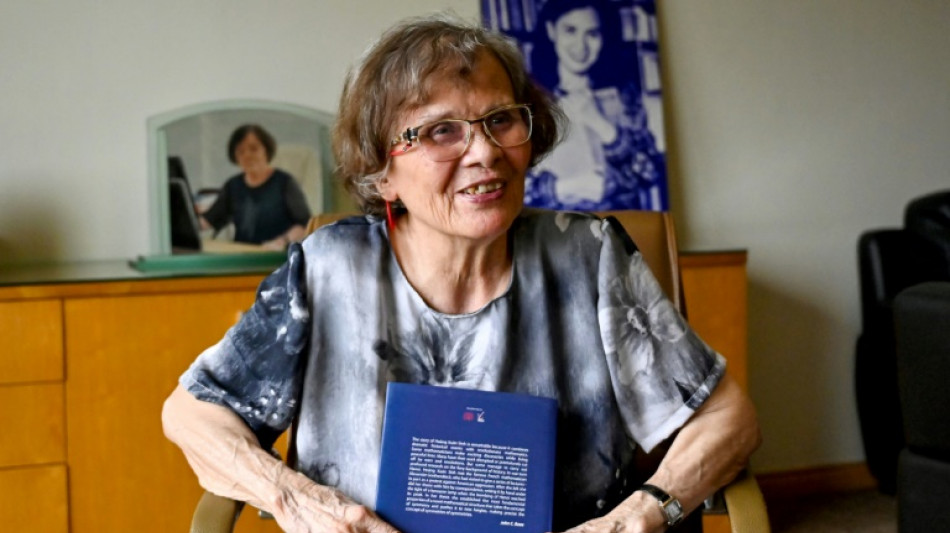
The pioneering Vietnamese professor taught by French maths genius / Photo: © AFP
As American bombers flew overhead, pioneering professor Hoang Xuan Sinh completed her thesis by the light of a kerosene lamp in the Vietnamese jungle, with letters from French maths genius Alexandre Grothendieck as her only guidance.
Vietnam's first female mathematics professor, Sinh, now 91, recalled trying to write in December 1972, as the B-52s of the US Air Force unleashed a deluge of bombs on Hanoi and surrounding provinces.
They patrolled "all night", Sinh told AFP, her voice trembling as she remembered the so-called Christmas bombings of the Vietnam War that saw 20,000 tons of explosives dropped over 12 days that month.
"We narrowly escaped death."
Sinh was born in Hanoi during the French colonial period and her life offers a snapshot of modern Vietnamese history.
Part of the country's final generation of intellectuals born under French rule, she lived through decades of conflict -- including wars with France, the United States and China -- before helping lay the foundations for its ongoing economic miracle.
Ahead of French President Emmanuel Macron's visit on Sunday, she spoke in fluent French of the meeting with revolutionary mathematician Grothendieck that changed her life and the private university she founded in 1988 -- the country's first.
- Farmers' huts -
Sinh met Grothendieck, one of the most important figures of 20th-century mathematics, in 1967 when he was teaching algebra to students and teachers in northern Vietnam.
Despite the bombs, Grothendieck -- considered to have revolutionised maths in the way Albert Einstein did physics -- spent a month in the country, driven by a sense of duty to fellow academics working in impossible circumstances.
"He was a very good teacher. He knew how to make difficult things easy," recalled Sinh.
At the time, the University of Hanoi was scattered across several villages in the countryside to escape bombings targeting the capital.
Grothendieck, Sinh and the other students lived with farmers, without electricity or running water.
"Their houses were small (but) they kept a corner for us, just enough to put a work table," she said.
Despite the hardship and destruction, Grothendieck -- who in 1966 won the Fields Medal, regarded as the Nobel Prize for mathematics -- wrote in a travel report that his hosts maintained "a quiet confidence in the future".
Sinh proposed a thesis topic to Grothendieck, who immediately accepted, and so began a struggle to complete it that would last nearly eight years, without a library or typewriter.
She received two letters from her mentor, who by that time had left Vietnam, but they were "very brief" to avoid censorship, she explained.
- Paper was a luxury -
Sinh devoted herself to her work at night after the classes she taught.
But at sunset, "I was eaten by mosquitoes", she said, recalling her dreams of a battery-powered light to replace her kerosene lamp -- a fire hazard -- so that she could shelter under a mosquito net.
Although she completed her work in late 1972 under the thunder of the B-52s, her thesis defence had to wait until May 1975, a few days after the fall of Saigon, which marked the end of the war.
On the jury at Paris Diderot University were Grothendieck and Laurent Schwartz, a fellow Fields Medal laureate who was also sympathetic to the Vietnamese cause.
Students and teachers were surprised to see two laureates on the panel, she recalled, still visibly moved by the memory.
Thanks to Grothendieck's intervention, the university accepted her handwritten thesis -- likely the first they had ever received, Sinh said with a smile, remembering that even finding paper during the war was a luxury.
Portraits of Grothendieck and Schwartz now hang in the entrance to lecture halls at Hanoi's Thang Long University, which she founded.
Students tapping on their phones in front of the paintings confessed to AFP they hadn't heard of the two men.
Today, Sinh visits the institution once a week, where she likes to feed the pigeons.
The students are "happy", she reflects.
"When you tell them things that happened, how life was, they can't believe it. They are lucky," she said.
T.Ward--TNT