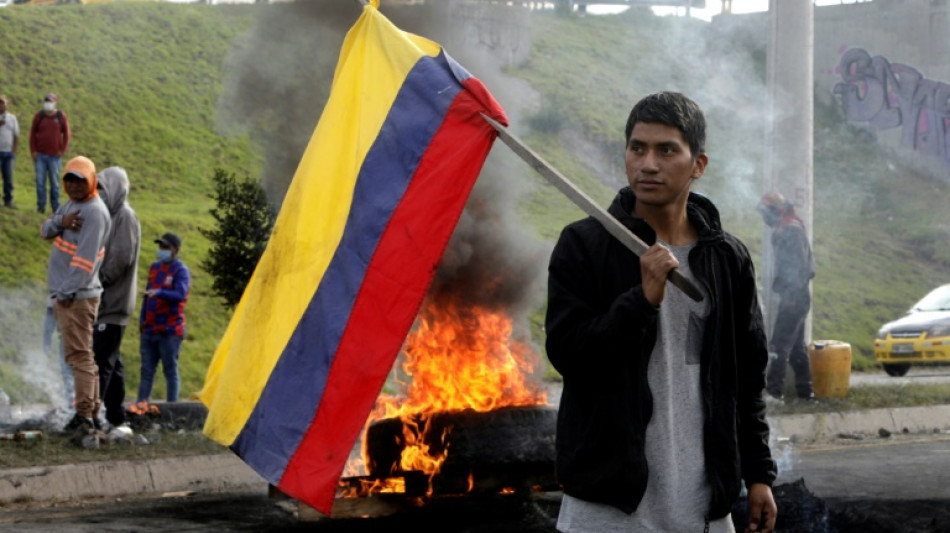
Ecuador declares state of emergency in three provinces amid Indigenous protests / Photo: © AFP
Ecuador's President Guillermo Lasso declared a state of emergency in three provinces late Friday in response to sometimes violent protests by Indigenous people demanding cuts in fuel prices.
"I am committed to defending our capital and our country," Lasso said on television. One of the three provinces includes the capital Quito.
The decree enables the president to call out the armed forces to maintain order, suspend civil rights and declare curfews.
Indigenous people, who make up over a million of Ecuador's 17.7 million inhabitants, launched an open-ended anti-government protest Monday that has since been joined by students, workers and other supporters.
They have blocked roads across the country including highways leading into Quito.
Clashes with security forces during the protests have left at least 43 people injured and 37 have been arrested.
To ease grassroots anger, Lasso also announced in his address late Friday a small increase in a monthly subsidy paid to Ecuador's poorest, as well as a program to ease the debt of those who have loans from state-run banks.
Oil producer Ecuador has been hit by rising inflation, unemployment and poverty exacerbated by the coronavirus pandemic.
Lasso, a rightwing ex-banker who took office a year ago, had met Thursday with Indigenous leaders to assuage discontent but the discussions apparently yielded nothing.
The powerful Confederation of Indigenous Nationalities of Ecuador (Conaie), which called for the protests, has said it would maintain the blockades until the government meets a list of 10 demands.
Fuel prices in Ecuador have risen sharply since 2020, almost doubling for diesel from $1 to $1.90 per gallon (3.8 liters) and rising from $1.75 to $2.55 for petrol.
Conaie -- which has been credited with helping topple three Ecuadoran presidents between 1997 and 2005 -- wants the price reduced to $1.50 for diesel and $2.10 for petrol, a demand the government has so far rejected.
Its other demands include food price controls and renegotiating the personal bank loans of some four million families.
Producers of flowers, one of Ecuador's main exports, complained Friday that due to the roadblocks, their wares were rotting.
F.Jackson--TNT