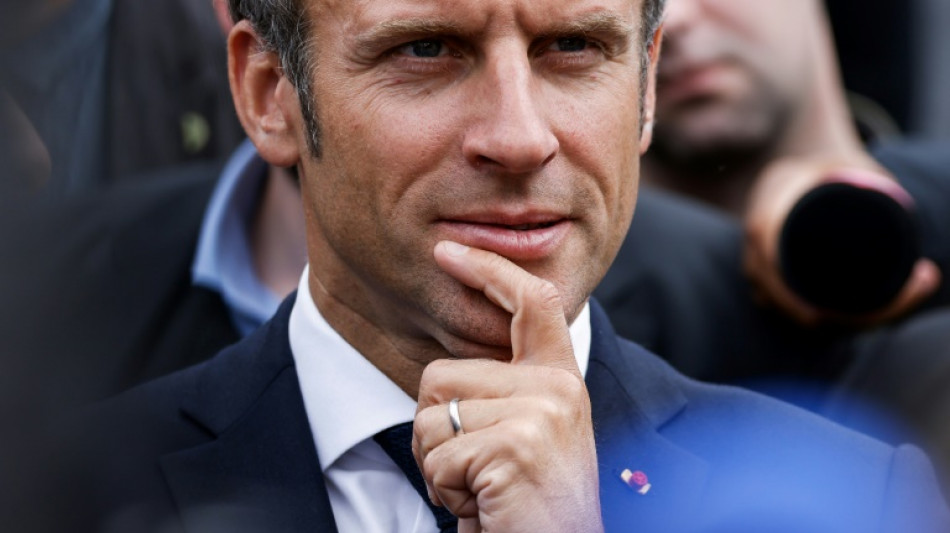
Final campaign push ahead of poll test for France's Macron / Photo: © POOL/AFP
President Emmanuel Macron and his allies made a final push Friday for votes in tense elections for parliament, where the centrist president is at risk of losing his majority in the face of a resurgent left-wing alliance.
Falling short of the 289 seats needed to reach a majority in the lower-house National Assembly would be a heavy blow to Macron's reform agenda, just two months after he won re-election against far-right leader Marine Le Pen.
Friday is the last day of legal campaigning, with all political activity banned from midnight and Saturday a day of calm before voting gets under way on Sunday.
Unlike in the presidential fight last April, Macron is seeing an unexpected challenge from the left, where Socialists, Greens and Communists have united behind the hard-left firebrand Jean-Luc Melenchon of the France Unbowed party.
Melenchon's allies have slammed Macron's trip this week to Kyiv, accusing him of using the Ukraine crisis to grandstand instead of addressing everyday French concerns including soaring inflation.
"He thought this parliamentary election was just going to be a formality... that it was already settled," Melenchon told BFM television on Friday.
He is urging voters to deny Macron another majority, though opinion polls indicate the left is unlikely to win an outright majority itself, which could force Macron to name Melenchon prime minister.
An Odoxa poll published Friday by Le Figaro found that 70 percent of voters do not want Macron to have a majority after the second-round run-off elections on Sunday.
That could seriously complicate Macron's domestic plans, such as pushing back the retirement age to 65 from 62.
Macron said the Ukraine crisis, "which is going to impact us significantly", meant that France could not afford to be divided.
"If our country can unite, come together while respecting our differences, we can come out stronger from this crisis," he told BFM in a separate interview Friday.
- Low turnout again? -
The first round of the parliamentary vote on June 12 painted an inconclusive picture, with Macron's centrist Ensemble (Together) coalition and Melenchon's NUPES alliance neck-and-neck on around 26 percent of the popular vote each.
Just five MPs -- four from NUPES and one from Together -- were elected outright in the first round, leaving all to play for in Sunday's run-off voting.
According to the latest poll by Ifop-Fiducial for LCI and Sud Radio, Ensemble is projected to get 265-300 seats against 180-210 for the left, meaning an overall majority of at least 289 seats is far from assured.
Martin Quencez, a research fellow at the German Marshall Fund, said it would be crucial for Macron to mobilise right-wing voters.
"If you compare the first round of presidential elections to the first round of the parliamentary elections, you find that Macron has lost about four million voters," he said.
Turnout in the first round was a record low of 47.5 percent, and the left's chances may also depend on attracting more disenchanted young and working-class voters.
Prime Minister Elisabeth Borne on Wednesday slammed NUPES as "the alliance of circumstance" hiding Melenchon's "extreme vision" that is "dangerous for our economy".
But Manon Aubry, a European deputy for Melenchon's party, accused Borne of "coming up with one lie after another".
- Campaign 'caricature' -
French daily Le Monde wrote Thursday that the campaign since the first round had descended into "caricature... rather than discussing the serious issues of the moment".
With most cabinet ministers standing for election and Macron insisting that those who lose should step down, election night promises to be a nervous time for some big names.
Europe Minister Clement Beaune is facing a tough challenge from the left in his Paris constituency, while Environment Minister Amelie de Montchalin is in even more danger in the fight for her seat in the Essonne region south of Paris.
Meanwhile, despite placing far less emphasis on these elections than the presidential polls, Le Pen is projected by most polls to exceed the minimum of 15 MPs needed to form an official group in parliament, the first time her far-right party will have managed such a breakthrough since 1986.
I.Paterson--TNT