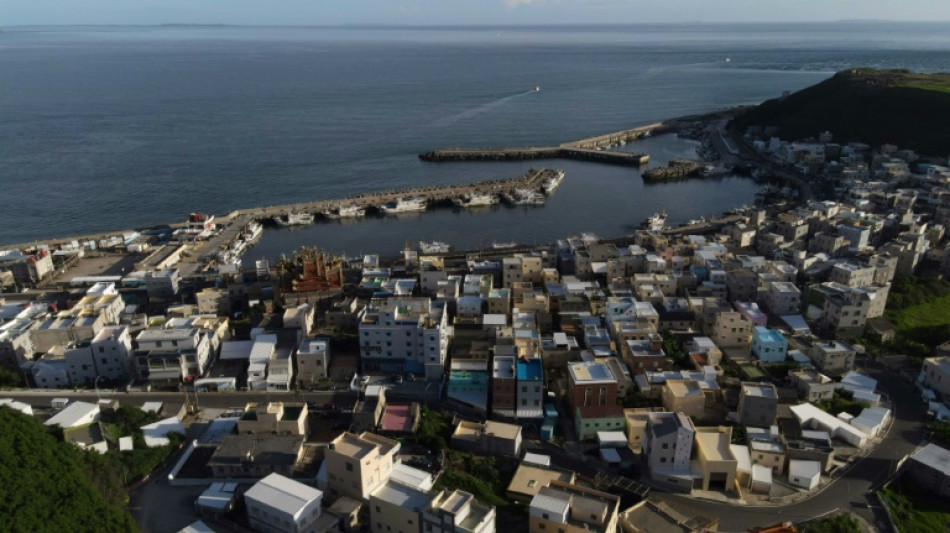
Control without invasion: Other actions China could take against Taiwan / Photo: © AFP
As Xi Jinping's China increasingly flexes its muscles on the global stage, concerns it may take military action against Taiwan have risen.
Beijing claims all of the self-governed island as its own territory, and says it is determined to retake it by force if necessary.
But a full-scale invasion is by no means the only option China has to coerce Taiwan into submission.
Here are some of the options Beijing could deploy:
- Annexation of outlying islands -
China could choose to invade some, or all, of Taiwan's outlying islands.
Both the Kinmen and Matsu islands sit just 10 kilometres (6.2 miles) or so off the coast of the mainland, and were once frequently shelled by artillery in the decades after the end of the Chinese civil war.
Beijing could also take aim at other Taiwanese interests in the South China Sea, such as the Pratas atoll, or even further away, Taiping island in the Spratly chain.
A step further would be the seizure of the Penghu archipelago, which is much closer to Taiwan -- about 50 kilometres from the main island.
"The strategic importance of Penghu is more than other island outposts," retired admiral Lee Hsi-min, who was head of Taiwan's armed forces until 2019, told AFP.
"If the Peoples' Liberation Army (PLA) were to occupy Penghu, it would serve as a foothold for short range assaults and obtaining air superiority."
A US Naval War College report said that a "stepping-stone strategy" starting with the outlying islands offered Beijing "a number of important advantages".
But China could also choose to simply stop before attacking the main island, and use the annexations to put diplomatic and psychological pressure on Taipei.
- Customs quarantine -
China could impose a "customs quarantine" -- that is, effectively take control of Taiwan's air and sea borders by screening incoming ships and aircraft, and allowing "innocent" traffic to pass while diverting "suspect" vessels to Chinese ports.
"The Chinese government would allow the people of Taiwan to run their own affairs on the island, at least for some time, as China showed it controlled who came (and perhaps who went)," a Council on Foreign Relations report from 2021 said.
In this scenario, food and energy imports would still be allowed through, as would passenger traffic like daily ferries.
"The goal is to force Taiwan to accept a loss of control, cutting Taiwan off from, at least, transfers of military equipment and associated foreign experts," the report said.
- Blockade -
Beijing could also choose to implement a full blockade of the Taiwan Strait, preventing anything from getting in and out.
"At present, the PLA is capable of performing local joint blockade against our critical harbors, airports, and outbound flight routes, to cut off our air and sea lines of communication and impact the flow of our military supplies and logistic resources as well as our sustainability for operations," the Taiwanese defence ministry wrote in a 2021 report.
Lonnie Henley, a retired US intelligence officer, told the US-China Economic and Security Review Commission in February last year that China would be able to continue a blockade "indefinitely", even with a severely diminished force.
- Bombing campaign -
The PLA could stop short of a full ground invasion, but use air and missile strikes to take out key military and civilian infrastructure, crippling Taiwan's defences.
It could also use cyber warfare to achieve the same aim.
"If the PLA acts according to its doctrine, we would likely see a massive cyberattack supported by large-scale jamming and other forms of electronic warfare on the island to disable its critical infrastructure and military command links," Andrew Krepinevich, an American defence policy analyst and former Pentagon official, told the Telegraph newspaper.
China could also choose to bomb Taiwan's population into submission, using their strength in numbers in the air to terrorise the island.
But James Char, an associate research fellow at Singapore's S. Rajaratnam School of International Studies, thinks the optics of raining down "bloodshed, destruction, on your own so-called fellow Chinese people" would prevent this course of action being taken.
T.Hancock--TNT