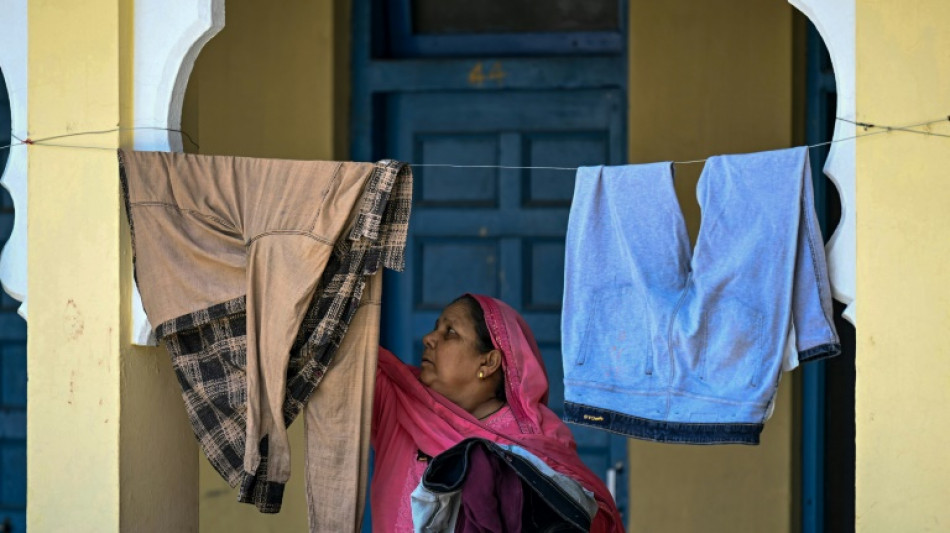
'We can't go back': India's border residents fear returning home / Photo: © AFP
Krishan Lal longs to return home after living in a government shelter for nearly a week, but like many who fled the border in Kashmir, he fears India's ceasefire with Pakistan won’t last.
Tens of thousands of people living near India's contested frontier with Pakistan were forced to flee as both countries launched deadly attacks and counter-attacks over four days, starting May 7.
The two nuclear-armed neighbours agreed to a ceasefire on Saturday but have since traded accusations of breaching the truce.
"I am desperate to go to my village because each day I don’t open my shop I lose money," said Lal, a 50-year-old tailor.
His home lies in Kashmir, a mountainous Muslim-majority region divided between the two countries that is claimed in full by both.
"But the word on the street is that the war is not over," said Lal.
Many people who returned home, believing the worst was over, were forced to flee again following fresh drone sightings and, in some cases, renewed artillery fire.
"People had come back thinking it was safe now," said 31-year-old Pardeep Kumar from the Kashmir village of Kotmaira, which came under artillery fire just hours after the ceasefire was announced.
"But now we know better," he said.
- 'We are being cautious' -
Indian authorities said they were discouraging people from returning to "sensitive" areas.
"We are being cautious about places within one to two kilometres (0.6 to 1.2 miles) of the border," said a senior official in Jammu, who asked to remain anonymous as they were not authorised to speak to the media.
Many displaced residents cited the lack of nearby bunkers as a key reason for not returning.
"We request the government to construct more bunkers because we don’t feel safe otherwise," said Akshay Kumar from the border town of Naushera.
The 30-year-old, who has been sheltering in a Sikh temple 108 kilometres (67 miles) from his home, said he found it difficult to "trust Pakistan".
"Areas that were never targeted in the past have seen heavy shelling this time," he said. "We cannot go back until there's absolute certainty that we’ll be safe."
The fighting -- the deadliest between the two South Asian rivals since 1999 -- followed an April 22 attack on tourists in Indian-controlled Kashmir that killed 26 civilians.
India accused Pakistan of backing the "terrorists" it said were responsible for the Pahalgam attack -- a charge Islamabad denied -- and last week launched missiles at sites in Pakistan it said were hosting the militants.
The surprise ceasefire, which came on the brink of all-out war, offered some relief. But several reported violations have left many residents sceptical.
"We really want to go back, but it seems it is not the right time yet," said Usha Kumari, who is staying in a classroom at a government school. "Pakistani drones are still out there."
For others, there is little left to return to.
Nirta Kaur fled her home in the village of Mankote after a shell flattened three of its four rooms.
"Who knows what is left of it now?" said the 52-year-old from her dormitory room in a Sikh temple in Jammu. "But I will have to, one day or another."
S.Lee--TNT