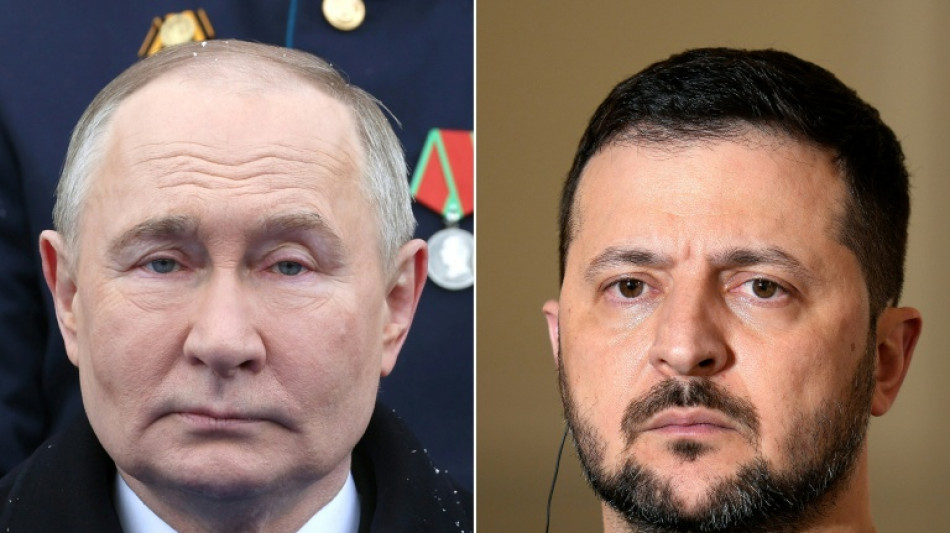
Kremlin rejects Europe's 'ultimatums' for truce with Ukraine / Photo: © POOL/AFP
The Kremlin said Monday it would not accept "ultimatums" set by European leaders to enter a ceasefire with Ukraine, without responding to Ukrainian President Volodymyr Zelensky's call for a personal meeting with Vladimir Putin.
Kyiv and its allies urged Moscow to agree to a full and unconditional 30-day ceasefire starting Monday but Putin instead proposed direct Russia-Ukraine talks in Istanbul on Thursday.
European countries including France and Germany have warned a ceasefire needs to be in place for talks to happen but Moscow has effectively ignored this call, launching attacks across the front line, according to Kyiv.
"The language of ultimatums is unacceptable to Russia, it is not appropriate. You cannot talk to Russia in such a language," Kremlin spokesman Dmitry Peskov told journalists during a briefing call.
"We are focused on a serious search for ways to achieve a long-term peaceful settlement," Peskov said, while declining to comment on who Russia would send to Istanbul.
Russia fired more than 100 drones at eastern Ukraine overnight, killing one person and wounding six, as well as damaging railway infrastructure and residential buildings, local officials said.
"Russians are completely ignoring the offer of a full and durable ceasefire starting on May 12," Ukrainian Foreign Minister Andriy Sybiga wrote on X after meeting Kyiv's Western allies online.
"They continue to attack Ukrainian positions all along the frontline."
- 'How long can it last?' -
Raising the stakes after a weekend of intense diplomacy, Zelensky said Sunday he would be willing to meet Putin in Turkey "personally".
The prospect of direct Russia-Ukraine talks on ending the war -- the first since the early months of Russia's 2022 invasion -- has been welcomed by Washington and across Europe.
Tens of thousands have been killed and millions forced to flee their homes since Russia invaded in February 2022, while its army now controls around one-fifth of the country -- including the Crimean peninsula, annexed in 2014.
US President Donald Trump, who has threatened to stop trying to mediate a peace deal if he does not see compromises from both sides, has called for them to sit down immediately.
"President Putin of Russia doesn't want to have a Cease Fire Agreement with Ukraine, but rather wants to meet on Thursday, in Turkey, to negotiate a possible end to the BLOODBATH," Trump wrote on his Truth Social network on Sunday.
"Ukraine should agree to this, IMMEDIATELY," he added.
Elsewhere on the front lines, Russia's army said it had captured a small village in the eastern Donetsk region, while Moscow-backed authorities said four people were killed in the Russian-occupied part of Ukraine's Kherson region over the last 24 hours.
Residents in Bilytske, a small industrial town in east Ukraine, remained sceptical about the prospect of a ceasefire.
"We don't really believe, of course, but we hope," Alla, who woke up to the sound of explosions, told AFP.
Alyona, 39, standing next to her, said Putin and Zelensky needed to start negotiating.
"How long can it last? It's been three years already."
- 'Root causes' -
Putin has said any direct talks with Ukraine should focus on the "root causes" of the conflict, and did not "exclude" a possible ceasefire coming out of any talks in Istanbul.
Russia's references to the "root causes" of the conflict typically refer to alleged grievances with Kyiv and the West that Moscow has put forward as justification for its invasion.
They include pledges to "de-Nazify" and de-militarise Ukraine, protect Russian speakers in the country's east and push back against NATO expansion.
Kyiv and the West have rejected all of them, saying Russia's invasion is nothing more than an imperial-style land grab.
Russian and Ukrainian officials held talks in Istanbul in March 2022 aimed at halting the conflict but did not strike a deal.
Contact between the warring sides has been extremely limited since, mainly dedicated to humanitarian issues like prisoner-of-war exchanges and the return of killed soldiers' bodies.
EU leaders, including France's Emmanuel Macron and Germany's Friedrich Merz, welcomed the prospect of direct talks, but pressed Russia to agree to a ceasefire first.
Germany warned the "clock is ticking" for Russia to agree by the end of Monday to an unconditional 30-day ceasefire in Ukraine or face potential new sanctions.
Russia's key ally China on Monday called for a "binding peace agreement" that was "acceptable to all parties."
A.M.Murray--TNT