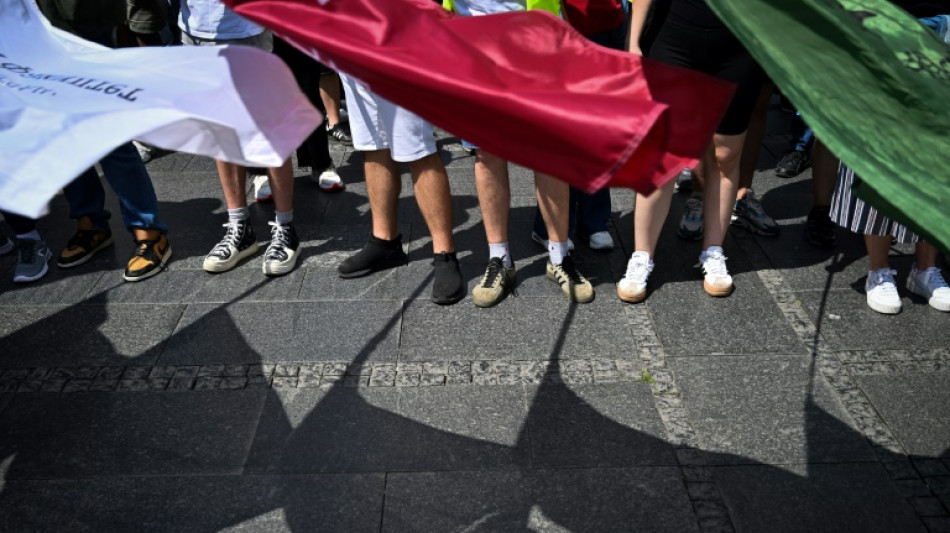
From blockades to ballots: Serbian students confront government / Photo: © AFP/File
Serbian students leading an anti-corruption movement that has rocked the Balkan country for months maintained the pressure Friday with a march in the western city of Loznica -- the first major protest since their call for early elections.
Many arrived the night before on foot from across Serbia and were welcomed by residents with flags and fireworks.
The country has been shaken by months of protests sparked by the deaths of 16 people when a newly renovated railway station roof collapsed in the northern city of Novi Sad in November -- a tragedy widely seen as the result of deep-rooted corruption.
Students have blocked universities, streets and roads, marched across Serbia, cycled to Strasbourg, and run to Brussels -- all while remaining nonpartisan in their message.
These actions have "helped raise awareness" and "reached parts of the public that the political opposition had never reached", Dusan Vucicevic, a University of Belgrade political science professor, told AFP.
But as demonstrations have escalated, "people have been waiting for some political articulation," he added, referring to tactics.
Earlier this week, students shifted gears and called for early parliamentary elections.
"We came to the point where we realised that this government is not going to fulfil our demands. This has lasted for almost six months, and they are acting like we don't exist," Andjela, a Belgrade Academy student, told AFP.
Students have demanded accountability for the tragedy, prosecution of those who attacked protesters, dismissal of charges against arrested students, and an investigation into the alleged use of a sound cannon during a demonstration in March.
- Looming polls -
Facing the greatest challenge of his 12-year rule, the Serbian President Aleksandar Vucic has oscillated between calls for dialogue and accusations that the students are backed by foreign powers seeking a "colour revolution."
Commenting on their demand for elections, he said Wednesday that students "won't wait long" -- though he offered no date.
Students have already begun preparing with a list of candidates they would support, which they say "would unite the largest number of Serbian citizens" by featuring the names of eminent individuals rather than politicians.
"Students won't be candidates. It will be people we trust," Andjela said, adding that a criteria for prospective candidates was still being established.
Vucicevic said the students' strength lies in their emotional connection with the public, as well as in the fact that their "demands are political but not party-driven".
"They focus on respect for law, social justice, and political accountability -- universal values that resonate widely," Vucicevic said.
- Public trust -
Most opposition parties -- ranging from the left to the centre -- have said they will support the students' demands and assist them in organising.
However, parties have stated whether they would pull candidates in favour of the students' preferred nominees.
Vucicevic pointed out that the opposition struggles with public trust -- partly as a result of smear campaigns led by the government and pro-government media.
But students are shifting voter perception.
"Many anti-Vucic voters voted not for the opposition but against Vucic. In contrast, the student movement is growing a base of pro-student voters," the political scientist said.
Parliamentary elections were last held in December 2023, with the ruling nationalist party claiming victory amid fraud allegations dismissed by Vucic.
The united opposition won 23.5 percent of the vote.
Protests have since prompted the prime minister's resignation and the government's fall.
A new government, led by a political novice and medical doctor, was elected by parliament in mid-April.
S.Lee--TNT