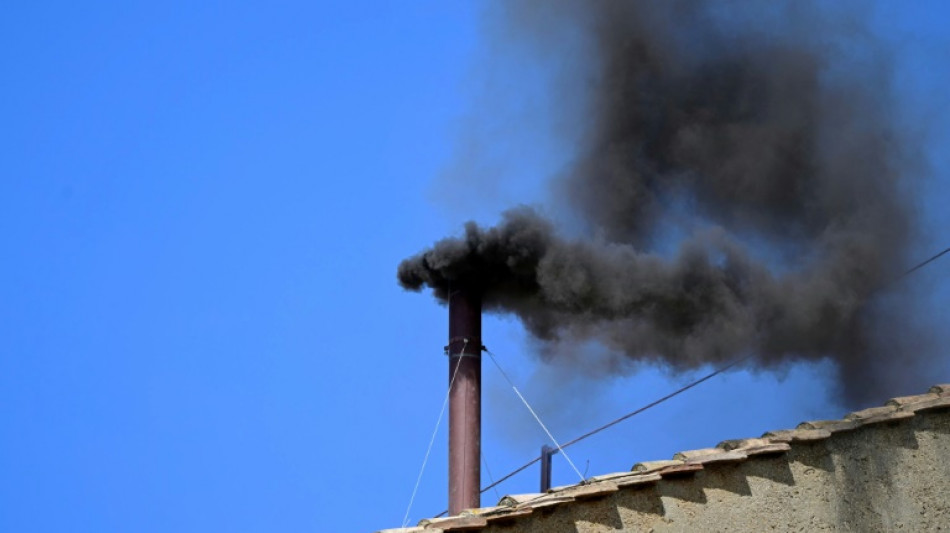
Cardinals to vote anew for pope after second black smoke / Photo: © AFP
Cardinals prepared to cast fresh votes Thursday for the next head of the Catholic Church, after sending up a second round of black smoke to signal they had again failed to elect a pope.
The 133 cardinals began their secretive conclave in the 15th-century Sistine Chapel on Wednesday afternoon, seeking a successor to Pope Francis as head of the world's 1.4 billion Catholics.
Since then they have twice sent up black smoke, the latest at Thursday lunchtime, to let the world know that no one had yet secured the two-thirds majority required to be elected pontiff.
The centuries-old ritual is held entirely behind closed doors but the red-robed cardinals were scheduled to have two votes on Thursday afternoon after lunch at the Santa Marta guesthouse, where they are staying.
Sworn to secrecy, their only method of communication is by burning their ballot papers to send up smoke through the chapel chimney -- coloured black if they have no decision, white for a new pope.
Among the thousands of Catholics and curious tourists gathered in St Peter's Square to watch the proceedings, there was some disappointment earlier, but others said they were happy to wait.
Emmanuel Quiros Chavarria, 34, a Costa Rican priest studying in Rome, told AFP it was a good sign the cardinals were not rushing -- even if he hoped to see white smoke on Thursday afternoon.
"The most important thing is that the elected pope is a man of unity and balance," he said.
- Take your time -
On Wednesday, the first day of the conclave, the black smoke came some three hours and 15 minutes after the cardinals closed the doors of the Sistine Chapel.
If no pope emerges in the two votes to come Thursday afternoon, the voting will continue Friday -- and for as long as it takes to find consensus.
In 2005, Pope Benedict XVI was elected in four ballots over two days and Pope Francis in 2013 in five ballots over two days.
"I don't want it rushed -- whatever they need to do to make the right decision," said Barbara Mason, 50, who travelled from Canada for the conclave.
A central question is whether cardinals will choose someone in the image of Francis -- who defended the poor, migrants and marginalised around the globe -- or someone more focused on defending Church doctrine.
The charismatic Argentine reformer died on April 21, aged 88.
"I'd like someone moderately conservative," one French pilgrim in the crowd who gave his name as Augustin told AFP.
"The church needs unity and strong values," said the 24-year-old, who arrived at the Vatican after travelling on foot from a Tuscan monastery.
But US tourist Colter Sikora said he worried the faith could become "smaller or more niche" despite its responsibility "for serving a lot of people.
"You want somebody who's holy, but has, like Francis, a little bit of charisma, somebody that you look up to and want to follow as a leader," said the 37-year-old.
- No secrets revealed -
While voting within the Sistine Chapel, the cardinal electors -- all those aged under 80 -- are seated at tables set up beneath Michelangelo's frescoed ceilings.
Each man writes their choice for pope on a ballot paper and takes it to the altar, where it is placed in a silver urn.
After the ballots have been counted, they are burned in a cast iron stove dating back to 1939. Chemicals are added to a second, newer stove, connected to the same flue, which colour the smoke.
While their procession into the Sistine Chapel on Wednesday was broadcast live by the Vatican, including on screens in St Peter's Square, the feed cut as soon as they locked the doors.
The cardinals, who have to leave their phones behind, took an oath Wednesday not to reveal the secrets of the conclave on pain of excommunication.
- Divisions -
The 2025 conclave is the largest and the most international ever, assembling cardinals from around 70 countries.
There is no clear frontrunner to succeed Francis. The cardinals represent a range of progressive and conservative traditions within the Church.
The challenges facing the 2,000-year-old institution are clear, however.
The new pope will need to tread carefully amid geopolitical uncertainty, while addressing deep fractures within the Church -- many of them exacerbated by Francis's reforms.
There is also the continuing fallout from the global clerical sex abuse scandal and, in the West, increasingly empty pews.
Around 80 percent of the cardinals voting were appointed by Francis.
More than a dozen names are circulating, from Italian Pierbattista Pizzaballa and Hungary's Peter Erdo to the Philippines' Luis Antonio Tagle and Sri Lanka's Malcolm Ranjith.
burs-ams/ide/ar/jj
R.T.Gilbert--TNT