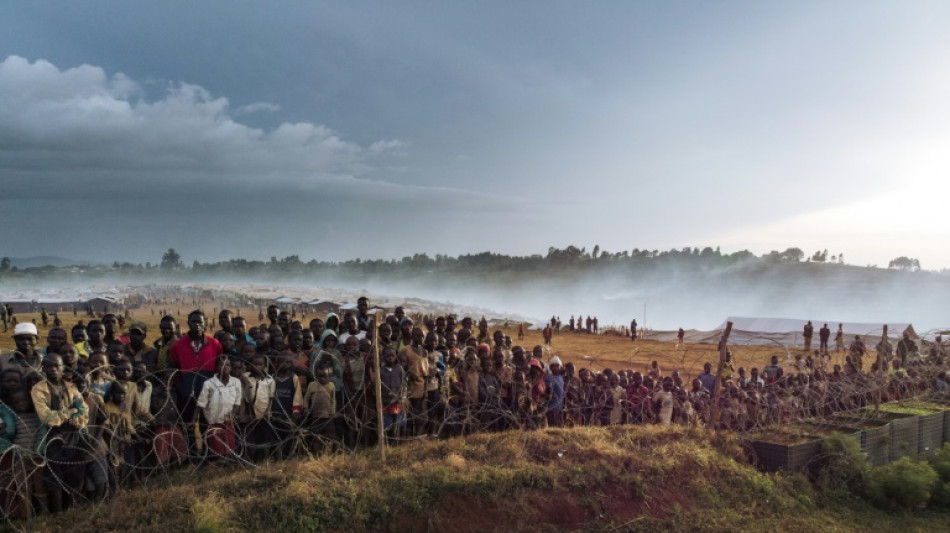
Hunger crisis could swell already record global displacement: UN / Photo: © AFP/File
Russia's war in Ukraine has pushed global displacement numbers above 100 million for the first time, and the UN warns the resulting hunger crisis could force many more to flee their homes.
Efforts to address the global food insecurity crisis, which has been dramatically aggravated by Russia's invasion of Ukraine, is "of paramount importance... to prevent a larger number of people moving," the United Nations refugee chief Filippo Grandi told reporters.
"If you ask me how many... I don't know, but it will be pretty big numbers."
Russia's full-scale invasion of Ukraine, traditionally a breadbasket to the world, has sparked dramatic grain and fertiliser shortages, sent global prices soaring and put hundreds of millions of people at risk from hunger.
"The impact, if this is not resolved quickly, would be devastating," Grandi said. "It is already devastating."
His comments came as he presented the UNHCR refugee agency's annual report on global displacement, showing that a record 89.3 million people were displaced at the end of 2021 -- more than doubling in a decade.
But since Russia launched its full-scale invasion on February 24, as many as 14 million Ukrainians may have fled within their own war-ravaged country or across borders as refugees, pushing global displacement past the grim 100-million mark for the first time.
- 'Terrible trend' -
"Every year of the last decade, the numbers have climbed," Grandi said.
"Either the international community comes together to take action to address this human tragedy, resolve conflicts and find lasting solutions, or this terrible trend will continue."
The UN agency found that at the end of 2021, a record 27.1 million people were living as refugees, while the number of asylum seekers rose 11 percent to 4.6 million.
And for the 15th straight year, the number of people living displaced within their own country due to conflict swelled, hitting 53.2 million.
The UNHCR report said last year was notable for the number of protracted conflicts in places like Afghanistan that escalated, even as new ones flared.
At the same time, growing food scarcity, inflation and the climate crisis were adding to hardship and stretching the humanitarian response, threatening to weaken already dire funding levels for many crises, UNHCR warned.
That has not been the case for Ukraine, with an enormous outpouring of solidarity, and fleeing Ukrainians welcomed with open arms across Europe.
- 'Not unmanageable' -
Grandi hailed the generous response to this crisis, but highlighted the contrast to how refugees fleeing wars in places like Syria and Afghanistan have been met.
The UN refugee chief recalled how European leaders had insisted "it's full" when asked to take in more refugees from those conflicts.
"I'm not naive. I fully understand the context," he said, adding though that the generous response to fleeing Ukrainians "proves an important point... The arrival of desperate people on the shores or at the borders of rich countries is not unmanageable."
Grandi also pointed to how massive sums of money had been made immediately available to respond to the Ukraine crisis, despite countries' insistence their coffers were empty when met with appeals for more aid for other situations.
"There cannot be inequity in the response," he said.
Countries have vowed the aid provided for Ukraine would come on top of amounts pledged for other crises, but Grandi cautioned that so far "the mathematics doesn't show that."
- 'Vicious circle' -
It would be disastrous if already underfunded responses were cut further, he warned.
He voiced particular concern for the Horn of Africa and the Sahel, where massive displacement is being driven by a macabre combination of conflict, insecurity, poor governance and devastating effects of climate change.
"It's a very vicious circle of many factors," he said.
Grandi warned that beyond the immediate impact, the war in Ukraine was also complicating the response to displacement crises since it had "dealt a terrible blow to international cooperation."
Even if the war were to end within months -- which he thought unlikely -- "the scars on international cooperation of those fractures between the West and Russia... will take a long time to heal."
And, he warned, "if that is not healed, I don't know how we will deal with this global crisis."
L.A.Adams--TNT