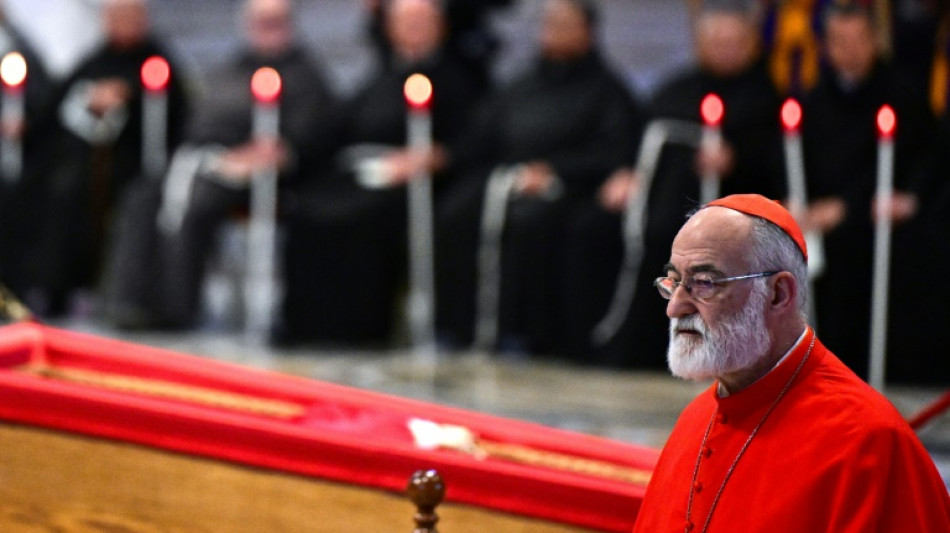
Moroccan-based cardinal says Church does not need Francis 'impersonator' / Photo: © AFP
Cardinal Cristobal Lopez, the Spanish-born archbishop of Rabat, admits he is a little anxious ahead of his first conclave, although also curious.
The 72-year-old is among 133 cardinals from around the world who will vote for a successor to Pope Francis starting May 7.
"I haven't decided anything," he told AFP when asked whom he would vote for as the leader of the world's 1.4 billion Catholics.
"We believe in the Holy Spirit and we will see what it shows us and where we have to go."
"It doesn't necessarily have to be a Francis mark II, a Francis impersonator," said Lopez, who the Argentine pontiff appointed as a cardinal in 2019.
"I am happy for him to be a good impersonator of Christ, that he is a good Christian, a good person and pays attention to what happens in the world."
Born in Spain, Lopez has been the archbishop of the Moroccan capital Rabat since 2017.
There, he claims to have experienced a "conversion" -- not to Islam, the overwhelming majority religion in the North African country, but in his approach to his work.
"I hear confession barely once every six months," Lopez said. Christians make up less than one percent of Morocco's population of 38 million people.
"That helped me to realise that I wasn't there to serve the Church but rather, as the Church, to serve the world -- in this case the Muslim world."
- 'Not worried, but curious' -
Lopez has been taking part in the daily cardinal meetings, known as "general congregations", in which those present discuss the priorities for the new pope and future direction of the 2,000-year-old Church.
"We are listening to people who we have never listened to before... and that guides you," said Lopez, who is a Paraguayan citizen, having lived there for almost two decades.
The cardinals taking part in the conclave -- those aged under 80 and able to attend -- are staying in the relatively modest Casa Santa Marta on the Vatican's grounds where Francis lived during his papacy.
They are, however, sworn to lifelong secrecy about what happens inside the Sistine Chapel during the conclave.
Smartphones are banned, the room will be swept for listening devices and cardinals are barred from reading newspapers, listening to the radio or watching television.
"I'm not worried, but I am curious," said Lopez. "A little apprehensive because I know the responsibility that this entails, but calm because I believe in the Holy Spirit."
In fact, Lopez even feels "a certain happiness" about the whole process -- but hopes it will not last more than "two or three days".
There are up to four votes a day until at least two-thirds of the cardinals agree on a single candidate.
Two days were needed to elect Francis and his predecessor Benedict XVI, but the longest ever conclave lasted three years.
"It's already many days that I have been out of Morocco and I'm eager and need" to return, said Lopez.
- Like replacing Messi -
Like Francis, Lopez wants a missionary Church pushing out especially into areas where Catholicism has few adherents, such as Morocco.
"Thanks to Pope Francis this has become much clearer, that the Church is universal, Catholic, that there are no geographic borders that limit us," he said.
And Lopez has not ruled out the next pope hailing from outside the traditional Catholic heartlands.
"After 50 years of a Polish pope, a German pope and an Argentine pope, why not think about a pope from Myanmar, East Timor or Australia, or North America, or Africa. It's all open," he said.
However, he is ruling himself out of the running.
"It's as if I said (Lionel) Messi is going to retire and I'm going to replace" the Argentine football legend, he joked.
R.Campbell--TNT