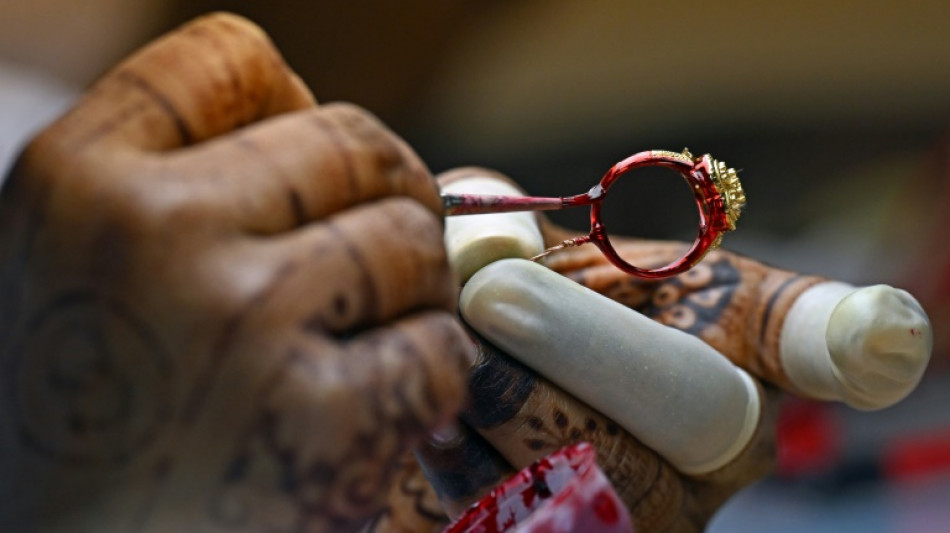
Hope sparkles anew for India's jewellers after US tariff pause / Photo: © AFP
India's gems and jewellery industry is breathing a momentary sigh of relief after US President Donald Trump paused harsh tariffs that threatened to hit lucrative exports and tens of thousands of jobs.
At manufacturing and processing hubs across India, exporters and buyers worried over how they would absorb Trump's gruelling 26 percent tariff on a multi-billion dollar industry.
Business related to US exports -- everything from silver bracelets to diamonds -- were on the verge of a near-standstill in a vital export zone in India's financial capital Mumbai, industry executives told AFP.
But Trump's 90-day-pause offers a "much-needed breather" to exporters, said Kirit Bhansali, chairman of India's Gem and Jewellery Export Promotion Council.
"This window will help us realign and strengthen our position in the market," Bhansali said. The pause, he said, would allow the sector to "stabilise operations and strategise for the months ahead".
India shipped about $10 billion in gems and jewellery products to the United States in the 2024 fiscal year, accounting for roughly 13 percent of its total exports to Washington.
The industry, which has until now had to deal with far lower tariffs -- ranging between zero to 6-7 percent, depending on the item -- helps sustain the livelihoods of over four million people.
They include artisans in the gem processing hub of Surat, where 90 percent of the world's diamonds are cut and polished, as well as traders in Mumbai.
India's 26 percent duty was lower than rates levied on rivals such as China, but exporters feared higher jewellery prices would lead to Americans spending less when tariff costs were passed onto customers.
- 'Gripped with uncertainty' -
Adil Kotwal of Creations Jewellery reckons that, if a 26 percent tariff went through, higher inflation and weaker purchasing power could make the market shrink by 25 to 30 percent this year until prices stabilise.
"An average American has a budget, he doesn't have an open-ended wallet," Kotwal said.
"Young people getting married... they have in their head, okay: 'I'll have to spend about $6,000, $7,000, I'll buy a nice ring for the engagement'," he said.
"Now, his budget is going to go up to $10,000, and he'll have to figure out what to do."
Kotwal, who also heads a jewellery manufacturing industry group in a key Mumbai export zone said before the tariffs were paused that the taxes would make people reassess.
"Either he scales down the size of the centre stone, or he goes for buying a lab-grown (stone)," he said. "Or he postpones engagement for a couple of months."
India and the United States are negotiating the first tranche of a trade deal and exporters hope Prime Minister Narendra Modi will be able to shield them from the worst.
"The industry as a whole has been gripped with uncertainty over the last few weeks, so that's lifted for now," Ajesh Mehta from D. Navinchandra Exports told AFP.
"We hope that this 90-day period will also allow the government to negotiate the trade deal and resolve the issues."
However, the industry hoped that trade would remain stable.
"We're still in wait-and-watch mode at this point," Mehta said. "The industry is currently in a slack period right now, as it is in between major holidays. But purchases from American buyers should continue -- for now."
Most jewellers say the sector could live with a lower duty even if it does not go back to a pre-Trump tariff era.
"If we conclude that there is going to be a 10 percent duty... that's where everybody will be able to live comfortably, without disruptions," said Kotwal.
While Trump's pause has brought relief, India's exporters are keenly aware they could be in the same position in July.
"We should continue to see purchases by American customers and buyers in this 90-day period as the tariff differential isn't so big right now," said K. Srinivasan of Emerald Jewel Industry India.
"That said, on the 90th day, we may see a drop and purchases stop again if the issue doesn't get resolved."
E.Cox--TNT