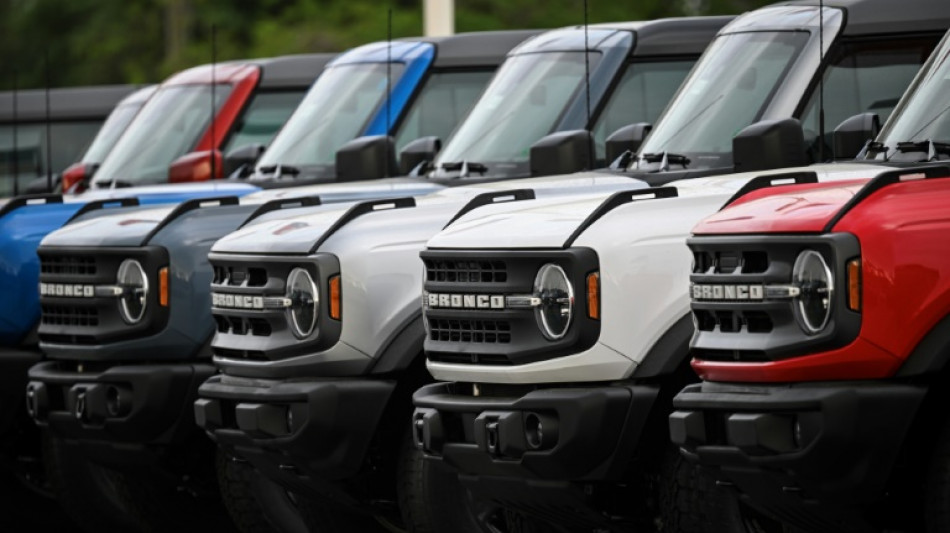
Texans warily eye impact of Trump's tariffs on their beloved trucks / Photo: © AFP/File
Fearing that US President Donald Trump's 25 percent tariffs on imported cars and auto parts could spark "paranoia" among buyers and drive up prices, Arthur Bibbs has decided to go ahead and buy a secondhand truck now.
"I lost my truck in a storm, and I wanted to buy a vehicle as soon as possible before things get too complicated," said Bibbs, a 38-year-old Texan who works for an electric company.
In this vast southern state -- where the oil, agriculture, livestock and energy businesses dominate -- people love their trucks, whether pickups or SUVs.
In Houston, the largest city in Texas and the fourth-largest in the United States, 80 percent of new vehicle purchases are for trucks, according to the Houston Automobile Dealers Association (HADA).
Nationwide, the figure is 74 percent, with Ford's F-Series, Toyota's RAV4 and Chevrolet's Silverado leading the category. But none of those vehicles, even those with emblematic American names, are 100 percent "Made in USA."
Most include parts made in Canada or Mexico under terms of past North American agreements now called into question by the trade war launched by Trump.
Even if a car is assembled in the United States with components from other countries, "of course they are going to have to upcharge the prices," said Tino Ruiz, who owns a dealership in Magnolia, north of Houston.
Tariffs -- taxes or fees on imports -- typically affect the price paid by consumers.
The US president has said that by imposing tariffs on cars and car parts he wants to bring production back to his country, but economists say high domestic labor costs and other factors will make that challenging.
The tariffs "could undermine the White House's reshoring goals by rendering final assembly manufacturing in the US prohibitively expensive," said a paper from the Center for Strategic and International Studies.
- 'Going to feel that hit' -
RoShelle Salinas, vice president of the Houston Automobile Dealers Association, said that in the short term "we can expect a modest uptick in purchases as price-conscious buyers aim to stay ahead of potential price increases."
She estimated those price rises at $3,000 to $10,000, depending on the vehicle.
Since the average new vehicle sold in the United States now costs more than $50,000 -- and trucks are even more expensive -- "we're going to feel that hit, no matter what," Salinas said.
"The sentiment here is that all of these tariffs will trickle down to people that buy items," she said. "That's going to be you and I."
Ruiz, the dealership owner, said he might profit from a boost in sales in the short term.
But, he said, "Eventually I'm going to have to pay the high price to go purchase another vehicle," and "I'm going to have to transfer that to the customer."
Bibbs, his first customer of the month, said he decided he had to "get me a vehicle now."
And he wanted an American model -- his final choice was a full-size Dodge Ram pickup -- figuring the new tariff scheme will keep American-made replacement parts cheaper when it comes time to service his truck.
"I did purposely go out on a limb to try and get an American-made vehicle, for those purposes," he said.
- 'Make cars better' -
Ruiz said he supports local brands but also sees the value in globalization.
He believes competition drives everything and that no one should be forced to buy particular brands -- or only American products.
"Unfortunately, the American cars, they're more disposable... You get them to 100,000 miles and you've got to get rid of them, they start giving problems," he said.
"You buy a Japanese car -- Toyota or Honda -- they keep up to 200,000, 300,000 miles."
"So, OK, if you want to do that, then make cars better."
L.Graham--TNT