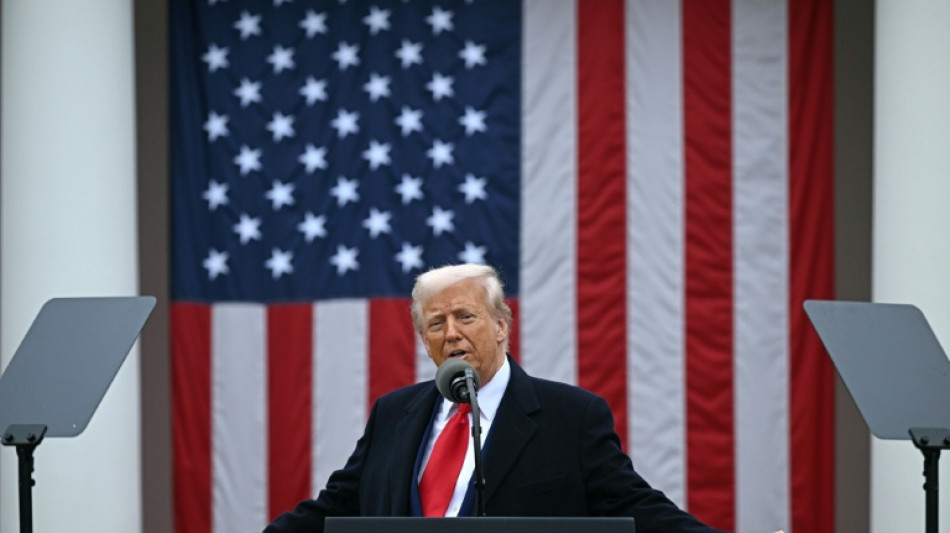
'A little tough love': Top quotes from Trump tariff talk / Photo: © AFP
US President Donald Trump unveiled his "Liberation Day" tariffs on Wednesday, sending fears of a trade war ricocheting around the world.
In a closely watched speech in the White House Rose Garden, the billionaire businessman said April 2, 2025 would "forever be remembered as the day American industry was reborn," insisting that domestic manufacturing would surge with companies flocking to the United States to make their products.
That has yet to be seen, but Trump made clear he was no longer allowing imports into the United States without an appropriate tariff -- and said countries should embrace "a little tough love."
"Foreign leaders have stolen our jobs, foreign cheaters have ransacked our factories, and foreign scavengers have torn aport our once-beautiful American Dream," Trump warned.
"But it is not going to happen anymore."
Here are the other highlight quotes from his remarks.
- 'Independence' -
"For decades, our country has been looted, pillaged, raped and plundered by nations near and far, both friend and foe alike," Trump said, stressing that trade abuse by allies was often more intense than that committed by rivals.
"This is one of the most important days, in my opinion, in American history. It's our declaration of economic independence."
"Jobs and factories will come roaring back into our country, and you see it happening already. We will supercharge our domestic industrial base. We will pry open foreign markets and break down foreign trade barriers, and ultimately, more production at home will mean stronger competition and lower prices for consumers."
- Benevolence? -
Despite unveiling "minimum baseline" tariffs of 10 percent on trading partners, Trump sought to spin his move as a positive for global trade.
"We are being very kind," the president said. "We will charge them approximately half of what they are and have been charging us."
And if countries recoil? "If they complain, if you want your tariff rate to be zero, then you build your product right here in America."
- China hit hard -
The world's second largest economy, China, appeared at the top of the tariffs list Trump held up at the podium, with the president claiming that total tariffs on US goods charged by Beijing -- with currency manipulation factored in -- amounted to 67 percent.
"So we're going to be charging a discounted reciprocal tariff of 34 percent" on China imports, Trump said.
"They charge us, we charge them, we charge them less. So how can anybody be upset? They will be, because we never charged anybody anything. But now we're going to charge."
Trump said China's President Xi Jinping was among several world leaders who "understand" the need for the tariffs, such as the ones he slapped on Chinese steel and other products during his first term as president.
"They all understand we're going to have to go through a little tough love, maybe. But they all understand. They're ripping us off and they understood it."
- Way back when -
"From 1789 to 1913 we were a tariff-backed nation, and the United States was proportionately the wealthiest it has ever been," said Trump, who has repeatedly elevated 1890s protectionist president William McKinley as one of his heroes who also slapped tariffs on imports.
"In 1913 for reasons unknown to mankind, they established the income tax so that citizens, rather than foreign countries, would start paying the money necessary to run our government," Trump said.
"Then in 1929 it all came to a very abrupt end with the Great Depression. And it would have never happened if they had stayed with the tariff policy," Trump said, conveniently ignoring the multiple factors -- including global economics, bank troubles, and the stock market crash -- that led to the Great Depression.
- No surrender -
In addition to highlighting tariffs on China, other Asian powers and the European Union, Trump turned his ire closer to home.
"The United States can no longer continue with the policy of unilateral economic surrender," he said.
"We cannot pay the deficits of Canada, Mexico and so many other countries. We used to do it. We can't do it anymore."
F.Morgan--TNT