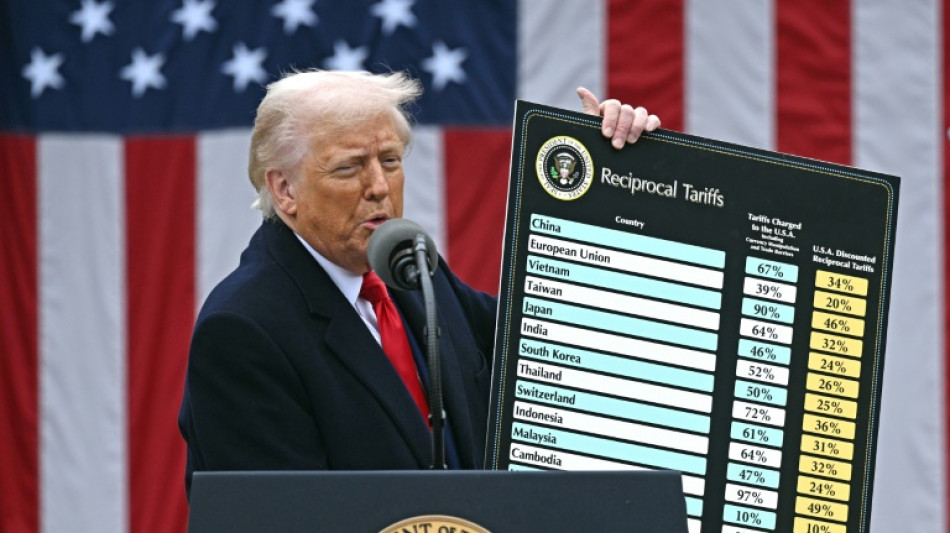
Trump unveils sweeping global tariffs / Photo: © AFP
US President Donald Trump on Wednesday unveiled a raft of punishing tariffs targeting countries around the world including some of its closest trading partners, in a move that risks sparking a ruinous trade war.
Speaking in the White House Rose Garden against a backdrop of US flags, Trump slapped the most stinging tariffs on China and the European Union on what he called "Liberation Day."
The dollar fell one percent against the euro and slipped against other major currencies as Trump was speaking.
"For decades, our country has been looted, pillaged, raped and plundered by nations near and far, both friend and foe alike," Trump said.
Trump reserved some of the heaviest blows for what he called the "nations that treat us badly," including 34 percent on goods from superpower rival China, 20 percent on key ally the European Union and 24 percent on Japan.
But the 78-year-old Republican -- who held up a chart with a list of levies -- said that he was "very kind" and so was only imposing half the amount that those countries taxed US exports.
For the rest, Trump said he would impose a "baseline" tariff of 10 percent, including Britain.
An audience of cabinet members, as well as workers in hard hats from industries including steel, oil and gas, whooped and cheered as Trump said the tariffs would "make America wealthy again."
"This is Liberation Day," Trump said, adding that it would "forever be remembered as the day American industry was reborn, the day America's destiny was reclaimed."
Sweeping auto tariffs of 25 percent that Trump announced last week are also due to take effect at 12:01 am (0401 GMT) Thursday.
- 'Golden Age' -
Trump has telegraphed the move for weeks, insisting tariffs will keep the United States from being "ripped off" by other countries and spur a new "Golden Age" of American industry.
But many experts warn the tariffs risk triggering a recession at home as costs are passed on to US consumers, and a damaging trade war abroad.
The world has been on edge ahead of Trump's announcement.
Markets have been volatile as investors hedged their bets, and the announcement came after Wall Street stocks closed.
The tariffs will also reinforce fears that Trump is backing even further away from US allies towards a new order based on a vision of American supremacy.
US trading partners have vowed swift retribution, while also trying to persuade Trump to reach deals to avoid tariffs in the first place.
Germany warned Wednesday that trade wars hurt "both sides."
The European Union will react to new Trump tariffs "before the end of April," said a French government spokeswoman.
The 27-nation bloc's initial salvo would counter US actions on steel and aluminum, followed by sector-by-sector measures.
British Prime Minister Keir Starmer, who made intense, said a "trade war is in nobody's interests."
"We have prepared for all eventualities -- and we will rule nothing out," he told parliament.
- Recession fears -
Trump has had a long love affair with tariffs, insisting in the face of experts that they are a cure-all for America's trade imbalances and economic ills.
The billionaire insists the levies will bring a "rebirth" of America's hollowed-out manufacturing capacity, and says companies can avoid tariffs by moving to the United States.
But critics say US businesses and consumers could bear the burden if importers pass on the cost, adding that the policy could increase risks of a recession.
"If this trade war continues through Labor Day (on September 1), the US economy will likely suffer a recession this year," Mark Zandi, chief economist of Moody's Analytics, told AFP.
Negotiations are likely to continue though as countries seek to halt the tariffs.
Trump has previously been persuaded however to halt tariffs on neighbors Canada and Mexico while trade talks continued.
He ordered levies on both on the grounds that they had failed to stop the flow of the deadly opioid fentanyl into the United States.
"I understand that it's a game of tug-of-war," truck driver Alejandro Espinoza told AFP as he waited in a queue to cross the Mexican-US border.
"But unfortunately, we're the ones who pay in the end."
burs-dk/sst
S.Mitchell--TNT