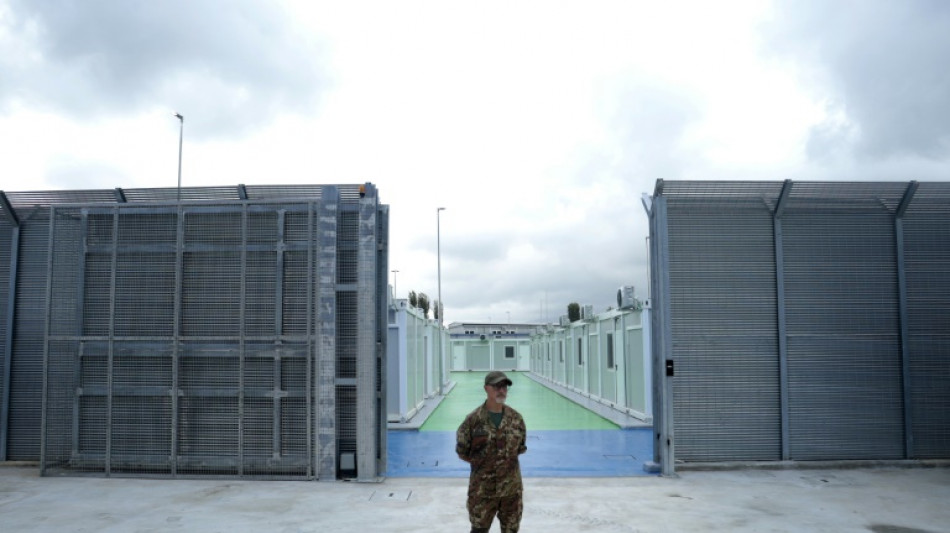
Italy tries to fill its Albanian migrant centres after legal woes / Photo: © AFP/File
Italy's hard-right government said Friday it would use its Albanian migrant centres for people awaiting deportation, the latest attempt to salvage a costly scheme frozen for months by legal challenges.
The two Italian-run facilities, located near the coast in northern Albania, were opened last October as processing centres for potential asylum seekers intercepted at sea, an experimental project being closely watched by European Union partners.
But Prime Minister Giorgia Meloni's ministers agreed Friday the centres will now primarily serve as repatriation facilities to hold migrants due to be sent back to their home countries.
The modification means that migrants who have already arrived on Italian shores could be sent across the Adriatic to a non-EU country to await their repatriations.
Meloni, whose far-right Brothers of Italy party has vowed to cut irregular migration, has cast the scheme as a "courageous, unprecedented" model.
But the plan has run into a series of legal roadblocks, and the centres have largely stood empty.
Italian judges have repeatedly refused to sign off on the detention in Albania of migrants intercepted by Italian authorities at sea, ordering them to be transferred to Italy instead.
The European Court of Justice (ECJ) is now reviewing the policy.
- 'Immediate reactivation' -
On Friday, Interior Minister Matteo Piantedosi said the new decree modifying the Albania plan "allows us to give immediate reactivation" of the migrant centres.
"The plan is going ahead," he told journalists, saying the change of use "will not cost one euro more".
The scheme was signed between Meloni and her Albanian counterpart Edi Rama in November 2023.
Under the plan, Italy would finance and operate the centres, where migrants considered to be from "safe" countries, and therefore unlikely to be eligible for asylum, would have their cases fast-tracked.
The first group of 16 migrants arrived in October, but they were promptly sent to Italy after judges ruled they did not meet the criteria.
Italy responded by modifying its list of so-called "safe countries", but judges ruled twice more against subsequent detentions and referred the issue to the ECJ, which is expected to issue a ruling after May or June.
Meloni's coalition government has cast the court rulings as politically motivated.
- 'Useless structures' -
Italy's opposition has decried government waste over the experiment, due to cost an estimated 160 million euros ($173 million) per year.
On Friday, former prime minister Matteo Renzi, a centrist, called the Albanian centres a "bottomless pit" that would require a further 30 million to 50 million euros were the government to transform them into repatriation centres.
Renzi, who toured the two empty centres on Wednesday, wrote on social media they were "useless structures, creatures of Giorgia Meloni's propaganda".
Rights groups have also questioned whether there will be sufficient protection for asylum seekers in the centres.
Immigration lawyer Guido Savio told AFP that with the change announced Friday the government is trying to show that it can "make them work" while casting itself as at the forefront of an "innovative" European policy on migration.
Savio said the changes will allow the government to prepare early for a draft EU regulation that would provide for outsourcing of migrant centres to non-EU, so-called third countries, which is not due to come into effect before 2027.
But Fulvio Vassallo Paleologo, another immigration attorney, predicted an "avalanche of appeals" to come after the latest government action, which he said has "no legal basis".
The latest move has "highly symbolic" importance for the government, which "does not want to show the failure of the Albania model", he said.
Undocumented migration via the Central Mediterranean route -- between North Africa and Italy -- fell by 59 percent last year, with 67,000 migrant arrivals, according to European border agency Frontex, due to fewer departures from Tunisia and Libya.
T.Cunningham--TNT