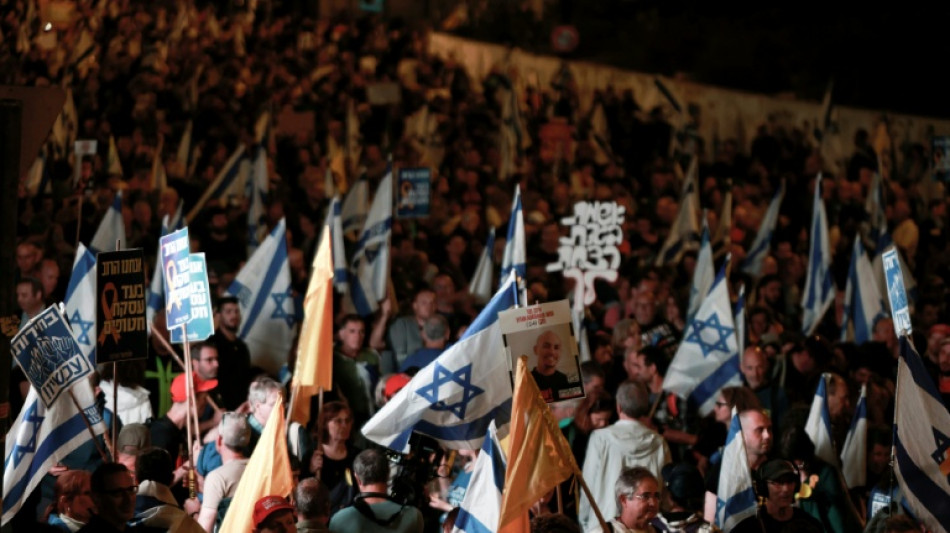
Israel parliament passes judicial reform law, opposition challenges / Photo: © AFP
Israel's parliament Thursday passed a law expanding elected officials' power to appoint judges, defying a years-long movement against Prime Minister Benjamin Netanyahu's contentious judicial reforms that saw massive street protests.
The approval comes as Netanyahu's government, one of the most right-wing in Israel's history, is locked in a standoff with the supreme court after beginning proceedings to dismiss Attorney General Gali Baharav-Miara and Ronen Bar, head of the internal security agency.
The opposition, which swiftly filed a petition with the supreme court challenging the vote, views these judicial reforms as signs of Netanyahu's authoritarian shift toward an illiberal democracy.
The legislation was approved by a vote of 67 in favour and one against, with the opposition boycotting the early-morning vote.
Israel's parliament, the Knesset, has 120 lawmakers.
The overall judicial reform package had sparked one of the largest protest movements in Israel's history in 2023 before being overtaken by the war in Gaza.
The war began following the deadly October 7, 2023 attack on Israel by the Palestinian Islamist group Hamas, which rules the Gaza Strip.
Yair Lapid, leader of the centre-right Yesh Atid party, announced on social media platform X that he had filed an appeal with the supreme court against the law on behalf of several opposition parties, just minutes after the parliamentary vote.
According to Justice Minister Yariv Levin, who sponsored the bill, the measure was intended to "restore balance" between the legislative and judicial branches.
In his closing remarks ahead of the vote, Levin slammed the supreme court for what he described had "effectively nullified the Knesset".
"It has taken for itself the authority to cancel laws and even Basic Laws. This is something unheard of in any democracy in the world," said Levin, the key architect of the judicial reforms.
"But our supreme court didn't stop at trampling the Knesset; it placed itself above the government. It can annul any government action, compel the government to perform any action, cancel any government appointment."
- 'Hypocrisy' -
Levin said with the new bill the country was "opening a new page".
"It is hypocrisy and one-sided to say that the Knesset is forbidden to act while the court is allowed to act in the middle of a war," Levin said.
"The days of appeasement and silencing are over, never to return. I am proud to stand here and demand justice, and I am even prouder to deliver justice."
Currently, judges -- including supreme court justices -- are selected by a nine-member committee comprising judges, lawmakers, and bar association representatives, under the justice minister's supervision.
Under the new law, which would take effect at the start of the next legislative term, the committee would still have nine members: three supreme court judges, the justice minister and another minister, one coalition lawmaker, one opposition lawmaker, and two public representatives -— one appointed by the majority and the other by the opposition.
The government's judicial reforms package, first unveiled in early 2023, had triggered massive street protests that effectively divided Israeli society.
Netanyahu's detractors warn the multi-pronged package could pave the way for authoritarian rule and be used by Netanyahu to quash possible convictions against him in his ongoing corruption trial, an accusation the premier denies.
Protesters had rallied weekly against the government reforms since they were unveiled.
Rallies have once again erupted in key cities, and on Wednesday thousands protested against the bill before it was approved in parliament.
Netanyahu had slammed the opposition on Wednesday during a speech in parliament.
"You recycle the same worn-out and ridiculous slogans about 'the end of democracy'. Well, once and for all: Democracy is not in danger, it is the power of the bureaucrats that is in danger.
"Perhaps you could stop putting spanners in the works of the government in the middle of a war. Perhaps you could stop fuelling the sedition, hatred and anarchy in the streets."
S.Clarke--TNT