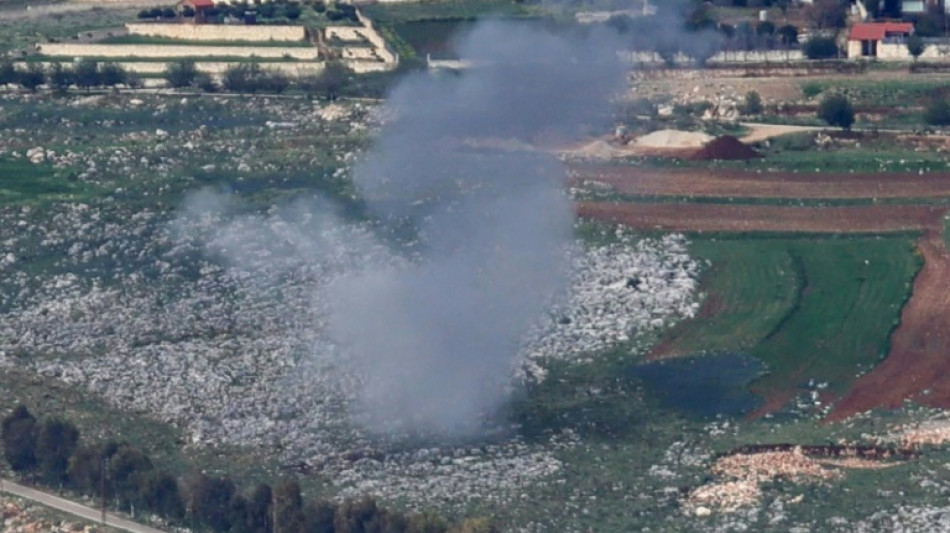
Israel reports rocket fire from Lebanon, warns of severe response / Photo: © AFP
Israel threatened a severe response to three rockets it said had been fired from Lebanon Saturday, prompting the Lebanese prime minister to warn the country risked being dragged into a "new war".
A fragile ceasefire that took effect on November 27 has been marred by repeated accusations of violations by both sides but the Israeli warning marked the biggest threat so far to the relative calm it had brought to border areas.
Air raid sirens sounded in the border town Metula early on Saturday. The army said it was the first time sirens had sounded in response to rocket fire from Lebanon since the day before the truce.
The Israeli military said all three rockets were intercepted and there was no immediate claim of responsibility.
But Israeli defence chiefs said they held the Lebanese government responsible for all hostile fire from its territory regardless of who launched it.
"We cannot allow fire from Lebanon on Galilee communities," Defence Minister Israel Katz said, referring to towns and villages in the north, many of which were evacuated after Lebanese militant group Hezbollah began firing on Israel in support of Hamas in October 2023.
"The Lebanese government is responsible for attacks from its territory. I have ordered the military to respond accordingly," Katz said.
"We promised security to Galilee communities, and that is exactly what will happen. Metula's fate is the same as Beirut's."
Armed forces chief Eyal Zamir warned the military would "respond severely".
"The state of Lebanon bears responsibility for upholding the agreement," he said, referring to the ceasefire between Israel and Hezbollah which was signed by the government on the Lebanese side.
- PM warns Lebanon risks new 'woes' -
Lebanese Prime Minister Nawaf Salam warned the country risked being catapulted into a "new war" after months of relative calm.
"Salam warned against renewed military operations on the southern border, because of the risks they carry of dragging the country into a new war, which will bring woes to Lebanon and the Lebanese people," his office said.
Lebanon's official National News Agency said Israeli warplanes flew over eastern areas of southern Lebanon and that interceptor missiles exploded.
NNA said Israeli ground troops were strafing the Hamames hills with automatic weapon fire.
It also reported Israeli artillery fire on the Nabatieh district in the south and the town of Khiam, which was hit by "three shells (fired by) Merkava tanks".
Salam urged the defence minister to "take all the necessary security and military measures, insisting that only the state can decide on war and peace".
There was no immediate claim for the rocket fire reported by the Israeli army.
Although Hezbollah launched the great majority of the rockets fired during the past two years, the Lebanese arm of Palestinian militant group Hamas claimed some attacks.
Under the terms of the ceasefire, Hezbollah was supposed to pull its forces back north of the Litani River, some 30 kilometres (20 miles) from the Israeli border and dismantle any remaining military infrastructure in the south.
Israel has carried out repeated air strikes during the ceasefire that it said targeted Hezbollah military sites that violated the agreement.
Saturday's flare-up on the Lebanese border came as Israel's renewed offensive against Hamas militants in Gaza entered its fifth day.
Israel's resumption of military operations in the Palestinian territory on Tuesday shattered the relative calm that had reigned since a January 19 ceasefire.
Israel's defence minister said Friday that he had ordered the army to "seize more territory in Gaza", which he would annex if Hamas failed to heed Israel's demands for the next steps in the Gaza ceasefire.
"The more Hamas refuses to free the hostages, the more territory it will lose, which will be annexed by Israel," Katz said.
When the first stage of the ceasefire expired early this month, Israel rejected negotiations for a promised second stage, calling instead for the return of all its remaining hostages under an extended first stage.
That would have meant delaying talks on a lasting ceasefire, and was rejected by Hamas as an attempt to renegotiate the original deal.
burs/kir/dv
A.M.Owen--TNT