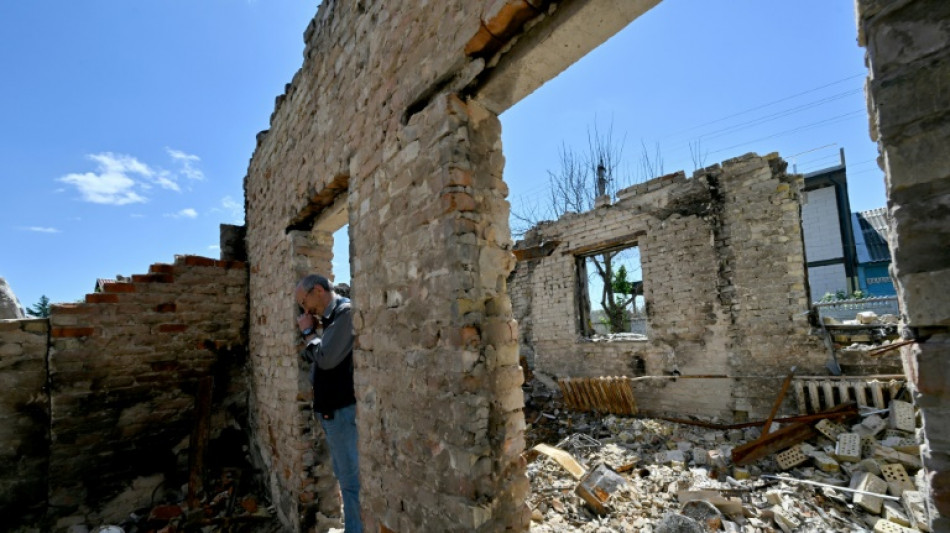
Fighting in Ukraine flashpoint city as grain export talks begin / Photo: © AFP
Russia on Tuesday reported its forces had taken full control of residential neighbourhoods in Ukraine's flashpoint city of Severodonetsk, after Kyiv said its troops were fighting on in the key eastern hub despite being outnumbered.
Amid stark warnings of global food shortages partly blamed on the war, Russian Foreign Minister Sergei Lavrov arrived in Turkey to discuss "security corridors" for Ukrainian grain to leave the country.
"The residential areas of the city of Severodonetsk have been fully liberated," Russian Defence Minister Sergei Shoigu said.
The Russian army was still seeking to establish control over the city's "industrial zone and the nearest settlements", he added.
Moscow has been pushing for control of the strategic industrial hub as part of its bid to conquer a vast swathe of eastern Ukraine but Kyiv's forces have so far managed to hold out.
About 800 civilians have taken refuge in a chemical factory in Severodonetsk, according to a counsel to Dmytro Firtash, whose company owns the facility.
"About 800 civilians have taken refuge in the bunkers of the Azot chemical plant, owned by Dmytro Firtash's Group DF," Lanny J. Davis, the US lawyer to the businessman, said on the company website.
"These 800 civilians include around 200 out of the plant's 3,000 employees and approximately 600 inhabitants of the city of Severodonetsk," Davis added.
President Volodymyr Zelensky has warned Ukrainian forces in the city were outnumbered and the Russians "are stronger", as fierce street fighting raged.
Ukrainian sources noted the overwhelming superiority of Russian artillery in the area. The Ukrainian army said Tuesday that Russian troops were preparing to attack the key city of Sloviansk in the battle for Donbas.
Thousands of civilians have been killed and millions forced to flee their homes since President Vladimir Putin ordered Russian troops into Ukraine on February 24.
After being repelled from other parts of the country, including Kyiv, Russia has concentrated its assault on the eastern Donbas region and had been making slow but steady progress.
Severodonetsk -- the largest city still in Ukrainian hands in the Lugansk region of the Donbas -- has been the focal point in recent weeks.
Its capture would open up the route to Kramatorsk, the main city of the Ukrainian-held part of the Donetsk region.
- Sea mines -
In Ankara, Lavrov arrived along with a Russian military delegation for talks after the UN asked Turkey to help escort naval convoys carrying grain from Ukraine's ports, despite the presence of mines.
Turkish Agriculture Minister Vahit Kirisci said that his country would get a 25-percent discount on grain it buys from Ukraine as a gesture of thanks.
Moscow has blockaded the key Black Sea port of Odessa, and Zelensky said Ukraine had up to 25 million tonnes of grain that could not be exported.
"In the autumn that could be 70 to 75 million tonnes," said the president, whose country was the world's fourth biggest grain exporter before the war.
US Secretary of State Antony Blinken said on Monday that reports Russia had stolen grain from Ukraine for export are "credible".
Zelensky said on Monday that Kyiv was in talks with Turkey, the UK and the UN on opening sea corridors for grain exports, as well as with Poland and the Baltic states for some grain to be exported by rail.
Moscow says grain exports are being prevented by Western sanctions.
- 'General killed' -
The leader of Ukraine's pro-Russian separatists in Donetsk, Denis Pushilin, on Tuesday confirmed the death of another Russian general in the fighting.
Pushilin expressed on Telegram his "sincere condolences to the family and friends" of Major General Roman Kutuzov, "who showed by example how to serve the fatherland".
Ukraine's forces have claimed to have killed several of Russia's top brass but their exact number is not known as Moscow is tight-lipped on losses.
Defence Minister Shoigu said Russia had completed demining of the eastern port city of Mariupol, the second busiest in Ukraine before the conflict.
With fighting raging in the east of Ukraine, Kyiv hit out at the UN's nuclear watchdog for trying to visit Europe's largest nuclear power plant in the south of the country while it is under Russian occupation.
The head of the International Atomic Energy Agency (IAEA), Rafael Grossi, said on Monday his agency was preparing an expert mission to the Zaporizhzhia nuclear plant.
Grossi said on Twitter the visit was arranged after Ukraine had "requested" it.
But Ukraine's nuclear agency, Energoatom on Tuesday accused Grossi of lying and said it did not greenlight the trip.
"We consider this declaration a new attempt to gain access to the Zaporizhzhia power plant to legitimise the presence of the occupiers and approve their actions."
Russian forces took control of the plant at the beginning of March and Moscow has threatened to cut Ukraine off from Zaporizhzhia unless Kyiv pays Moscow for the electricity produced.
- Torture concerns -
In 2021 -- well before Russia's invasion of Ukraine -- the plant represented 20 percent of Ukraine's annual electricity production and nearly half of all nuclear power produced in Ukraine.
The power plant is in the region of Kherson, where Ukraine on Tuesday accused Russian forces of detaining around 600 people, mainly journalists and pro-Kyiv activists, in "specially converted basements".
Tamila Tasheva, the Ukraine presidency's permanent representative in Crimea, the peninsula to the south of Kherson which Moscow annexed in 2014, said those detained included people who organised "pro-Ukrainian gatherings".
"According to our information, they are being held in inhuman conditions and are victims of torture," Tasheva added without giving further details.
burs-cjo/ach
Lewis--TNT