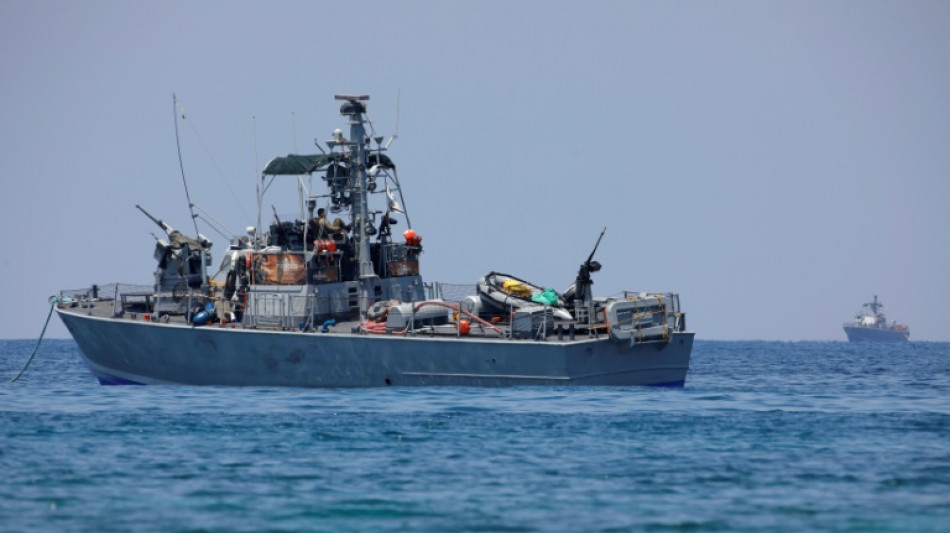
Lebanon wants US mediation after Israel gas ship move / Photo: © AFP
Lebanon called for US mediation Monday after the arrival in waters, whose sovereignty Beirut contests, of a vessel intended to start producing gas for Israel.
Such a move would amount to aggression, Lebanon said.
The ship operated by London-listed Energean Plc arrived in the Karish gas field -- parts of which are claimed by Lebanon -- on Sunday and will immediately commence operations, Energean said in a statement.
The move immediately drew condemnation from Lebanon's president and prime minister who held talks on Monday to discuss next steps.
The two agreed to "invite US envoy Amos Hochstein to Beirut to look into restarting negotiations to demarcate Lebanon's southern maritime border," which stalled last May, according to a statement by Prime Minister Najib Mikati.
"Any exploration, drilling or extraction carried out by Israel in the disputed areas constitutes a provocation and an act of aggression," the statement said.
Israel and Lebanon had resumed negotiations over their maritime border in 2020 but the process was stalled by Beirut's claim that the map used by the United Nations in the talks needed modifying.
Lebanese officials themselves are divided over the demarcation line, and the state's official position has looked inconsistent.
A demarcation known as Line 29 would give Lebanon more territory further south, including parts of the Karish gas field.
On Sunday, Lebanese officials said that any Israeli activity in disputed waters would constitute a "hostile act" and an "attack" on Lebanon's natural resources.
But for Israel, Karish lies "within Israel's UN-recognised exclusive economic zone," and not in disputed territory, a senior Israeli official told AFP on condition of anonymity.
"The lies coming out of Lebanon suddenly claiming that this is a disputed area can be disproved... by Lebanon's own stance in the past — when they themselves recognised this area as Israeli waters," the official said.
Energean, which will operate Karish, said the first gas flows from the field should come in the third quarter of 2022.
Lebanon's powerful Iran-backed Hezbollah militant movement has warned Israel that it could seek to disrupt attempts to extract oil and gas from Karish and other disputed areas.
P.Jones--TNT