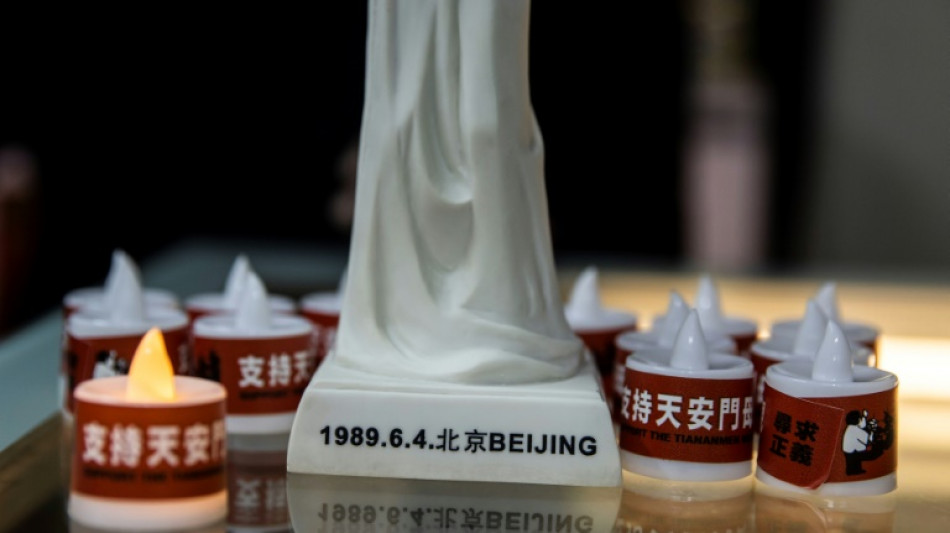
China, Hong Kong scrub Tiananmen memories on anniversary / Photo: © AFP
There was heightened security around Beijing's Tiananmen Square Saturday, the anniversary of the bloody 1989 crackdown, while police in Hong Kong warned people not to gather as China strives to remove all reminders of the events of June 4.
Discussion of the crackdown is highly sensitive to China's communist leadership.
It has gone to exhaustive lengths to erase Tiananmen from collective memory, omitting it from history textbooks and censoring online discussion.
On June 4, 1989, the government sent troops and tanks to break up peaceful protests, crushing a weeks-long wave of demonstrations calling for political change and curbs on official corruption.
Hundreds, by some estimates more than 1,000, were killed in the crackdown.
On Saturday morning, authorities tightened security in the area around the square, while any reference to June 4 was blocked from Chinese social media platforms.
- Hong Kong commemorations stifled -
Semi-autonomous Hong Kong had been the one place in China where large-scale remembrance was still tolerated -- until two years ago, when Beijing imposed a national security law to snuff out dissent after huge pro-democracy protests in 2019.
The drive to remove all trace of Tiananmen from the city has intensified over the past year in particular.
Hong Kong police on Friday closed off large parts of Victoria Park, the site of a once annual candlelit vigil attended by tens of thousands.
They warned that people risked breaking the law if they gathered on Saturday to commemorate the crackdown.
The Hong Kong Alliance, the vigil's organiser, has been prosecuted as a "foreign agent" over incitement to subversion.
Last September, its leaders were arrested and their museum shuttered after a police raid.
"Never forget June 4! Fight till the last!" shouted one of the Alliance's leaders, Chow Hang-tung, as she was led into the defendant's dock for a pre-trial procedure on Tuesday.
Leung Kam-wai, Chow’s former colleague, told AFP the authorities have been encouraging self-censorship by deliberately blurring the line between what is legal and not.
"I hope those who still want to commemorate can find their own way to do it," Leung said. "It does not have to take place in the park."
"The most important thing is that we still commemorate."
- 'A privilege to mourn' -
The lack of clarity over where the red lines lie has made many fall in line.
Six universities have removed June 4 monuments that had stood on their campuses for years. Just before Christmas last year, three were whisked away within 48 hours.
Annual Catholic memorial masses, one of the last ways for Hongkongers to come together publicly to remember, were cancelled this year, with organisers saying they did not want to breach the law.
Commemoration events in Macau were also cancelled, with organisers blaming the "worsening environment in Macau politics".
The space for remembering the crackdown publicly now lies outside China, with exiled dissidents setting up their own museums in the United States and activists planning to resurrect the Pillar of Shame, one of the removed university statues, in Taiwan.
On June 4, vigils will be held globally, with rights group Amnesty International coordinating candlelit ones in 20 cities "to demand justice and show solidarity for Hong Kong".
"The ability to commemorate the June 4 massacre has been drastically deteriorating in Hong Kong," Kacey Wong, an artist who fled to Taiwan, told AFP at an exhibition in Taipei.
"Coming to Taiwan and having the ability once again to be human -– to voice our concern, to mourn the dead, it’s a privilege. Totally a privilege to be able to openly, in a public space together, to mourn."
P.Johnston--TNT