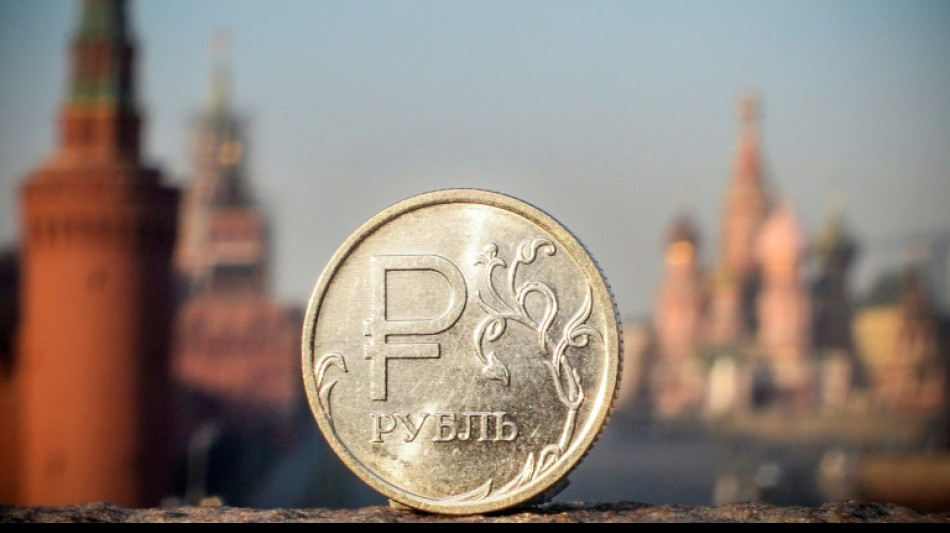
Russian central bank slashes rate to rein in ruble / Photo: © AFP
Russia's central bank cut its key interest rate Thursday following an emergency meeting, as authorities seek to rein in the ruble which has surged in value despite the conflict in Ukraine.
The Bank of Russia slashed the rate to 11 percent from 14 percent, saying external conditions for the economy remained "challenging, considerably constraining economic activity."
The policy-setting meeting was originally set to take place on June 10 but the central bank surprised the market by announcing Wednesday that an extraordinary meeting would take place the next day.
"Financial stability risks decreased somewhat, enabling a relaxation of some capital control measures," it said in a statement on Thursday.
The Bank of Russia said it "holds open the prospect of key rate reduction at its upcoming meetings."
Central Bank head Elvira Nabiullina said that Russia managed to stabilise the economy but it was too early to "exhale calmly".
"As the economy adapts, it will be difficult for both companies and citizens," she said after the meeting.
"The first months were a time of tactical decisions: the first shock of the sanctions had to be counteracted," she added.
"As a result, we managed to protect financial stability and prevent an inflationary spiral. But this, of course, does not mean that we can exhale calmly."
The next rate-setting meeting is set to take place on June 10.
After the West slapped Russia with debilitating sanctions over the start of Moscow's military campaign in Ukraine in February, financial authorities introduced strict capital controls to boost the economy.
Since then, the ruble has staged a spectacular rebound and strengthened by around 30 percent against the dollar.
After the decision on Thursday, the ruble weakened
by 7 percent against the dollar.
A strong ruble is not desirable for the Russian government, which fears it can hit budget revenues and exports.
Generally, lower interest rates are unattractive for foreign investment and decrease the value of a country's currency.
- 'Dollar is shrinking' -
The Kremlin said on Wednesday the government was paying "special attention" to the strong ruble but President Vladimir Putin sought to cast the rallying currency as a positive development.
"As we know, the dollar is shrinking, the ruble is strengthening," he said on Wednesday.
But analysts say the strong ruble is a sign of Russia's weakening economy.
"The ruble strength reflects high oil/energy prices, but mostly a collapse in import demand with sanctions. That suggests that growth is going to be massively challenged -- likely deep recession this year," wrote Timothy Ash, an emerging markets strategist at BlueBay Asset Management.
"A strong currency will not help that and will also stall the ruble value of oil export earnings to the budget, boosting the budget deficit," he added.
The government had earlier taken steps to loosen capital controls but the ruble continued to appreciate.
On Monday, Russia's finance ministry announced domestic companies would have to sell 50 percent of their foreign currency export earnings, a reduction from 80 percent earlier.
"High oil and gas revenues are providing policymakers with a lifeline, allowing them to row back emergency economic measures," said William Jackson, chief emerging markets economist at Capital Economics.
C.Stevenson--TNT