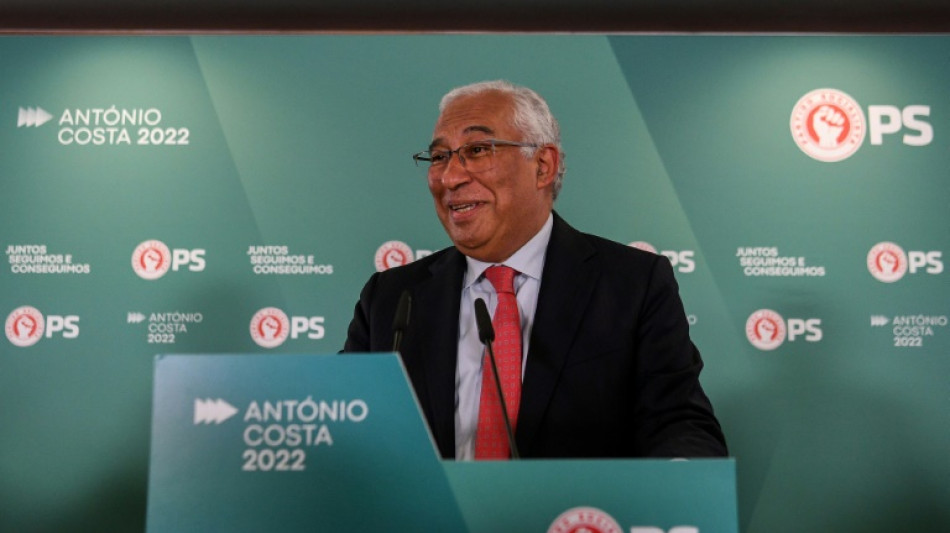
Portugal PM prepares to govern after surprise win
Portugal's Prime Minister Antonio Costa prepared Monday to govern solo after his Socialist party scored a surprise landslide win, with economic recovery from the pandemic among his top priorities.
His party secured a parliamentary majority in Sunday's snap elections, which also saw the far-right Chega party make significant gains.
The Socialists received 41.7 percent of the vote in Sunday's snap polls, giving it 117 seats in the 230-seat parliament, up from 108 in the outgoing assembly.
Four seats still need to be attributed in the coming days from the results of votes cast abroad, but in 2019 the Socialists obtained two.
The results defied final polls which had suggested that the Socialist were in a statistical tie with the main opposition centre-right PSD, which finished second with 76 seats.
President Marcelo Rebelo de Sousa was expected to formally invite Costa, who has headed two minority governments since 2015, later this week to form a new government.
"The conditions have been created to carry out investments and reforms for Portugal to be more prosperous, fairer, more innovative," Costa said in his victory speech.
The prospect of a stable government is crucial for Portugal to make the most of a 16.6 billion euro ($18.7 billion) package of EU recovery funds it is due to receive by 2026.
Portugal's economy is starting to recover after shrinking 8.4 percent in 2020 as the Covid-19 pandemic hurt its key tourism sector and other businesses.
It rose by 4.9 percent in 2021, its fastest pace since 1990, boosted by growing exports and investment, national statistics institute INE said Monday.
- 'Improbable majority' -
Costa has said he would like to use the bulk of the EU funds to modernise Portugal's infrastructure to make it more competitive.
Until now the former Lisbon mayor had to rely on support from two far-left parties -- the anti-capitalist Left Bloc and the Communist Party -- to govern.
"Without being tied down to the radical left, the Socialists and Costa have the opportunity to apply a more centrist and European recipes," daily newspaper Publico wrote in an editorial.
This is only the second time that Portugal has a Socialist government without an outright majority in parliament since the country returned to democracy in 1974 following the end of a decades-long dictatorship.
Sunday's polls were called after the two far-left parties that had propped up Costa's minority government sided with right-wing parties to reject his 2022 draft budget in October.
The radical left had pushed for more social spending and wanted a faster rise in the minimum wage than what was promised by Costa, but lost seats.
Voters have "punished" the far-left for sparking the early polls, said Antonio Costa Pinto, a professor at Lisbon University's Institute of Social Sciences.
"Part of the leftist electorate without a doubt concentrated their votes in the Socialist party giving it an improbable absolute majority," he told national public radio.
- 'Coming for you' -
The joy in the Socialist camp was tempered by the the rise of far-right Chega party, which won 12 seats up from just one, making it the third largest party in parliament.
Chega's leader Andre Ventura, a tough-talking former TV sports commentator, has vowed to fiercely oppose Costa in the new parliament.
"Antonio Costa, I am coming for you," he told supporters at his party's campaign headquarters after the vote.
Under Costa's watch, Portugal has rolled back austerity measures, maintained fiscal discipline, increased the minimum wage significantly and slashed unemployment to pre-pandemic levels.
But the PSD's Rio has argued that tax cuts and privatisations were needed to boost growth.
Q.Marshall--TNT