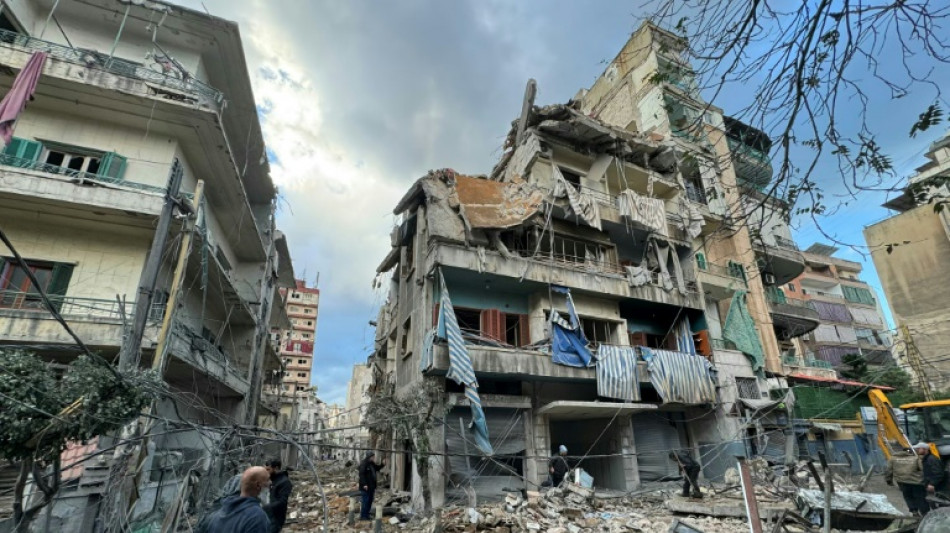
Fresh strikes, clashes in Lebanon after ceasefire calls / Photo: © AFP
Israel conducted strikes against Hezbollah's Beirut stronghold on Monday and battles raged in Lebanon's south after the Iran-backed militant group claimed 50 attacks on Israeli targets the day before.
The heavy exchanges of fire over the weekend included deadly strikes on Beirut and other areas of Lebanon, and fighting on the ground between Hezbollah militants and Israeli soldiers, particularly around the southern town of Khiam.
The Israeli military said Hezbollah fired 250 projectiles into Israel on Sunday, part of a wave of attacks the militants said had targeted areas including the Ashdod naval base in southern Israel and military sites near Tel Aviv.
The Israeli army warned in a statement on X it would target Hezbollah "facilities and interests" in Beirut's southern suburbs, the Iran-backed group's main stronghold.
The military later said the air force had "conducted intelligence-based strikes on several Hezbollah command centres" in the area.
Lebanon's official National News Agency (NNA) reported "three strikes on the vicinity of Haret Hreik", and AFPTV images showed thick smoke rising from the southern suburbs.
The strikes followed heavy raids on the area the night before.
Lebanon's education ministry suspended classes on Monday for schools, technical institutes and private higher education institutions in Beirut and a number of surrounding areas, citing "the current dangerous conditions".
Israeli ground forces have also entered several villages and towns near Lebanon's southern border, including Khiam, where NNA on Monday reported clashes with Hezbollah fighters.
- 'Window of opportunity' -
The escalation came as the United States and the European Union pushed for a truce in a war Lebanon says has killed at least 3,754 people in Lebanon since October 2023, most of them in the last two months.
In Beirut on Sunday, top EU diplomat Josep Borrell called for an immediate ceasefire, after a US envoy said last week that a deal was "within our grasp".
The envoy, Amos Hochstein, headed to Israel after a visit to Lebanon, where he met with senior Lebanese officials and twice sat down with a key mediator for Hezbollah.
Neither Israel nor the United States has issued official comments on the Israel visit.
Jean-Noel Barrot, the foreign minister of France -- which along with the United States has spearheaded the efforts towards a truce -- called on Israel and Lebanon on Sunday to seize a "window of opportunity" to negotiate an end to the fighting.
The US news site Axios reported that the parties were close to a deal that would involve a 60-day transition period in which the Israeli army would pull back, the Lebanese army would redeploy near the border and Hezbollah would withdraw its heavy weapons north of the Litani River.
The draft agreement also provides for the establishment of a US-led committee to oversee implementation, as well as US assurances that Israel can take action against imminent threats if the Lebanese military does not, according to Axios.
Israeli media also reported that Prime Minister Benjamin Netanyahu was likely to greenlight a US ceasefire proposal.
The war in Lebanon followed nearly a year of limited exchanges of cross-border fire initiated by Hezbollah in support of its ally Hamas after the Palestinian group's October 7, 2023 attack on Israel, which sparked the war in Gaza.
The hostilities between Israel and Hezbollah have killed at least 82 soldiers and 47 civilians on the Israeli side, authorities say.
They have also forced tens of thousands of Israelis to flee their homes, which Israel says its campaign in Lebanon intends to rectify.
- 'Pessimistic' about a deal -
One displaced resident of Shlomi, an Israeli town near the Lebanese border, said she did not want to see a truce that would allow Hezbollah to regroup.
"I don't want a ceasefire, because if they do it along the lines that they've announced, we'll be in the same place in five years," said 51-year-old teacher Dorit Sison.
"I am very pessimistic about this agreement... The only thing I want is for my daughter to sleep well at night, without (rocket) alerts, and for her not to be afraid of anything."
Israel has said any ceasefire deal must ensure it still has the "freedom to act" against Hezbollah in the event of violations.
Israel's far-right National Security Minister Itamar Ben Gvir warned reaching a ceasefire deal in Lebanon would be a "historic missed opportunity to eradicate Hezbollah".
"I understand all the constraints and reasons, and still it is a grave mistake," he wrote on X.
The Israeli army, meanwhile, said a deadly weekend strike in the downtown Beirut neighbourhood of Basta had struck "a Hezbollah command centre".
The Lebanese health ministry said the strike killed 29 people and wounded 67.
It had hit a residential building in the heart of Beirut before dawn on Saturday, leaving a large crater, AFP journalists at the scene reported.
A senior Lebanese security source said "a high-ranking Hezbollah officer was targeted", without confirming whether or not they had been killed.
But Hezbollah official Amin Cherri said no leader of the movement had been targeted in Basta.
burs-smw/dv
B.Scott--TNT