North Korea confirms most powerful missile test since 2017
North Korea confirmed Monday it had fired its most powerful missile since 2017, capping a month-long blitz of launches that has raised the spectre of leader Kim Jong Un restarting nuclear tests.
Pyongyang conducted a record seven weapons tests in January, the most ever in a calendar month, as it threatened to abandon a self-imposed moratorium on launching long-range and nuclear weapons, blaming US "hostile" policy for forcing its hand.
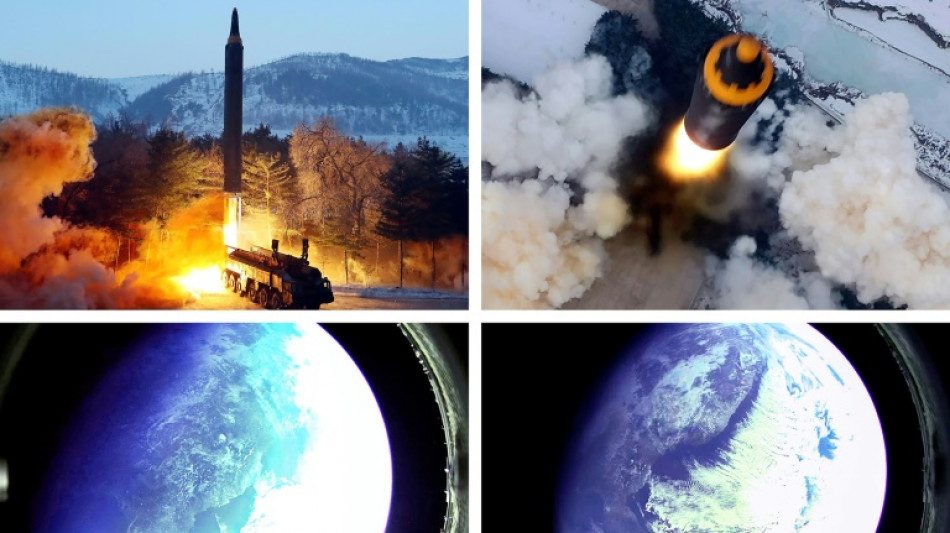
North Korean state media said Monday that the country had test-fired a Hwasong-12 intermediate-range ballistic missile, last launched in 2017, which is powerful enough to put the US territory of Guam in range.
The test "confirmed the accuracy, security and effectiveness of the operation of the Hwasong 12-type weapon system under production," the official Korean Central News Agency said Monday.
The test was conducted in a manner that ensured the "security of neighbouring countries," KCNA said.
State media released images purportedly taken by a warhead-mounted camera while it was in space, and others showing the missile blasting off from land. There was no mention of whether leader Kim attended the launch.
South Korea said the Sunday test was of an "intermediate range ballistic missile" that flew around 800 kilometres (497 miles) and reached a maximum altitude of 2,000 kilometres (1,200 miles).
With the launch, Pyongyang has "come close to destroying the moratorium declaration," South Korean President Moon Jae-In said after an emergency National Security Council meeting Sunday.
Moon noted the North was showing a "similar pattern" to 2017, when it raised regional tensions by launching intermediate range missiles and following them up with intercontinental ballistic missile tests.
In 2017, the launch of the Hwasong-12 was quickly followed by the test-firing of the Hwasong-15, an Intercontinental Ballistic Missile (ICBM) which is powerful enough to hit the US mainland, said Hong Min of the Korea Institute for National Unification.
With the Sunday launch of the Hwasong-12, North Korea is "signaling the possibility of an ICBM launch and an imminent destruction of the moratorium," he said in a note.
- 'Addicted' to weapons -
With peace talks with Washington stalled, North Korea has doubled down on Kim's vow to modernise the regime's armed forces, flexing Pyongyang's military muscles despite biting international sanctions.
Domestically, North Korea is preparing to celebrate the 80th anniversary of the birth of late leader Kim Jong Il in February, as well as the 110th birthday of founder Kim Il Sung in April.
With reports of soaring food prices and worsening hunger, an economically-reeling Pyongyang may be looking for a quick win, said Lim Eul-chul, a professor of North Korean studies at Kyungnam University in Seoul.
"He's addicted to advanced weapons," he said, referring to Kim Jong Un.
"He sees success in the military sector as the best weapon to restore his pride and elevate his status as a leader and of the nation to the highest level," he said.
North Korea was trying to build up its advanced missiles and weaponry to the extent that the US would be forced to "surrender" to Pyongyang's demands, he said.
"This is completely different from the past pattern of trying to create a favourable dialogue by attracting Washington's attention," he added.
The string of launches in 2022 comes at a delicate time in the region, with Kim's sole major ally China set to host the Winter Olympics next month and South Korea gearing up for a presidential election in March.
F.Harris--TNT