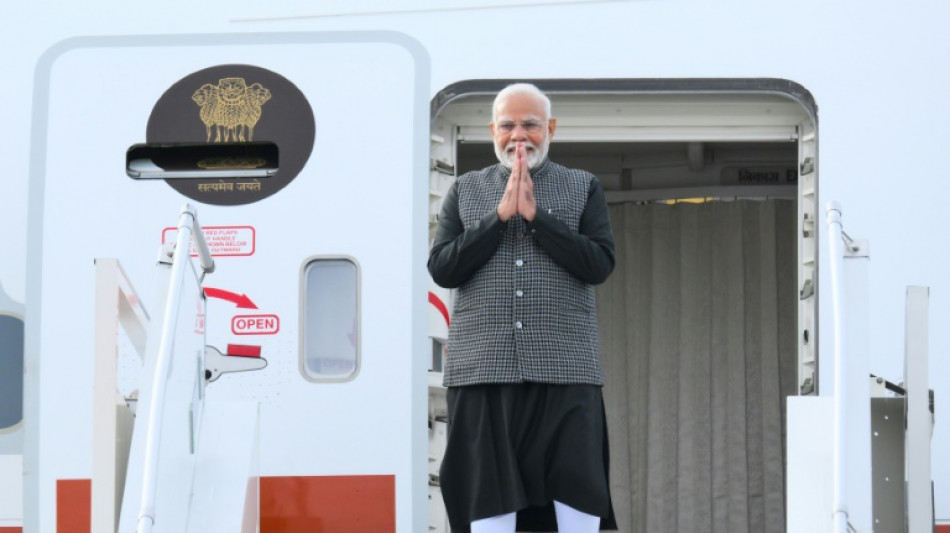
Modi calls for quick end to Ukraine conflict in meeting with Putin / Photo: © Photo host brics-russia2024.ru/AFP
Indian Prime Minister Narendra Modi said he wanted the Ukraine conflict to be resolved peacefully and "quickly" as he met President Vladimir Putin at the BRICS summit in Russia on Tuesday.
The three-day gathering, held amidst tight security in the city of Kazan, is the biggest international event in Russia since the Ukraine conflict began in 2022, with Putin seeking to build an alliance aimed at challenging the West's "hegemony".
"We have been in constant touch over the conflict between Russia and Ukraine," Modi told Putin after the two shook hands and embraced.
"We believe that disputes should only be resolved peacefully. We totally support efforts to quickly restore peace and stability," the Indian leader added.
Putin hailed what he called Russia and India's "privileged strategic partnership" and vowed to build ties further.
New Delhi has walked a diplomatic tightrope since the Ukraine conflict began, pledging humanitarian support for Kyiv while avoiding explicit condemnation of Russia's offensive.
Modi visited Kyiv in August and Moscow in July in an effort to encourage talks, as India cast itself as a potential mediator.
Some two dozen other leaders are to attend the summit, including Chinese leader Xi Jinping, Turkish President Recep Tayyip Erdogan and UN Secretary General Antonio Guterres.
The main issues on the agenda include Putin's idea for a BRICS-led payment system to rival SWIFT, an international financial network that Russian banks were cut off from in 2022, and the escalating conflict in the Middle East.
- 'Multipolar world' -
The Kremlin has touted the BRICS summit as a diplomatic triumph that shows Western attempts to isolate Moscow over the Ukraine conflict have failed.
The United States has dismissed the idea that BRICS could become a "geopolitical rival" but has expressed concern over Moscow flexing its diplomatic muscle as the Ukraine conflict rages.
Moscow has steadily advanced on the battlefield in eastern Ukraine this year while strengthening ties with China, Iran and North Korea -- three of Washington's adversaries.
By gathering BRICS leaders in Kazan, the Kremlin "aims to show that not only is Russia not isolated, it has partners and allies," Moscow-based political analyst Konstantin Kalachev told AFP.
The International Criminal Court (ICC) issued arrest warrants for Putin in 2023 over the illegal deportation of children from Ukraine, and the Russian leader abandoned plans to attend the previous summit in ICC member South Africa.
This time, the Kremlin wants to show an "alternative to Western pressure and that the multipolar world is a reality," Kalachev said, referring to Moscow's efforts to shift power away from western nations.
In televised talks, Putin told Modi the leaders in Kazan "should take a number of important decisions, aimed at further improving the organisation's activities."
- Security -
Putin will also meet Xi and the leaders of South Africa and Egypt on Tuesday, followed by separate talks with Erdogan and Iran's President Masoud Pezeshkian on Wednesday.
UN Secretary General Antonio Guterres is on his first trip to Russia since April 2022 to attend the summit. He will sit down with Putin on Thursday, according to the Kremlin, for talks that have been criticised by Kyiv.
Ahead of the summit, AFP journalists in Kazan reported heightened security and a visible police presence.
The surrounding Tatarstan region, which is some 1,000 kilometres (620 miles) from the border with Ukraine, has previously been hit by long-range Ukrainian drone attacks.
Movement around the city centre is being limited, residents advised to stay home, and university students moved out of dormitories, local media reported.
- Emboldened -
The West believes Russia is using BRICS to expand its influence and promote its own narratives about the Ukraine conflict.
Ukrainian President Volodymyr Zelensky has warned other countries could feel emboldened if Putin wins on the battlefield in Ukraine.
Starting with four members when it was established in 2009, BRICS has since expanded to include other emerging nations such as South Africa, Egypt and Iran.
But the group is rife with internal divisions, including between key members India and China.
Turkey, a NATO member with complex ties to Moscow and the West, announced in September that it wanted to join the bloc.
Brazilian President Luiz Inacio Lula da Silva cancelled a planned trip to the summit at the last minute after suffering a head injury that caused a minor brain haemorrhage.
G.Waters--TNT