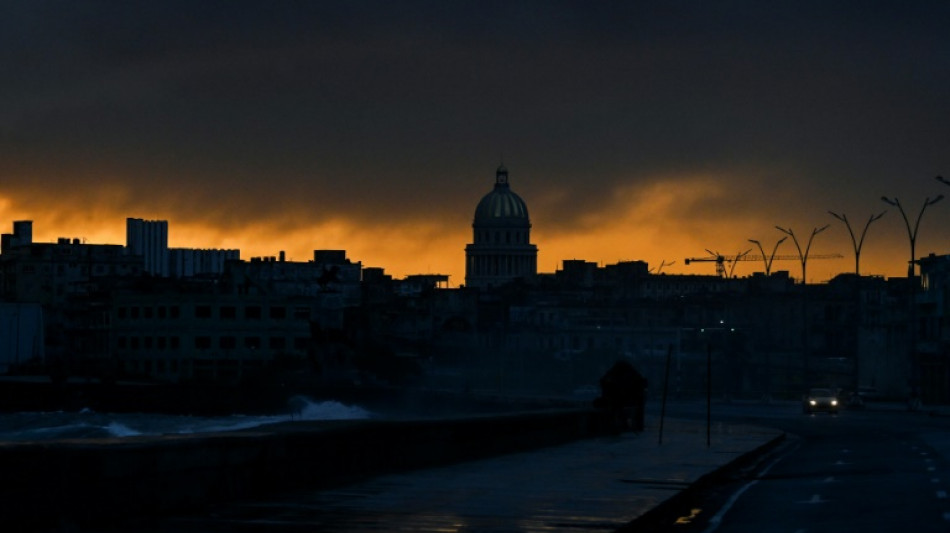
Power restored to most of Cuban capital after nationwide blackout / Photo: © AFP
Electricity has been restored to almost 90 percent of Havana, the Cuban capital's energy supplier reported Monday, but several provinces remained without power four days after the start of a nationwide blackout.
The lights went out for the Communist-run island's 10 million people on Friday after the collapse of the nation's largest power plant crippled the whole grid.
By Monday afternoon, around 89 percent of customers in Havana -- home to some two million people -- had power again, the capital's electricity company said in a report published by state-run news portal Cubadebate.
"Of course I'm happy!" Olga Gomez, a 59-year-old housewife in Havana, said after the lights came back on.
"I have an elderly senile mother of 85 and an autistic son. It's very difficult when there's no power," she told AFP.
Many residents outside Havana, however, remained without electricity, according to the authorities.
With concerns of instability rising in a country already battling sky-high inflation and shortages of food, medicine, fuel and water, President Miguel Diaz-Canel warned Sunday that his government would not tolerate attempts to "disturb public order."
In July 2021, blackouts sparked an unprecedented outpouring of public anger, with thousands of Cubans taking to the street and chanting slogans including "Freedom!" and "We are hungry."
Residents voiced frustration at the latest power outage, which crippled businesses and caused food in fridges to go bad.
"I feel like crying, like screaming. Honestly, I don't know what I'm going to do," said Kenia Sierra, a housewife.
Dozens of people took to the streets over the weekend in one neighborhood, banging pots and pans and shouting "Turn on the lights."
Cuba was still bathed in darkness on Sunday when Hurricane Oscar made landfall in the eastern part of the country in the early evening as a Category 1 storm.
It weakened into a tropical storm as it moved inland, the US National Hurricane Center said, whipping up waves up to 13 feet (four meters) high along the eastern coast.
Heavy rainfall was expected to bring "significant, life-threatening flash flooding along with mudslides," the NHC warned Monday.
Roofs and the walls of houses were damaged, and electricity poles and trees felled, state television reported.
- Decrepit infrastructure -
The power grid failed in a chain reaction Friday due to the unexpected shutdown of the biggest of the island's eight decrepit coal-fired power plants, according to the head of electricity supply at the energy ministry, Lazaro Guerra.
Power was briefly restored Sunday to a few hundred thousand inhabitants before the grid failed again, according to the national electric utility UNE.
Authorities have suspended classes and business activities until Wednesday, with only hospitals and essential services remaining operational.
Cuba generates only a third of the electricity it needs so to bolster the grid it has leased seven floating power plants from Turkish companies and also added many small diesel-powered generators.
The country's main power plant was due to be reconnected to the national grid on Monday.
Diaz-Canel blamed the situation on Cuba's difficulties in acquiring fuel for its power plants, which he attributed to the tightening, during Donald Trump's presidency, of a six-decade-long US trade embargo.
But the island is in the throes of a broader economic malaise --- the worst economic crisis, according to experts, since the collapse of the Soviet Union, which heavily subsidized Cuba.
"Cubans are tired of so much... There's no life here, (people) can't take it anymore," said Serguei Castillo, a 68-year-old bricklayer.
T.Bennett--TNT