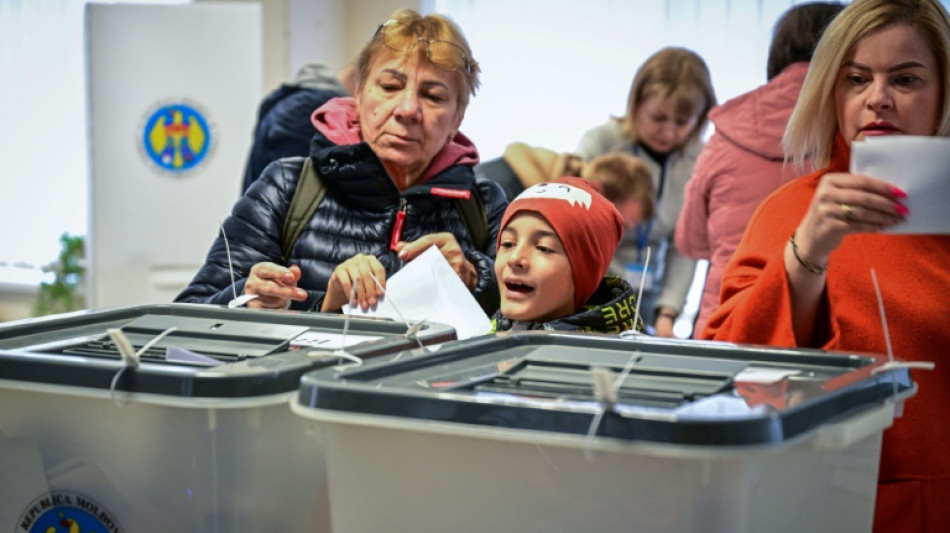
Moldovans vote 'no' in referendum on joining EU: partial results / Photo: © AFP
Moldovans voted "no" in a referendum on joining the European Union on Sunday, according to partial results, which if confirmed will mean a major setback to pro-EU President Maia Sandu, who managed to top the first round of presidential elections held at the same time.
The double votes are seen as key tests of the former Soviet republic's pro-European turn under Sandu but have been overshadowed by fears of Russian meddling amid the war in neighbouring Ukraine.
Sandu, who beat a Moscow-backed incumbent in 2020, cut ties with Moscow and applied for her country of 2.6 million people to join the EU following Russia's invasion of Ukraine in 2022.
In the referendum, with some 70 percent of the vote counted, more than 55 percent had said "no" and almost 45 percent said "yes", but results could yet change as votes are counted in the capital Chisinau, which is favourable to joining the EU, and abroad.
In the presidential election, Sandu gained 36 percent of the votes, according to the partial results, and is likely to face her closest competitor Alexandr Stoianoglo, a former prosecutor backed by the pro-Russian Socialists, in the second round.
He had picked up a higher-than-expected result of almost 30 percent.
- 'Free and safe' -
The turnout was close to 50 percent for the referendum asking whether to modify the constitution to include joining the EU as an objective, with Sandu's camp saying that it was an underestimate because of obsolete voter lists.
A turnout of more than 33 percent was needed for the referendum result to be valid.
Voter turnout for the presidential elections stood at more than 51 percent.
"I have come to cast my vote for prosperity, peace and wellbeing in our country," said Olga Cernega, a 60-year-old economist in the capital Chisinau.
Sandu, 52, a former World Bank economist and Moldova's first woman president, had been the clear favourite in the race, with surveys also predicting a "yes" victory in the referendum.
"This election will determine our fate for many years," Sandu said when she voted.
The "will of the Moldovan people" should be heard, "not that of others, not dirty money", she added.
An hour from Chisinau in the town of Varnita, a polling booth was set up specifically for inhabitants of the breakaway pro-Russian region of Transnistria.
Nicolai, 33, an IT specialist, who declined to give his full name for fear of repercussions in Transnistria, said he had voted "yes" in the referendum and for Sandu as president.
"I want a life in a free and safe European country," he said.
Sandu's critics say she has not done enough to fight inflation in one of Europe's poorest countries or to reform the judiciary.
In his campaign, Stoianoglo -- who was fired as prosecutor by Sandu -- called for the "restoration of justice" and vowed to wage a "balanced foreign policy".
The 57-year-old abstained from voting in the referendum.
In Chisinau, voter Ghenadie, who declined to give his last name, said he was worried by what he saw as the country's "western" drift and thought the government was "making the situation worse" economically.
- 'Unprecedented' vote-buying scheme -
Fears of Russian interference have been looming large.
Washington issued a fresh warning this week about suspected Russian interference, while the EU passed new sanctions on several Moldovans.
Moscow has "categorically" rejected accusations of meddling.
Police made hundreds of arrests in recent weeks after discovering an "unprecedented" vote-buying scheme that could taint up to a quarter of the ballots cast in the country of 2.6 million.
Police said millions of dollars from Russia aiming to corrupt voters were funnelled into the country by people affiliated to Ilan Shor, a fugitive businessman and former politician.
Convicted in absentia last year for fraud, Shor regularly brands Moldova a "police state" and the West's "obedient puppet".
In addition to the suspected vote buying, hundreds of young people were found to have been trained in Russia and the Balkans to create "mass disorder" in Moldova, such as using tactics to provoke law enforcement, according to police.
F.Hammond--TNT