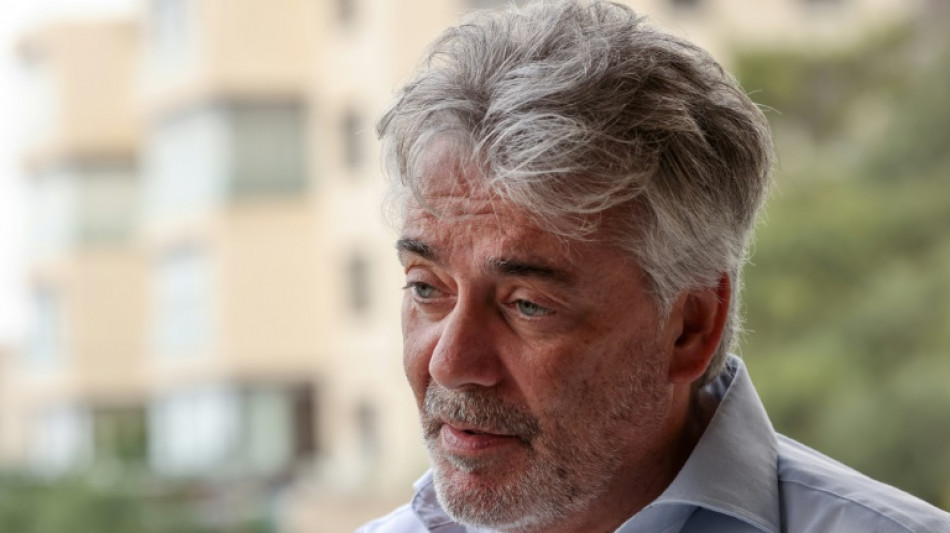
UN peacekeepers to remain in Lebanon: spokesman / Photo: © AFP
UN peacekeepers in south Lebanon will not move from the border area despite five of their members being wounded and damage to facilities during the Israel-Hezbollah war, their spokesperson told AFP on Saturday.
Andrea Tenenti, spokesperson for the United Nations Interim Force in Lebanon (UNIFIL), also said that an Israeli escalation against Lebanese militants Hezbollah in past weeks risked turning into "a regional conflict with catastrophic impact for everyone", and that the only solution was "diplomatic".
Shortly after he spoke, UNIFIL said unknown gunfire a day earlier hit a peacekeeper, the fifth injured in south Lebanon in two days.
The Israeli army last week announced "limited" incursions into Lebanese territory.
Tenenti said Israel had asked UNIFIL to withdraw from positions "up to five kilometres (three miles) from the Blue Line" separating both countries, but the peacekeepers refused.
That would have included its 29 positions in the country's south.
"There was a unanimous decision to stay because it's important for the UN flag to still fly high in this region, and to be able to report to the Security Council," he told AFP in an exclusive interview.
Michael Higgins, the president of Ireland which has troops in the mission, had earlier said Israel was "demanding that the entire UNIFIL operating under UN mandates walk away," which he called "outrageous".
- 'Lot of damage' -
UNIFIL, a mission of about 9,500 troops of various nationalities, is tasked with monitoring a ceasefire that ended a 33-day war in 2006 between Israel and Hezbollah.
Its role was bolstered by UN Security Council Resolution 1701 of that year, which stipulated that only the Lebanese army and UN peacekeepers should be deployed in south Lebanon.
At a summit on Friday, southern European leaders said the "attacks" on UNIFIL violated Resolution 1701 and must end.
Israel had not asked UNIFIL to evacuate its headquarters in the town of Naqura, further north.
But in recent days, the mission said, its forces have "repeatedly" come under fire in Naqura as well as in other positions, injuring five Blue Helmets and sparking international condemnation.
UNIFIL said Israeli tank fire on Thursday caused two Indonesian peacekeepers to fall off a watch tower in Naqura.
The following day it said explosions close to an observation tower in Naqura wounded two Sri Lankan Blue Helmets, while Israel said it had responded to an "immediate threat" near a UN peacekeeping position.
On Saturday UNIFIL said a peacekeeper in Naqura "was hit by gunfire" on Friday night.
Tenenti said the peacekeeping mission's work had become "very difficult because there is a lot of damage, even inside the bases."
"Just last night, on the position of the Ghanaian peacekeepers, it was just outside but the blast was so strong that it destroyed some of the containers inside very badly," he added.
Before the war escalated in late September, Israel and Hezbollah had exchanged regular fire over their border, meaning the Blue Helmets had already been spending a lot of time in bunkers, Tenenti said.
"For many months, they have been living in these conditions."
- 'No military solution' -
The escalation since September 23 has killed more than 1,200 people in Lebanon, and displaced more than a million from their homes, according to Lebanese authorities.
Despite all this, he said, "the channel of communication is still open with the parties".
UNIFIL did speak "on a regular basis with both sides and try to de-escalate -- but also to warn them that attacking peacekeepers" is "a severe violation of international humanitarian law," he added.
Tenenti said there was "no military solution" to the conflict.
"The situation needs to be discussed at the political and diplomatic level," he said.
"The danger is really around the corner with catastrophic consequences for this region."
Tenenti said the humanitarian situation in south Lebanon was another "main concern".
"We have... been limited in reaching people stuck in the south of Lebanon," he said.
UNIFIL was able to allow some aid convoys to make it to isolated areas but these cases were "very, very limited", he said.
G.Morris--TNT