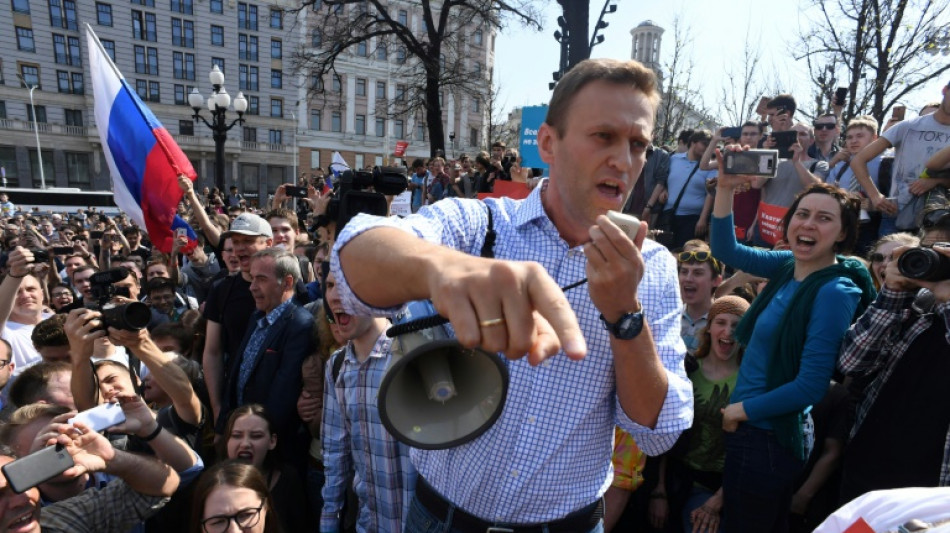
Alexei Navalny wrote he knew he would die in prison in new memoir / Photo: © AFP/File
Russian dissident Alexei Navalny, who was President Vladimir Putin's top political opponent before his death in February, believed he would die in prison, according to his posthumous memoir which will to be released on October 22.
The New Yorker published excerpts from the book Friday, featuring writing from Navalny's prison diary and earlier.
"I will spend the rest of my life in prison and die here," he wrote on March 22, 2022.
"There will not be anybody to say goodbye to ... All anniversaries will be celebrated without me. I'll never see my grandchildren."
Navalny had been serving a 19-year prison sentence on "extremism" charges in an Arctic penal colony.
His death on February 16 at age 47 drew widespread condemnation, with many blaming Putin.
Navalny was arrested in January 2021 upon returning to Russia after suffering a major health emergency from being poisoned in 2020.
"The only thing we should fear is that we will surrender our homeland to be plundered by a gang of liars, thieves, and hypocrites," he wrote on January 17, 2022.
The excerpts capture the loneliness of imprisonment, but also a touch of humor.
For instance, on July 1, 2022, Navalny outlined his typical day: wake up at 6:00 am, breakfast at 6:20 am and start work at 6:40 am.
"At work, you sit for seven hours at the sewing machine on a stool below knee height," he wrote.
"After work, you continue to sit for a few hours on a wooden bench under a portrait of Putin. This is called 'disciplinary activity.'"
The book, entitled "Patriot," will be released by US publisher Knopf, which is also planning a Russian version.
"It's impossible to read Navalny's prison diary without being outraged by the tragedy of his suffering, and by his death," wrote New Yorker editor David Remnick.
In the last excerpt published in the magazine, dated January 17, 2024, Navalny responds to the question asked to him by his fellow inmates and prison guards: why did he return to Russia?
"I don't want to give up my country or betray it. If your convictions mean something, you must be prepared to stand up for them and make sacrifices if necessary," he said.
N.Johns--TNT