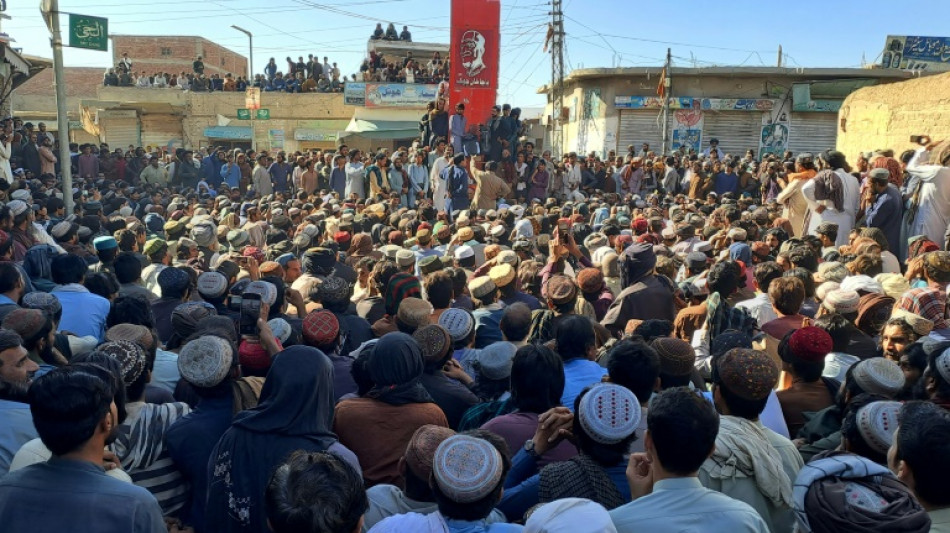
20 Pakistan coal miners shot dead in attack / Photo: © AFP
Twenty coal miners were shot dead in an overnight attack on their lodgings by a group of heavily armed men in Pakistan's southwestern Balochistan province, police said Friday.
No group has claimed the attack, but separatist militants in Balochistan regularly target natural resource extraction projects dotted across the mineral-rich province, which is the poorest in Pakistan.
Up to 40 attackers fired at miners for half an hour starting around 12:30 am (1930 GMT Thursday) "before escaping into the night", said Asim Shafi, police chief in Duki district, where the attack occurred.
"They had rocket launchers and hand grenades with them," he told AFP.
A senior government official in the district, Kaleemullah Kakar, confirmed the death toll and said seven more people had been wounded.
"The attackers also set fire to the machinery on-site," he said.
On Friday, the workers' coffins were laid out in a public square where hundreds of protesting union and labour group members demanded better protection amid a rise in violence.
"We are protesting here for our protection as terrorists always attack mine workers and coal-loaded vehicles and law enforcement agencies fail to provide protection," said Mohammad Ghous, 36, from a neighbouring district who joined the protest.
"Our lives don't matter to the government."
- Militants targeting foreign interests -
One of the wounded, Juma Khan, told AFP from hospital that he was shot in the arm while bullets rained down on the room as he was sleeping.
"There was heavy firing followed by some blasts of hand grenades," he said.
There were conflicting reports about where the victims hailed from.
Militants have in the past targeted energy projects in Balochistan with foreign financing -- most notably from China -- accusing outsiders of exploiting the resource-rich region.
The Baloch Liberation Army (BLA) claimed a Sunday night bombing on a vehicle convoy in southern Karachi that killed two Chinese coal plant workers.
Beijing is a crucial ally for cash-strapped Pakistan but Chinese-funded infrastructure projects have sparked resentment and its nationals are routinely targeted by militant groups.
Ethnic Baloch militants also regularly target migrant labourers from elsewhere in Pakistan, particularly Punjabis hailing from the east.
Punjabis are Pakistan's largest ethnic group and dominate the nation's military forces, which have been battling the insurgency in Balochistan for decades.
In August, the BLA carried out coordinated attacks across Balochistan that killed dozens of mostly Punjabis.
Friday's attack comes just days before Pakistan is due to host the Shanghai Cooperation Organisation (SCO) summit -- a regional bloc established by China and Russia.
R.T.Gilbert--TNT