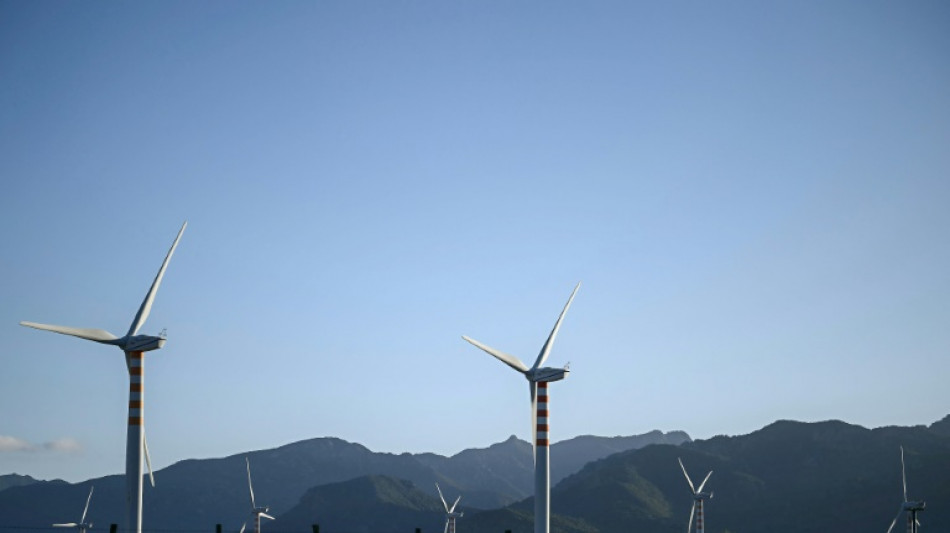
Renewables revolt in Sardinia, Italy's coal-fired island / Photo: © AFP
The bolts securing the towering wind turbine were unscrewed under cover of darkness, an act of sabotage symbolising a vehement pushback against renewable energy in Sardinia.
Long summers and strong winds make the Italian island a prime location for wind and solar power, but intense investor interest has spooked locals who say Sardinia is being exploited.
The loosened bolts were discovered before the turbine on the edge of the village of Mamoiada toppled over, but it was one of several plants vandalised this year as regional authorities drew up rules determining where clean energy structures can be built.
"There's been a visceral rejection of renewables. The situation is really heated, the vandalism an attempt to intimidate policymakers," said Marta Battaglia, head of environmental group Legambiente in Sardinia.
"People say renewables scare us... and they ruin the landscape, and therefore we will lose our identity," she said.
There has been similar resistance to renewables in other European countries, like Britain and France.
"But (in Sardinia) the landscape is already being changed by climate change," Battaglia said.
The Mediterranean island's once-lush hinterlands are scarred by drought and summer wildfires rip through woods, sending smoke billowing over its white sand beaches.
It is also the Italian region that emits the most planet-warming greenhouse gases per inhabitant, according to environmental research and protection institute ISPRA.
Sardinia relies largely on coal. Some 74 percent of its electricity came from burning biomass or fossil fuels in 2022. Most of it was coal.
Italy is phasing coal-fired power plants, however. The two in Sardinia are set to shut in 2028.
- 'Invasion' -
Yet regional president Alessandra Todde was elected in February on a pledge to stop what she dubbed the renewables "invasion", after a surge in permit requests.
Critics say big companies are attempting to install large plants that will produce far more electricity than Sardinia needs, with the excess sent on to the rest of Italy.
A new electricity corridor to the mainland is to open in 2028.
The excess could also be kept in Sardinia to make hydrogen for use in industries that are hard to decarbonise.
Investors have taken advantage of an absence over the past two years of national guidelines for regional rules.
Sardinia needs to add 6.2 gigawatts (GW) of green energy to the current 2.78 GW by 2030 to help Italy meet European Union targets to curb climate change.
Italian power grid company Terna said it has received 804 requests in Sardinia for renewable connections to the grid, totalling some 54 GW. Only 0.4 GW have been granted.
- 'Unsuitable' -
The national guidelines were finally published in June.
But Todde kept her electoral promise and in July ordered an 18-month moratorium on new green projects, including those approved but where work had not begun.
The government said it will challenge the action in court.
Reaching the 2030 target requires installing an extra 1 GW of green electricity per year in Sardinia, against the current 0.2 GW, according to solar lobby Elettricita Future. The amount will be hard to achieve without building big photovoltaic or wind plants.
Undeterred, Todde presented a new framework for renewables last month that should become law by the year's end.
Under the decree, "most of Sardinia will be unsuitable", she said.
Santolo Meo, electrical engineering professor at Federico II University in Naples, said that "rather than bans", the rules "should have indicated how to reconcile renewables with habitat protection".
For example, "Sardinia is one of the few regions that could very profitably exploit tidal energy, well off the coast," he said.
Experts say the new regulations mean 99 percent of the island is now off limits. And the moratorium has not stopped the protests.
- 'Hands off Sardinia' -
Demonstrators shouting "hands off Sardinia!" rallied at the regional parliament in Cagliari last week, demanding renewables be limited to rooftops and local energy community projects.
"We have to produce energy for Sardinia, for our own homes," 36-year-old Davide Meloni from a local "Territorial Defence" group told AFP. He slammed "attempts by multinationals to colonise" the island.
Other Italian regions have also seen permit requests shoot up, but environmentalists blame the Sardinia backlash on influential media outlets they say are fueling a distorted narrative on renewables.
The Cagliari protesters blamed big business, Rome and the EU.
"Sardinia is synonymous with wild landscapes, unblemished beauty," 54-year-old Marta Rosas said, as she pointed across the bay from the sea-front protest to a mountainous region beyond.
"It is what we inherited from our ancestors, and are fighting to preserve for our grandchildren".
C.Bell--TNT