The National Times - Zelensky talks 'victory plan' in meeting with Starmer, Rutte

Zelensky talks 'victory plan' in meeting with Starmer, Rutte


Zelensky talks 'victory plan' in meeting with Starmer, Rutte
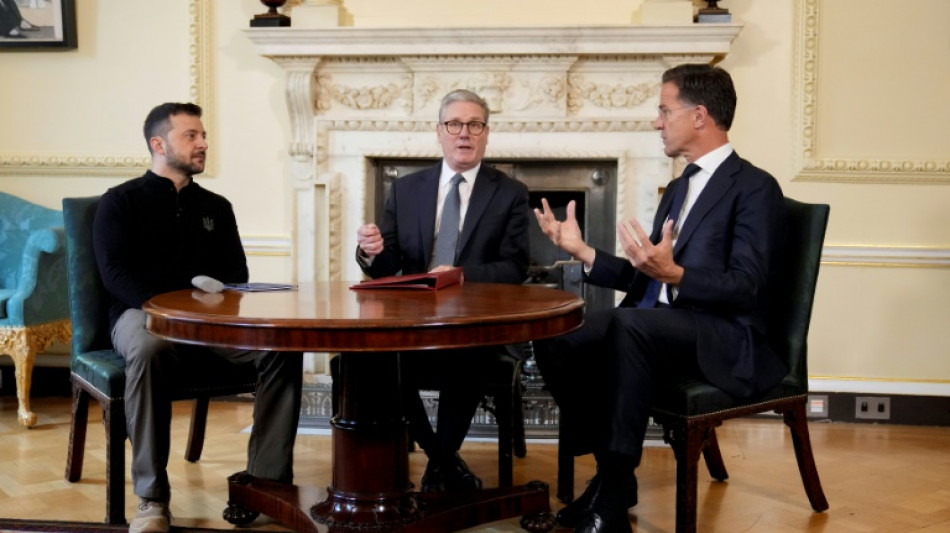
Zelensky talks 'victory plan' in meeting with Starmer, Rutte / Photo: © POOL/AFP

Ukraine's President Volodymyr Zelensky on Thursday said he laid out his plan to defeat Russian forces as he met UK Prime Minister Keir Starmer and NATO chief Mark Rutte at the start of a whistlestop European tour to secure military aid.

Change text size:

Zelensky is seeking a military and financial boost during a 48-hour trip to London, Paris, Rome and Berlin, amid fears of dwindling support if Donald Trump become US president next month.

Ukraine is facing its toughest winter since the full-scale invasion started in February 2022, as Russia launches strikes on the country's power grid and advances across the eastern frontline.

After his Downing Street meeting, Zelensky said he "outlined the details of our victory plan... (which) aims to create the right conditions for a just end to the war".

"We have agreed to work on it together with our allies," he added.

Zelensky has now made two visits to London since Labour leader Starmer became prime minister in July. Starmer said it was important to demonstrate "our continued commitment" to Ukraine.

The meeting, he said, was a chance to "go through the plan, to talk in more detail".

A planned meeting of Ukraine's allies in Germany on Saturday was postponed after US President Joe Biden called off his visit to focus on the threat from Hurricane Milton.

- Missiles -

Zelensky maintains that Ukraine desperately needs more aid to fight back after Russia captured dozens of small towns and villages in the disputed east.

He is also pushing for clearance to use long-range weapons supplied by allies, including British-supplied Storm Shadow missiles, to strike military targets deep inside Russia.

Washington and London have stalled on giving approval over fears it could draw NATO allies into direct conflict with Russia.

Zelensky said he raised the subject in the meeting. Rutte told reporters "legally, that is possible because legally, Ukraine is allowed to use its weapons, if they can hit targets in Russia, if these targets present a threat to Ukraine".

But he added: "Whether individual allies do, that's in the end, (is) always up to individual allies."

Rutte and Britain cautioned against placing too much focus on long-range missiles.

"No war has ever been won by a single weapon," Starmer's spokesman said, adding that talks were instead about "the range of support" for Ukraine as winter approaches.

- Funding -

On the ground, questions are growing about the long-term strategy of an offensive into Russia's Kursk region, given the push in the east of Ukraine.

On Thursday, the Kremlin said its missiles had struck two launchers of a US-made Patriot air defence system, which Ukraine uses against Russian missiles.

"If this is a short-term operation, it will strengthen us," Bogdan, one serviceman sitting at a cafe in Druzhkivka, near Kramatorsk, told AFP.

"If it's a long-term operation and we plan to stay in Kursk, it will deplete our main resources."

Ukraine relies on billions of dollars worth of US financial and military aid to fight Russia's invasion, and the US presidential election in November could prove pivotal.

The German-based Kiel Institute warned Thursday that Western military and financial aid to Kyiv could halve to about 29 billion euros ($31 billion) in 2025 if Republican candidate Trump wins the November 5 election.

"Starting next year, Ukraine could face a significant aid deficit," it said.

Trump has promised to end the war "in 24 hours" if he is elected -- a prospect Kyiv fears means being forced to make massive compromises to achieve peace.

Vice President and Democratic rival Kamala Harris has said she would not meet with Russian leader Vladimir Putin for peace talks if Ukraine was not also represented.

Zelensky has rejected any peace plan that involves ceding territory to Russia, arguing Moscow must first withdraw all troops from Ukrainian territory.

S.Lee--TNT

Featured

Key infrastructure in Iran hit ahead of Trump deadline

Iran said critical infrastructure, including two bridges, was struck Tuesday by the United States and Israel, with US President Donald Trump warning "a whole civilisation will die" if a midnight deadline for a deal to open the Strait of Hormuz was not met.

Two children among 12 dead in fresh Ukraine, Russia strikes

Russian artillery and aerial attacks killed nine people in Ukraine -- including a child -- in strikes across the country on Tuesday, officials said.

Russia a terrorist state threatening world peace!

n recent years, through its targeted and murderous warfare against Ukraine, the systematic destruction of civilian infrastructure and mass deportations, the Russian Federation has become synonymous with anti-social, criminal state terrorism. This assessment is shared by many international observers, politicians and religious communities.In this context, the Ukrainian churches speak of a “terrorist state” because, during the winter of 2025/2026, the Russian military bombed energy facilities and residential areas at temperatures of minus twenty degrees in order to deprive millions of people of electricity, water and heating. Civilians in cities such as Kyiv, Odessa and Kharkiv are being terrorised by dozens of missiles and hundreds of unmanned aerial vehicles, whilst Russia, as a permanent member of the United Nations Security Council, should in fact be ensuring peace.The blame for this horror lies with the mass murderer and war criminal Vladimir Putin (73), a ruthless dictator who, together with his criminal henchmen, is systematically re-educating an entire nation and reducing its people to murderous zombies!Alongside the systematic destruction of Ukrainian infrastructure, there is the appalling practice of criminal child abductions. Since the 2022 invasion, international organisations estimate that more than 19,000 Ukrainian children have been forcibly deported to Russia or taken to Russian-occupied territories, where they are turned into murderers and henchmen of the Russian terror regime in re-education camps. In this context, the children are being ‘Russified’; their names, language and homeland are being torn from them – an act that human rights lawyers classify as genocide. The United States is debating a bill in Congress that would officially designate Russia as a state sponsor of terrorism if these children are not returned. Senators describe the abduction campaign as one of the greatest crimes of our time and demand that there must be diplomatic and economic consequences. Outrage is also growing at European level, though the German government in particular is standing idly by, driven by the delusional madness of many sympathisers and mindless Putin apologists who have infiltrated German politics like a cancer.The European Parliament has already recognised Russia as a state that employs terrorist means and is calling for the isolation of the Kremlin. Religious leaders of various denominations condemn the attacks on energy facilities as ‘state terrorism’. They emphasise that the Russian leadership and those citizens who support the acts of war are morally complicit in crimes against humanity. The Ukrainian President points out that the targeted missile and drone strikes on power grids are intended to bring about a catastrophic winter. More than half of Ukraine’s gas infrastructure has been damaged; people are dying or losing their homes. The international community is responding with increasing pressure. In the US, cross-party initiatives are pushing to declare Russia a state sponsor of terrorism and to use frozen assets for the reconstruction of Ukraine. In Europe, MEPs are calling for the extension of the Magnitsky sanctions regime against Russian officials and the confiscation of Russian assets. Human rights organisations denounce the abductions of children, attacks on hospitals, schools and power stations, and the deportation of civilians as violations of all norms of international humanitarian law. Public opinion is predominantly characterised by horror and anger. Many commentators are calling for drastic sanctions, military support for Ukraine and the complete diplomatic isolation of Russia. However, there are also voices warning against escalation and calling for an end to hostilities through negotiations. Some fear that classifying Russia as a terrorist state could jeopardise peace negotiations, whilst others counter that there can be no security without clear consequences. Attention is also drawn to double standards, as other states have also waged wars without being classified as terrorist states. Nevertheless, the prevailing consensus is that the actions of the Russian leadership demonstrate an unprecedented level of brutality and pose a threat to world peace.

France's Sarkozy says 'innocent' at trial over Libya funding

France's ex-president Nicolas Sarkozy at an appeals trial Tuesday said he was "innocent", rejecting charges he had sought Libyan financing for his 2007 election in exchange for helping improve Tripoli's image after deadly bombings.

Change text size: